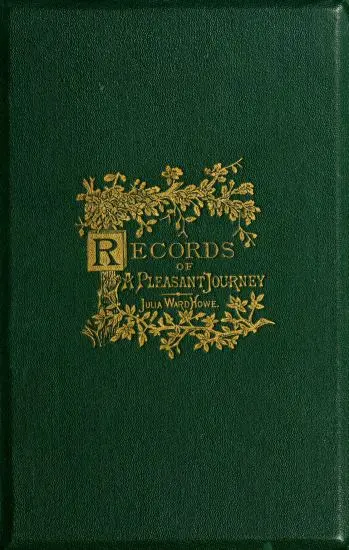
From the Oak to the Olive: A Plain record of a Pleasant Journey
Julia Ward Howe
THE CLASSIC COLLECTION · 1860
"A Trip to Cuba" by Julia Ward Howe is a travel narrative written in the mid-19th century. This work chronicles the author's experiences and observations during her journey from the United States to Cuba, including her reflections on the landscapes, cultures, and the people she encounters along the way. As she travels on the British Mail steamer "Karnak," the narrative offers insights into the discomforts of sea travel, the exuberance of anticipation, and the nuances of foreign societies. At the start of the narrative, the author reflects on the bittersweet emotions associated with leaving home for the adventure that lies ahead. She captures the sensation of embarking on a voyage, detailing the initial discomfort of sea sickness among her fellow passengers and the vibrant colors of nature as they approach Nassau before continuing on to Cuba. Through humor and keen observation, she sets the stage for a journey that promises not only exploration of Cuba's physical beauty but also contemplations on societal structures, particularly regarding the treatment of people, including topics such as slavery. The prose is rich and descriptive, effectively engaging the reader's curiosity about her travel experiences.
Introduction adapted from the source catalogue; source summaries may be automatically generated.
Free to read · English · 45,435 words · No account needed
MAKE TIME FOR A GOOD BOOK
On by default. Untick to stop anonymous reading totals. Each page counts after 10 seconds in view. How this works.
Anonymous counting is on unless you have switched it off.
Now I know very well that those of my readers who intend visiting Cuba will be much more interested in statistics of hotels than in any speculations, poetical or philosophical, with which I might be glad to recompense their patience. Let me tell them, therefore, that the Ensor House is neither better nor worse than other American hotels in Cuba. The rooms are not very bad, the attendance not intolerable, the table almost commendable. The tripe, salt-fish, and plantains were, methought, much as at other places. There were stews of meat, onions, sweet peppers, and ochra, which deserve notice. The early coffee was punctual; the tea, for a wonder, black and hot. True, it was served on a bare pine table, with the accompaniment only of a bit of dry bread,--no butter, cake, nor dulces. But Mr. Ensor has heard, no doubt, that sweet things are unwholesome, and is determined, at whatever cost to his own feelings, to keep them out of the way of his guests, who are, for the time, his children. Then there is an excellent English servant called John, whom, though the fair Ensor did berate him, we must enumerate among the comforts of the establishment. There is a dark corner about volantes, which they are disposed to order for you at a very unreasonable profit; but as there are plenty of livery stables at hand, and street volantes passing all the time, it will be your own fault if you pay six dollars where you ought to pay three.
The first thing to be done at Matanzas is to drive out and see the Cumbre, a hill in the neighborhood, and from it the valley of the Yumori. The road is an improvement on those already described;--the ruts being much deeper and the rocks much larger, the jolting is altogether more complete and effective. Still, you remember the doctrine that the volante cannot upset, and this blind faith to which you cling carries you through triumphantly. The Cumbre is lofty, the view extensive, and the valley lovely, of a soft, light green, like the early leaves and grass of spring, dotted everywhere with the palms and their dark clusters. It opens far, far down at your feet, and on your left you see the harbor quiet and bright in the afternoon sun, with a cheering display of masts and pennons. You would look and linger long, but that the light will wane, and you are on your way to Jenks his sugar-plantation, the only one within convenient distance of the town. Here the people are obviously accustomed to receive visitors, and are decently, not superfluously, civil. The major-domo hands you over to a negro who speaks English, and who salutes you at once with, "Good-bye, Sir!" The boiling here is conducted in one huge, open vat. A cup and saucer are brought for you to taste the juice, which is dipped out of the boiling vat for your service. It is very like balm-tea, unduly sweetened; and after a hot sip or so you return the cup with thanks. A loud noise, as of cracking of whips and of hurrahs, guides you to the sugar-mill, where the crushing of the cane goes on in the jolliest fashion. The building is octagonal and open. Its chief feature is a very large horizontal wheel, which turns the smaller ones that grind the cane. This wheel is turned after the following manner. In the centre of the building, and as it were in the second story, stands a stout post, to which are attached, at equal distances, six horizontal bars, which are dragged round by six horses, vehemently flogged by the like number of slaves, male and female. This is really a novel and picturesque sight. Each negro is armed with a short whip, and their attitudes, as they stand, well-balanced on the revolving wheel, are rather striking. Liberal as they were of blows and of objurations to the horses, all their cries and whipping produced scarcely a tenth of the labor so silently performed by the invisible, noiseless slave that works the steam-engine. From this we wandered about the avenues, planted with palms, cocoas, and manifold fruit-trees,--visited the sugar-fields, where many slaves were cutting the canes and piling them on enormous ox-carts, and came at last to a great, open field, where many head of cattle were quietly standing. Our negro guide had not been very lavish or intelligible in his answers to our numerous questions. We asked him about these cattle. "Dey cows," he replied. We asked if they gave milk, and if butter was made on the plantation. He seemed quite puzzled and confused, and finally exclaimed,--"Dat cows no got none wife." Coming nearer, we found that the cows were draught oxen, employed in dragging the canes and other produce of the plantation. Jenks his garden we found in good order, and beautiful with many plants in full blossom; but Jenks his house seemed dreary and desolate, with no books, a wretched print or so, dilapitated furniture, and beds that looked like the very essence of nightmare. Nothing suggested domestic life or social enjoyment, or anything ----; but as Jenks is perfectly unknown to us, either by appearance or reputation, we give only a guess in the dark, and would suggest, in case it may displease him, that he should refurnish and repaint a little, and diffuse an air of cheerfulness over his solitary villa, remembering that Americans have imaginations, and that visitors will be very apt to construct an unknown host from his surroundings.
Your reading position is saved on this browser. Take it to another device with a library code. Reading pages adapt to text, rather than matching a printed edition.
Julia Ward Howe
Julia Ward Howe
Julia Ward Howe
Julia Ward Howe
BEHIND THE BOOK
This eBook is for the use of anyone anywhere in the United States and most other parts of the world at no cost and with almost no restrictions whatsoever. You may copy it, give it away or re-use it under the terms of the Project Gutenberg License included with this eBook or online at www.gutenberg.org. If you are not located in the United States, you will have to check the laws of the country where you are located before using this eBook. Read the source licence.
The original source file, including credits and licence, is retained by this library. Request an original-format copy at no charge. Please include the book title and Project Gutenberg identifier #38203.
KEEP YOUR CURIOSITY GOING
Wilfrid Scawen Blunt
Wilfrid Scawen Blunt

E. W. (Edgar Watson) Howe
Francis Greenleaf Allinson & Anne C. E. (Anne Crosby Emery) Allinson
Cyrenus Cole

John Martineau