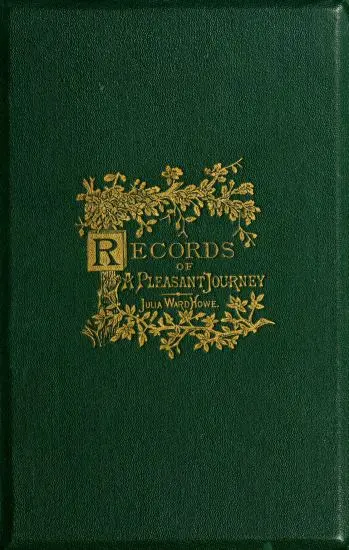
From the Oak to the Olive: A Plain record of a Pleasant Journey
Julia Ward Howe
THE CLASSIC COLLECTION · 1860
"A Trip to Cuba" by Julia Ward Howe is a travel narrative written in the mid-19th century. This work chronicles the author's experiences and observations during her journey from the United States to Cuba, including her reflections on the landscapes, cultures, and the people she encounters along the way. As she travels on the British Mail steamer "Karnak," the narrative offers insights into the discomforts of sea travel, the exuberance of anticipation, and the nuances of foreign societies. At the start of the narrative, the author reflects on the bittersweet emotions associated with leaving home for the adventure that lies ahead. She captures the sensation of embarking on a voyage, detailing the initial discomfort of sea sickness among her fellow passengers and the vibrant colors of nature as they approach Nassau before continuing on to Cuba. Through humor and keen observation, she sets the stage for a journey that promises not only exploration of Cuba's physical beauty but also contemplations on societal structures, particularly regarding the treatment of people, including topics such as slavery. The prose is rich and descriptive, effectively engaging the reader's curiosity about her travel experiences.
Introduction adapted from the source catalogue; source summaries may be automatically generated.
Free to read · English · 45,435 words · No account needed
MAKE TIME FOR A GOOD BOOK
On by default. Untick to stop anonymous reading totals. Each page counts after 10 seconds in view. How this works.
Anonymous counting is on unless you have switched it off.
Nassau produces neither hay nor corn,--these, together with butter, flour, and tea, being brought chiefly from the United States. Politics, of course, it has none. As to laws, the colonial system certainly needs propping up,--for under its action a man may lead so shameless a life of immorality as to compel his wife to leave him, and yet not be held responsible for her support and that of the children she has borne him. The principal points of interest are, first, the garrison,--secondly, Government-House, with an occasional ball there,--and, third, one's next-door neighbor, and his or her doings. The principal event in the memory of the citizens seems to be a certain most desirable wreck, in consequence of which, a diamond card-case, worth fifteen hundred dollars, was sold for an eighth part of that sum, and laces, whose current price ranges from thirty to forty dollars a yard, were purchased at will for seventy-five cents. That was a wreck worth having! say the Nassauese. The price of milk ranges from eighteen to twenty-five cents a quart;--think of that, ye New England housekeepers! That precious article, the pudding, is nearly unknown in the Nassauese economy; nor is pie-crust so short as it might be, owing to the enormous price of butter, which has been known to attain the sum of one dollar per pound. Eggs are quoted at prices not commendable for large families with small means. On the other hand, fruits, vegetables, and sugar-cane are abundant.
The Nassauese, on the whole, seem to be a kind-hearted and friendly set of people, partly English, partly Southern in character, but with rather a predominance of the latter ingredient in their composition. Their women resemble the women of our own Southern States, but seem simpler and more domestic in their habits,--while the men would make tolerable Yankees, but would scarcely support President Buchanan, the Kansas question, or the Filibustero movement. Physically, the race suffers and degenerates under the influence of the warm climate. Cases of pulmonary disease, asthma, and neuralgia are of frequent occurrence, and cold is considered as curative to them as heat is to us. The diet, too, is not that "giant ox-beef" which the Saxon race requires. Meat is rare and tough, unless brought from the States at high cost. We were forced to the conclusion that no genuine English life can be supported upon a régime of fish and fruit,--or, in other words, no beef, no Bull, but a very different sort of John, lantern-jawed, leather-skinned, and of a thirsty complexion. It occurred to us, furthermore, that it is a dolorous thing to live on a lonely little island, tied up like a wart on the face of civilization,--no healthful stream of life coming and going from the great body of the main land,--the same moral air to be breathed over and over again, without renewal,--the same social elements turned and returned in one tiresome kaleidoscope. Wherefore rejoice, ye Continentals, and be thankful, and visit the Nassauese, bringing beef, butter, and beauty,--bringing a few French muslins, to replace the coarse English fabrics, and buxom Irish girls to outwork the idle negro women,--bringing new books, newspapers, and periodicals,--bringing the Yankee lecturer, all expenses paid, and his drink found him. All these good things, and more, the States have for the Nassauese, of whom we must now take leave, for all hands have been piped on deck.
Your reading position is saved on this browser. Take it to another device with a library code. Reading pages adapt to text, rather than matching a printed edition.
Julia Ward Howe
Julia Ward Howe
Julia Ward Howe
Julia Ward Howe
BEHIND THE BOOK
This eBook is for the use of anyone anywhere in the United States and most other parts of the world at no cost and with almost no restrictions whatsoever. You may copy it, give it away or re-use it under the terms of the Project Gutenberg License included with this eBook or online at www.gutenberg.org. If you are not located in the United States, you will have to check the laws of the country where you are located before using this eBook. Read the source licence.
The original source file, including credits and licence, is retained by this library. Request an original-format copy at no charge. Please include the book title and Project Gutenberg identifier #38203.
KEEP YOUR CURIOSITY GOING
Wilfrid Scawen Blunt
Wilfrid Scawen Blunt

E. W. (Edgar Watson) Howe
Francis Greenleaf Allinson & Anne C. E. (Anne Crosby Emery) Allinson
Cyrenus Cole

John Martineau