THE CLASSIC COLLECTION✦An outlaw’s diary: the CommuneCLASSIC FREE BOOKS
An outlaw’s diary: the Commune
Cécile Tormay
THE CLASSIC COLLECTION · 1799
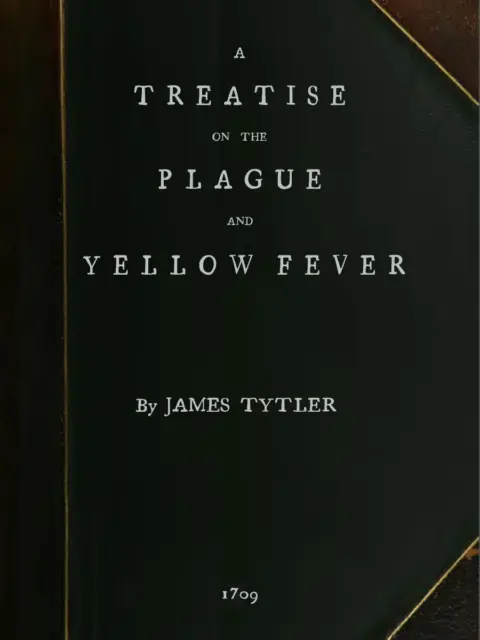
"A Treatise on the Plague and Yellow Fever" by James Tytler is a scientific publication written in the late 18th century. This work delves into the historical and medical aspects of two significant infectious diseases, the plague and yellow fever, exploring their origins, symptoms, and methods of prevention and cure. It is an extensive examination aimed at providing physicians and the public with a deeper understanding of these devastating diseases. At the start of the treatise, Tytler introduces the concept of the plague, describing its historical prevalence and examining different plagues recorded throughout history, including references to the Old Testament and accounts from ancient and modern sources. He highlights the catastrophic impact of plagues, not just in terms of mortality rates but also in how they disrupt societies, leading to moral and social decay during outbreaks. Tytler sets the stage for a detailed inquiry into the nature of the plague, its contagion, and the significant challenges faced by medical practitioners in combating such diseases, aiming to provide a comprehensive analysis that blends historical accounts with medical perspectives.
Introduction adapted from the source catalogue; source summaries may be automatically generated.
Free to read · English · 225,650 words · No account needed
MAKE TIME FOR A GOOD BOOK
On by default. Untick to stop anonymous reading totals. Each page counts after 10 seconds in view. How this works.
Anonymous counting is on unless you have switched it off.
On the subject of climate, therefore, I must conclude with the following observations:--First: That, as the diseases above mentioned are produced both in moist and dry countries, in those in the torrid and those in the temperate zone, they can neither be the offspring of moisture or drought, of heat or cold, of septics or antiseptics, but of something not yet discovered. Second: That, upon fair investigation, it does not appear, that ancient historians have been able to ascertain the origin of any plague whatever: they have universally ascribed it to the anger of the Deity, while their own pride would never allow it to have originated in any country with which they were connected. Third: It doth not by any means appear, that the climates of those countries, where the plague is known to be most common, are at all inferior to those already described, excepting the very circumstance of having the plague frequently in them: nay, indeed, that they are equally bad. Nobody will pretend to argue, that the climate of Asia Minor, of Greece, of the Morea, or of any of the countries most infected with the plague, was, or is, worse than that of Catchou in Africa, already described; yet it is certain, that we have a number of testimonies that the plague has ravaged Asia Minor, while we have not one of its visiting Catchou. Ancient Greece, the Peloponnesus (Morea) and Asia Minor, were accounted healthy and fine countries; and modern travellers assure us, that they have not degenerated in this respect; yet these countries are desolated by the plague, while the unwholesome regions above described are entirely free from it, unless imported from some other quarter. To give this matter, however, as fair a discussion as possible, I shall here consider the account we have of the climate of Bassorah, given by the gentleman residing there in 1780; whose case, in the remitting fever, is given, Appendix, No. VI. “The overflowing of the Euphrates, and its waters stagnating in the desert, have always been accounted primary causes of epidemical diseases at Bassorah. The great floods from the melting of the snow on the mountains of Diarbekir, the ancient Assyria, happened in the year 1780, early in the month of May, when the heats in Persia and Arabia begin to be excessive. The desert, which reaches to the gates of Bassorah, is, for many miles, incrusted with a surface of salt; which, when mixed with the stagnated waters, and exposed to the sun, produces the most noxious effluvia. As early as the 25th of May, the town was surrounded by a salt marsh, the heated steam arising from which was, at times, almost intolerable; but the canal that runs through a great part of the city being filled with the bodies of animals, and all kinds of putrid matter; and, at low tides, all these substances exposed to the sun, made the air in the town scarce supportable; and, being totally destitute of police, the streets were in many places covered with human ordure, the bodies of dead dogs and cats, &c. which emitted a stench more disagreeable and putrid than any thing I ever experienced in my life. As to the degree of solar heat, it far exceeded what I conceived the human frame to be capable of bearing. The sensation under this heat was totally different from what I had ever experienced; it resembled the approach of an heated substance to the body. The quicksilver, in Fahrenheit’s thermometer, rose to between 156 and 162 degrees.[28] From the 30th of May I never saw it so low as 156, but generally between 158 and 160. After I left Bassorah I was told that it rose still higher. In the coolest part of the house, with the aid of every invention to decrease the heat, the quicksilver rose to 115; but after I came away, I was informed that it rose still higher, even at seven in the morning, the hour which we accounted the coolest in the day. Once the heat was said to be so intolerable, that no one could expose himself to it long enough to observe the thermometer in the sun. Some of the oldest inhabitants of Bassorah said that they never remembered to have heard of such a heat in any part of Persia or Arabia. The natives of the country appeared more alarmed at the heat than the Europeans: nothing could induce them to expose themselves to the sun after ten o’clock. I left Bassorah for Aleppo on the 30th of May. On our arrival at Zabira, the heat was so intense, that even the Arabs sunk under it.”
Your reading position is saved on this browser. Take it to another device with a library code. Reading pages adapt to text, rather than matching a printed edition.
BEHIND THE BOOK
This eBook is for the use of anyone anywhere in the United States and most other parts of the world at no cost and with almost no restrictions whatsoever. You may copy it, give it away or re-use it under the terms of the Project Gutenberg License included with this eBook or online at www.gutenberg.org. If you are not located in the United States, you will have to check the laws of the country where you are located before using this eBook. Read the source licence.
The original source file, including credits and licence, is retained by this library. Request an original-format copy at no charge. Please include the book title and Project Gutenberg identifier #67453.
KEEP YOUR CURIOSITY GOING
Cécile Tormay

Moritz Busch
John L. Ransom
Frances Wright
Cécile Tormay

Mabel Potter Daggett