THE CLASSIC COLLECTION✦An outlaw’s diary: the CommuneCLASSIC FREE BOOKS
An outlaw’s diary: the Commune
Cécile Tormay
THE CLASSIC COLLECTION · 1799
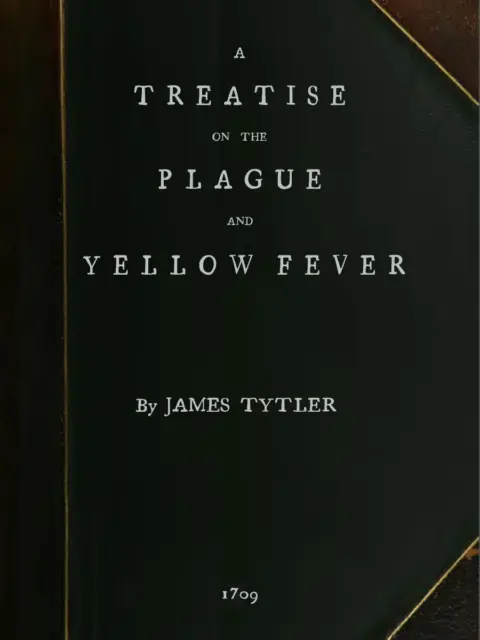
"A Treatise on the Plague and Yellow Fever" by James Tytler is a scientific publication written in the late 18th century. This work delves into the historical and medical aspects of two significant infectious diseases, the plague and yellow fever, exploring their origins, symptoms, and methods of prevention and cure. It is an extensive examination aimed at providing physicians and the public with a deeper understanding of these devastating diseases. At the start of the treatise, Tytler introduces the concept of the plague, describing its historical prevalence and examining different plagues recorded throughout history, including references to the Old Testament and accounts from ancient and modern sources. He highlights the catastrophic impact of plagues, not just in terms of mortality rates but also in how they disrupt societies, leading to moral and social decay during outbreaks. Tytler sets the stage for a detailed inquiry into the nature of the plague, its contagion, and the significant challenges faced by medical practitioners in combating such diseases, aiming to provide a comprehensive analysis that blends historical accounts with medical perspectives.
Introduction adapted from the source catalogue; source summaries may be automatically generated.
Free to read · English · 225,650 words · No account needed
MAKE TIME FOR A GOOD BOOK
On by default. Untick to stop anonymous reading totals. Each page counts after 10 seconds in view. How this works.
Anonymous counting is on unless you have switched it off.
Whether all these mortal signs appeared on such as died very suddenly of plagues, and were by the English writers confounded under the general name of tokens, cannot certainly be determined. Dr. Russel saw none who died within the twenty-four hours, and few who died within thirty hours, so that we cannot from him expect any particular account of the situation of those who died suddenly. In general, however, he says, that “in the most destructive forms of the plague, the vital principle seems to be suddenly, as it were, extinguished, or else enfeebled to a degree capable only for a short while to resist the violence of the disease; in the subordinate forms, the vital and animal functions, variously affected, are carried on in a defective, disorderly manner, and denote more or less danger accordingly.” It seems probable therefore that in those who are suddenly killed, the same effects take place in a short time which are observed to take place after a longer space in those who die gradually, buboes only excepted, which require for their formation a longer time than is allowed to the patient to live. Internal mortifications, or rather eschars, are therefore to be suspected, and dissections have evinced that this was really the case; but besides these there was an appearance observed in the plague at Marseilles which is not taken notice of by former physicians; viz. a preternatural enlargement of the heart. M. Deidier on that occasion communicated an account of nine dissections, but of these only one had died without eruptions. This was a woman of 40 years of age, who lived till the third day. In her “the mediastinum[101] was torn towards the upper part; the pericardium of a livid colour; the heart larger than in its natural state, by the swelling of its ventricles; full of thick, black blood. The liver was also very large, and of a livid colour, with a carbuncular pustule on the side of the gall-bladder, which was filled with very black bile.” In others who had eruptions, and who of consequence we must suppose to have lived longer, the enlargement of the heart was still more remarkable. In one who lived eleven days, the heart was of double the bigness, having scarce any blood in the ventricles, whose cavities were filled each with a large polypus, that on the right side having dilated the auricle to the breadth of four inches. The liver also was larger than ordinary, and the gall-bladder full of a black and green bile. The appearances were much the same in all the rest, but, as the time they sustained the disease is not mentioned, we cannot determine whether the enlargement of the heart took place at the very first, or was only an adventitious symptom after the fever had come on. Dr. Russel takes notice that such patients as he attended complained greatly of their heart. “A sense of oppression about the præcordia (says he) which the sick were at a loss to describe, was, in one degree or other, a constant attendant on the plague, except in very slight cases of infection; and where it came on early, or persisted in a high degree, was always a dangerous symptom. The sick showed how severely they suffered by their perpetually changing their posture, in hopes of relief; but, when asked where their pain lay, they either answered hastily they could not tell, or, with a fixed, wild look, exclaimed kulbi! kulbi! (my heart! my heart!) This anxiety increasing as the disease advanced, terminated at length in mortal inquietude, the patient, for many hours, in the last stages, incessantly writhing his body and limbs as if in agony. Though pain at the heart was often conjoined with the symptom just mentioned, and by the sick seemingly blended together, it appeared to be different, and to exist separately. They often exclaimed as in the other, my heart! my heart! pointing also towards the scrobiculum cordis, but then would add eujani kulbi, my heart pains me; or naar fi kulbi, my heart is on fire.” This last pain the Doctor supposes might have its seat in the upper orifice of the stomach; the extreme anxiety may be accounted for from the enlargement of the heart; but as neither of these symptoms took place in such as died in a very short time, we must be apt to consider this enlargement not as any primary and essential symptom of the disease, but as one which takes place when the vital powers are able to oppose for some considerable time the cause of the disease.
Your reading position is saved on this browser. Take it to another device with a library code. Reading pages adapt to text, rather than matching a printed edition.
BEHIND THE BOOK
This eBook is for the use of anyone anywhere in the United States and most other parts of the world at no cost and with almost no restrictions whatsoever. You may copy it, give it away or re-use it under the terms of the Project Gutenberg License included with this eBook or online at www.gutenberg.org. If you are not located in the United States, you will have to check the laws of the country where you are located before using this eBook. Read the source licence.
The original source file, including credits and licence, is retained by this library. Request an original-format copy at no charge. Please include the book title and Project Gutenberg identifier #67453.
KEEP YOUR CURIOSITY GOING
Cécile Tormay

Moritz Busch
John L. Ransom
Frances Wright
Cécile Tormay

Mabel Potter Daggett