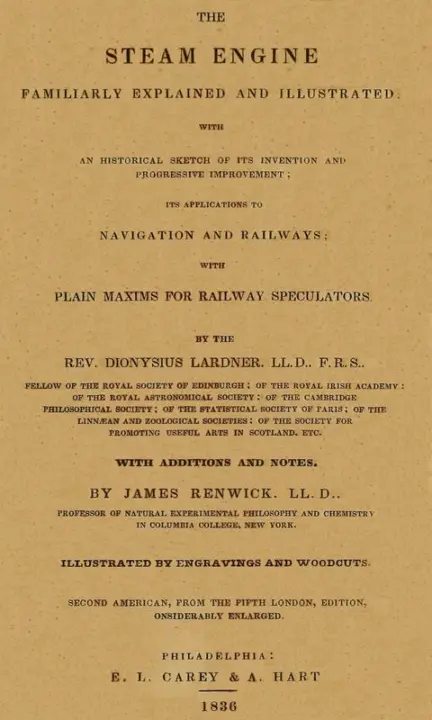
The Steam Engine Familiarly Explained and Illustrated With an historical sketch of its invention and progressive improvement; its applications to navigation and railways; with plain axioms for railway speculators
Dionysius Lardner
THE CLASSIC COLLECTION · 1830
"A Treatise on Mechanics" by Captain Henry Kater and Dionysius Lardner is a scientific publication written in the early 19th century. The text delves into the principles of mechanics, focusing on the properties and behavior of matter, motion, force, and the underlying laws governing these phenomena. It serves as an exploration of the fundamental aspects of physics, aiming to educate readers about the mechanics of the physical world. The opening of the treatise establishes a foundation for understanding the properties of matter. It begins by discussing the nature of sensory perception and how human beings gather knowledge about the material world through observation. The authors elaborate on key properties of matter such as magnitude, impenetrability, and the concept of inertia, emphasizing that matter exists within a set framework of laws that govern its behavior. By introducing these foundational concepts, the text sets the stage for a comprehensive exploration of mechanics, showcasing the complexities of interaction between various forces and matter. This educational approach reveals the authors' intent to guide readers through the core principles of mechanical philosophy, making the treatise a vital resource for understanding foundational physics.
Introduction adapted from the source catalogue; source summaries may be automatically generated.
Free to read · English · 124,878 words · No account needed
MAKE TIME FOR A GOOD BOOK
On by default. Untick to stop anonymous reading totals. Each page counts after 10 seconds in view. How this works.
Anonymous counting is on unless you have switched it off.
It was in the year 1721 that Graham first put up a pendulum of this description, and subjected it to the test of experiment; but it appears to have been afterwards set aside to make way for Harrison’s gridiron pendulum, or for others of a similar description. For some years past, however, its merits have been more generally known, and it is not surprising that it should be considered as preferable to others, both from the simplicity of its construction, and the perfect ease with which the compensation may be adjusted.
We have already alluded to Mr. Baily’s very able paper on this pendulum, and we shall take the liberty of extracting from it the following description:--
At fig. 223. is a drawing of the mercurial pendulum, as constructed in the manner proposed by Mr. Baily.
“The rod S F is made of steel, and perfectly straight; its form may be either cylindrical, of about a quarter of an inch in diameter, or a flat bar, three eighths of an inch wide, and one eighth of an inch thick: its length from S to F, that is, from the bottom of the spring to the bottom of the rod at F, should be 34 inches. The lower part of this rod, which passes through the top of the stirrup, and about half an inch above and below the same, must be formed into a coarse and deep screw, about two tenths of an inch in diameter, and having about thirty turns in an inch. A steel nut with a milled head must be placed at the end of the rod, in order to support the stirrup; and a similar nut must also be placed on the rod above the head of the stirrup, in order to screw firmly down on the same, and thus secure it in its position, after it has been adjusted nearly to the required rate. These nuts are represented at B and C. A small slit is cut in the rod, where it passes through the head of the stirrup, through which a steel pin E is screwed, in order to keep the stirrup from turning round on the rod. The stirrup itself is also made of steel, and the side pieces should be of the same form as the rod, in order that they may readily acquire the same temperature. The top of the stirrup consists of a flat piece of steel, shaped as in the drawing, somewhat more than three eighths of an inch thick. Through the middle of the top (which at this part is about one inch deep) a hole must be drilled sufficiently large to enable the screw of the rod to pass freely, but without shaking. The inside height of the stirrup from A to D may be 8-1/2 inches, and the inside width between the bars about three inches. The bottom piece should be about three eighths of an inch thick, and hollowed out nearly a quarter of an inch deep, so as to admit the glass cylinder freely. This glass cylinder should have a brass or iron cover G, which should fit the mouth of it freely, with a shoulder projecting on each side, by means of which it should be screwed to the side bars of the stirrup, and thus be secured always in the same position. This cap should not press on the glass cylinder, so as to prevent its expansion. The measures above given may require a slight modification, according to the weight of the mercury employed, and the magnitude of the cylinder: the final adjustment, however, may be safely left to the artist. Some persons have recommended that a circular piece of thick plate glass should float on the mercury, in order to preserve its surface uniformly level.[7] The part at the bottom marked H is a piece of brass fastened with screws to the front of the bottom of the stirrup, through a small hole, in which a steel wire or common needle is passed, in order to indicate (on a scale affixed to the case of the clock) the arc of vibration. This wire should merely rest in the hole, whereby it may be easily removed when it is required to detach the pendulum from the clock, in order that the stirrup might then stand securely on its base. One of the screw holes should be rather larger than the body of the screw, in order to admit of a small adjustment, in case the steel wire should not stand exactly perpendicular to the axis of motion. The scale should be divided into degrees, and not inches, observing that with a radius of 44 inches (the estimated distance from the bend of the spring to the end of the steel wire) the length of each degree on the scale must be 0·768 inch.”
Your reading position is saved on this browser. Take it to another device with a library code. Reading pages adapt to text, rather than matching a printed edition.
BEHIND THE BOOK
This eBook is for the use of anyone anywhere in the United States and most other parts of the world at no cost and with almost no restrictions whatsoever. You may copy it, give it away or re-use it under the terms of the Project Gutenberg License included with this eBook or online at www.gutenberg.org. If you are not located in the United States, you will have to check the laws of the country where you are located before using this eBook. Read the source licence.
The original source file, including credits and licence, is retained by this library. Request an original-format copy at no charge. Please include the book title and Project Gutenberg identifier #66078.
KEEP YOUR CURIOSITY GOING

John Muir

Asa Gray
Asa Gray

Florence Nightingale
Elizabeth Robins Pennell
Denison Olmsted