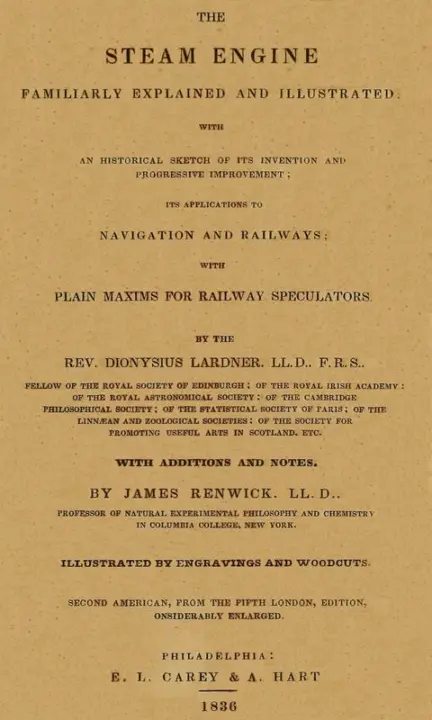
The Steam Engine Familiarly Explained and Illustrated With an historical sketch of its invention and progressive improvement; its applications to navigation and railways; with plain axioms for railway speculators
Dionysius Lardner
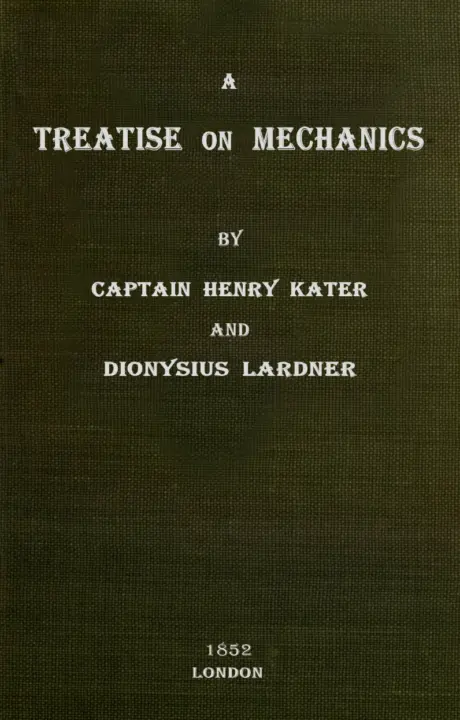
THE CLASSIC COLLECTION · 1830
"A Treatise on Mechanics" by Captain Henry Kater and Dionysius Lardner is a scientific publication written in the early 19th century. The text delves into the principles of mechanics, focusing on the properties and behavior of matter, motion, force, and the underlying laws governing these phenomena. It serves as an exploration of the fundamental aspects of physics, aiming to educate readers about the mechanics of the physical world. The opening of the treatise establishes a foundation for understanding the properties of matter. It begins by discussing the nature of sensory perception and how human beings gather knowledge about the material world through observation. The authors elaborate on key properties of matter such as magnitude, impenetrability, and the concept of inertia, emphasizing that matter exists within a set framework of laws that govern its behavior. By introducing these foundational concepts, the text sets the stage for a comprehensive exploration of mechanics, showcasing the complexities of interaction between various forces and matter. This educational approach reveals the authors' intent to guide readers through the core principles of mechanical philosophy, making the treatise a vital resource for understanding foundational physics.
Introduction adapted from the source catalogue; source summaries may be automatically generated.
Free to read · English · 124,878 words · No account needed
MAKE TIME FOR A GOOD BOOK
On by default. Untick to stop anonymous reading totals. Each page counts after 10 seconds in view. How this works.
Anonymous counting is on unless you have switched it off.
(264.) In order to equalise the wear of the teeth of a wheel and pinion, which work in one another, it is necessary that every leaf of the pinion should work in succession through every tooth of the wheel, and not continually act upon the same set of teeth. If the teeth could be accurately shaped according to mathematical principles, and the materials of which they are formed be perfectly uniform, this precaution would be less necessary; but as slight inequalities, both of material and form, must necessarily exist, the effects of these should be as far as possible equalised, by distributing them through every part of the wheel. For this purpose it is usual, especially in mill-work, where considerable force is used, so to regulate the proportion of the number of teeth in the wheel and pinion, that the same leaf of the pinion shall not be engaged twice with any one tooth of the wheel, until after the action of a number of teeth, expressed by the product of the number of teeth in the wheel and pinion. Let us suppose that the pinion contains ten leaves, which we shall denominate by the numbers 1, 2, 3, &c., and that the wheel contains 60 teeth similarly denominated. At the commencement of the motion suppose the leaf 1 of the pinion engages the tooth 1 of the wheel; then after one revolution the leaf 1 of the pinion will engage the tooth 11 of the wheel, and after two revolutions the leaf 1 of the pinion will engage the tooth 21 of the wheel; and in like manner, after 3, 4, and 5 revolutions of the pinion, the leaf 1 will engage successively the teeth 31, 41, and 51 of the wheel. After the sixth revolution, the leaf 1 of the pinion will again engage the tooth 1 of the wheel. Thus it is evident, that in the case here supposed the leaf 1 of the pinion will continually be engaged with the teeth 1, 11, 21, 31, 41, and 51 of the wheel, and no others. The like may be said of every leaf of the pinion. Thus the leaf 2 of the pinion will be successively engaged with the teeth 2, 12, 22, 32, 42, and 52 of the wheel, and no others. Any accidental inequalities of these teeth will therefore continually act upon each other, until the circumference of the wheel be divided into parts of ten teeth each, unequally worn. This effect would be avoided by giving either the wheel or pinion one tooth more or one tooth less. Thus, suppose the wheel, instead of having sixty teeth, had sixty-one, then after six revolutions of the pinion the leaf 1 of the pinion would be engaged with the tooth 61 of the wheel; and after one revolution of the wheel, the leaf 2 of the pinion would be engaged with the tooth 1 of the wheel. Thus, during the first revolution of the wheel the leaf 1 of the pinion would be successively engaged with the teeth 1, 11, 21, 31, 41, 51, and 61 of the wheel: at the commencement of the second revolution of the wheel the leaf 2 of the pinion would be engaged with the tooth 1 of the wheel; and during the second revolution of the wheel the leaf 1 of the pinion would be successively engaged with the teeth 10, 20, 30, 40, 50, and 60 of the wheel. In the same manner it may be shown, that in the third revolution of the wheel the leaf 1 of the pinion would be successively engaged with the teeth 9, 19, 29, 39, 49, and 59 of the wheel: during the fourth revolution of the wheel the leaf 1 of the pinion would be successively engaged with the teeth 8, 18, 28, 38, 48, and 58 of the wheel. By continuing this reasoning it will appear, that during the tenth revolution of the wheel the leaf 1 of the pinion will be engaged successively with the teeth 2, 12, 22, 32, 42, and 52 of the wheel. At the commencement of the eleventh revolution of the wheel the leaf 1 of the pinion will be engaged with the tooth 1 of the wheel, as at the beginning of the motion. It is evident, therefore, that during the first ten revolutions of the wheel each leaf of the pinion has been successively engaged with every tooth of the wheel, and that during these ten revolutions the pinion has revolved sixty-one times. Thus the leaves of the pinion have acted six hundred and ten times upon the teeth of the wheel, before two teeth can have acted twice upon each other.
Your reading position is saved on this browser. Take it to another device with a library code. Reading pages adapt to text, rather than matching a printed edition.
BEHIND THE BOOK
This eBook is for the use of anyone anywhere in the United States and most other parts of the world at no cost and with almost no restrictions whatsoever. You may copy it, give it away or re-use it under the terms of the Project Gutenberg License included with this eBook or online at www.gutenberg.org. If you are not located in the United States, you will have to check the laws of the country where you are located before using this eBook. Read the source licence.
The original source file, including credits and licence, is retained by this library. Request an original-format copy at no charge. Please include the book title and Project Gutenberg identifier #66078.
KEEP YOUR CURIOSITY GOING

John Muir

Asa Gray
Asa Gray

Florence Nightingale
Elizabeth Robins Pennell
Denison Olmsted