
Last letters from the living dead man
David Patterson (Spirit) Hatch
THE CLASSIC COLLECTION · 1752
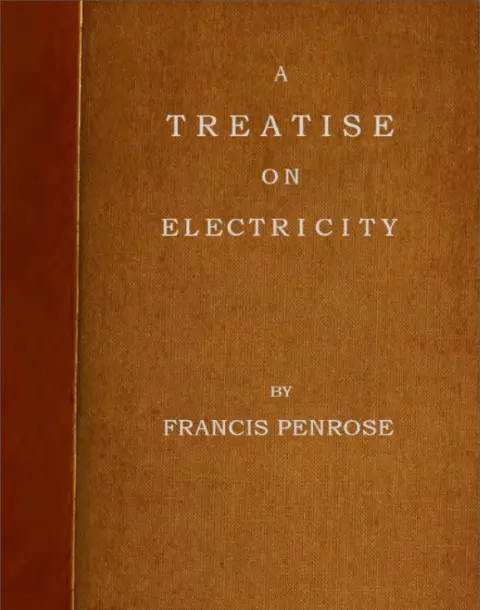
"A Treatise on Electricity" by Francis Penrose is a scientific publication written in the 18th century. This treatise examines various electrical phenomena and explores their potential applications in medicine and healing. The author, a surgeon, seeks to blend scientific inquiry with practical applications, suggesting how electricity might be harnessed for therapeutic purposes. In this work, Penrose investigates the nature of electricity, proposing that it results from the friction and agitation of air particles. He presents a series of experiments to demonstrate how air and light are intricately linked and examines the implications of these findings for understanding gravity and the attraction between solid bodies. The treatise also discusses the effects of electrical forces on the human body, asserting that while electricity can facilitate healing in certain conditions, care must be taken not to apply it indiscriminately, especially in cases involving weakened nerves. Penrose's observations reflect the scientific curiosity of the time, as he attempts to reconcile empirical findings with philosophical reflections on the nature of matter and energy.
Introduction adapted from the source catalogue; source summaries may be automatically generated.
Free to read · English · 8,856 words · No account needed
MAKE TIME FOR A GOOD BOOK
On by default. Untick to stop anonymous reading totals. Each page counts after 10 seconds in view. How this works.
Anonymous counting is on unless you have switched it off.
Boerhaave has another observation, which seems to prove to a demonstration, that fire or heat is caused by an attrition of the air; which observation I shall give in his own words. “A cannon ball, shot in the winter time, will fly 600 feet in a minute through the cold air, which makes a greater resistance than any wind, the most rapid of which only moves 22-1/2 feet; hence it appears how much friction the ball must have undergone in its passage, which by the way did not proceed in a right line, but by its whirling motion continually describes a cycloid with every point of its body. When it falls, it is found quite hot; notwithstanding in its whole passage, it had continually met with cold air. This heat could not have arisen from the flaming gunpowder, whereby it was exploded, since it only remained in that flame, an incredible small space of time, in which it is by no means credible so solid a body should have acquired such a heat; which is much more naturally accounted for from the great attrition of the ball, driven with such a velocity through the air, and repelled by a wind, which is above 27 times swifter than the strongest wind hitherto observed.” Boerhaave’s Chym. by Shaw, Vol. 1. pag. 244.
I shall mention one more experiment from Mr. Boyle, which proves that air is not only convertible into light; but that it may afterwards be forced through glass, and thereby the same vacuum be made that is by an air pump. “Liquid phosphorus being put into a vial, when it was disposed to shine in the dark, the cavity of the vial above the liquor seemed to be full of whitish fumes, though at other times transparent. The vial, when close stopped, was not luminous in the dark, but the light or flame appeared as soon as it was exposed to the air, and the vial was unstopped; and that the occasion and propagation of this flame depended on the contact of the air, appeared, since agitation would not kindle it, but when the bottle was unstopped, the kindled flame would gradually be propagated downwards; the flame always appeared most vivid the nearer the air, and when it was extinguished, it first disappeared in the bottom, and then expired at the top. When the Vial was unstopped for some time, when it was stopped again, the air that had leisurely insinuated itself would cherish the flame for an hour or two. It was observable, that when the air had been long pent up with this shining liquor, its resistance would be so weakened, that when the vial was unstopped, the external air would presently rush in with violence, from whence appears the interest of the air in propagating the shining of this liquor. The agitation before the vial was unstopped would not kindle the light; yet when it was opened, it would be increased by it, and even when it was in its dull state, if I poured a little of it upon my hand, and rubbed it with my finger, it would presently become vivid, and emit store of luminous rays, as well as fumes very offensive to the nostrils; and when I ceased to rub, and the luminous quality was lost, it would be renewed again by a repeated attrition; but in a little time its lucid virtue would decay,” Boulton’s Epitome of Boyle’s works, vol. 2. pag. 246. From these experiments it may be observed, that this liquid phosphorus could not be made to emit light, without a communication with the air, not even by the utmost agitation; though when it had a free communication with the air, a small agitation greatly increased the quantity and strength of the light; that, whenever the air was admitted to join it, a violent intestine motion came on, by which motion or attrition, light was not only produced, but also a great deal of the liquid was carried off by it; which might be perceived either by the sight, or smell. And when the vial had been long without a cork, by which means it was filled to the utmost with air, the light would continue a considerable time after the vial was stopped. We likewise find, that, after the vial has been stopped some time, and the liquor has acted upon the air as much as it possibly can, there is not only a less quantity of gross air than there was when the vial was first stopped, but that there is the same vacuum as is made by the air pump; for as soon as ever it is unstopped, the air presseth in with violence, the fluid above the phosphorus (within the vial) being of a more subtle nature than the air without.
Your reading position is saved on this browser. Take it to another device with a library code. Reading pages adapt to text, rather than matching a printed edition.
BEHIND THE BOOK
This eBook is for the use of anyone anywhere in the United States and most other parts of the world at no cost and with almost no restrictions whatsoever. You may copy it, give it away or re-use it under the terms of the Project Gutenberg License included with this eBook or online at www.gutenberg.org. If you are not located in the United States, you will have to check the laws of the country where you are located before using this eBook. Read the source licence.
The original source file, including credits and licence, is retained by this library. Request an original-format copy at no charge. Please include the book title and Project Gutenberg identifier #60392.
KEEP YOUR CURIOSITY GOING
David Patterson (Spirit) Hatch
Coulson Kernahan

Ralph Waldo Emerson
Frances Wright

Edwin Abbott Abbott

Joseph Droz