THE CLASSIC COLLECTION✦An outlaw’s diary: the CommuneCLASSIC FREE BOOKS
An outlaw’s diary: the Commune
Cécile Tormay
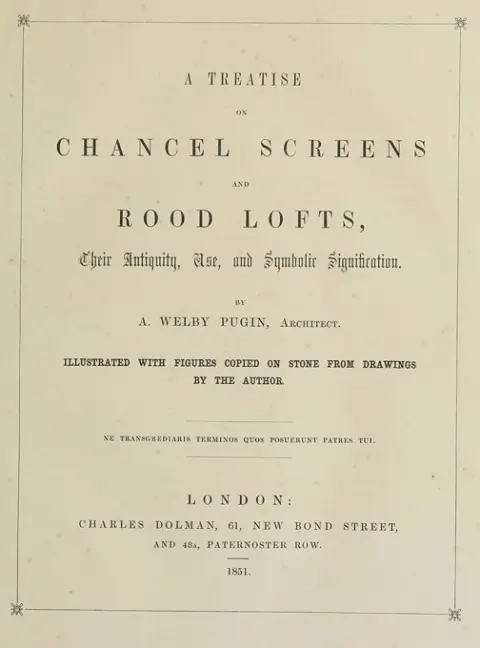
THE CLASSIC COLLECTION · 1851
"A Treatise on Chancel Screens and Rood Lofts" by Augustus Welby Northmore Pugin is a scholarly work focused on ecclesiastical architecture, probably written in the mid-19th century. The book examines the historical significance, design, and function of chancel screens and rood lofts in churches, emphasizing their importance in maintaining tradition and reverence in worship settings. The opening of the treatise establishes the importance of the subject, arguing against modern innovations that detract from the sacredness of church spaces. Pugin discusses the significance of screens in Ecclesiastical architecture, tracing their historical presence back to early Christian practices and emphasizing their role in separating the sanctified areas of worship from the congregation. He critiques contemporary practices that obscure the traditional roles of these architectural features, which he believes are vital for preserving the solemnity of the Mass and the reverence due to the altar and choir, recalling the historical practices of earlier centuries to bolster his arguments.
Introduction adapted from the source catalogue; source summaries may be automatically generated.
Free to read · English · 41,404 words · No account needed
MAKE TIME FOR A GOOD BOOK
On by default. Untick to stop anonymous reading totals. Each page counts after 10 seconds in view. How this works.
Anonymous counting is on unless you have switched it off.
If men were but acquainted with the Catholic church as she really is, in her canons, and her authoritative service books, how differently would they think and speak of her! The majesty of the language used in her ritual and pontifical is inferior only to that of the sacred scriptures themselves, and would almost seem to bear the evidence of inspiration in the text. How we must admire the appropriate fitness of each consecration to the peculiar object to be devoted to the service of Almighty God, from the walls of the temple and altar of sacrifice to those heralds of solemnity, the bells, whose brazen notes can animate a whole population with one intention and one prayer! Then if we consider the divine song of the church, its serenity, its melody, and indeed its almost sacramental power in infusing faith into the heart as its tones flow into the ears of the assistants, while the rhythm most perfectly expresses the sense of the sacred words thus solemnly sung, without vain repetitions and distracting fugues, but as is ordered by the Roman ceremoniale, sit devota, distincta, et intelligibilis, so that men listen, not to curious sounds, but sing in prayer and with one voice, glorify God in unison of heart and sound. What majestic, what consoling services has the church provided for her children! What happiness, even on earth, might they not realize by fulfilling the loving intentions of such a mother, and by devoting their means and energies, carry out the authorized and ancient ritual! But alas, such is the degenerate spirit of this age, that even among those who profess the ancient faith in this land, the existence of solemn services is the exception and not the rule; and while this is the case how can we wonder at the feelings with which they are regarded by the majority of our separated countrymen, who from curiosity or better motives of inquiry attend them? A great portion of the old country missions have usually a sort of room with a look of chilling neglect, at one end of which a wooden sarcophagus or quatrefoil box serves for an altar, duly supplied with some faded artificials and mean candlesticks of a culinary pattern. A mouldy picture of the bad Italian school, given by some neighbouring patron on account of its worthlessness to the chapel, hangs above. A cupboard, painted in marble streaks, serves for a tabernacle; a half-parlour, half-kitchen, for a sacristy and confessional, damp and neglected; and a range of benches, with kneeling boards, provided with every description of carpet patch and moth-eaten cushions, complete the fittings of these establishments; and here, Sunday after Sunday, is a short said mass, badly responded by some poor lad, a large amount of English prayers, with a discourse, &c. &c. This is the only service which the congregation hear on the greatest festivals; to them the solemn offices of Holy Week and the alleluias of the Paschal time are equally unknown. A poor priest, ill supported and alone, without means and persons to aid in his functions, abandons the glories of religion in despair, and thinks himself truly fortunate if he can secure the essential sacraments to those committed to his charge. But what is the consequence? Though the old people, from long habit, are content with this state of things, their children do not imbibe any of that zeal and Catholic spirit that the glorious offices of the church infuse into the tender mind,—that love of the house of God and of his service,—that interest which the succeeding and varied festivals awake in the youthful heart; and, sad to relate, many of the old congregations are decaying, and some have already died out. Now, if this state of things was the result of absolute unavoidable poverty, it would seem cruel to allude to it; but I grieve to say, many of these sort of places are sustained, or pretended to be sustained, by old and wealthy families, who, out of abundant fortunes, dole a much worse pittance to the chaplain than the butler: and who, to avoid the inconvenience of people coming too near their habitations, have fitted up an unoccupied stable, or an old outhouse, for the tabernacle of the living God!! This is no overdrawn picture, and I draw it to try if public shame can work on these men, who seem dead to every other. Why, there are estates possessed by nominal Catholics so broad, that six parochial churches might be raised, and filled with the faithful; and yet, perhaps in this vast space is only one wretched room like that described for all the Catholic community, thus depriving more than two-thirds of the Catholic population of even the practical means of fulfilling the duties of their religion! It is a common cry that the Catholic body are poor,—but it is false: the bishops are poor, the clergy are poor, the masses of town population are poor; but there is wealth yet in possession of men who have not altogether renounced the name, although they have the practice of Catholics (if the world and Satan did not grasp their hands), to restore religion throughout England, and to place it in such a position as to be a beacon and a light to all. What, then, must be the black despair of one of these men, when the world to whom he has sacrificed all is passing away from him for ever! His gay companions of the turf who have cheated him, and fattened on his rents and lands, have left him to die alone,—not one of these jovial friends are there. A few mercenary attendants hover round, to watch the last, and divide what they may. No chapel or chaplain: the priest has long been driven out to live on a distant portion of the property; the old chapel is a disused garret, where a few moth-eaten office-books and unstrung beads tell of the departed piety of the older members of the family. But many years have elapsed since holy rites or holy men were there seen or heard. Stupified with disease, the wretched owner of a vast estate, childless and deserted, draws near his end. He has wasted a life which might have been one of usefulness and honour. He has impaired a property which was ample enough to have enabled him to have placed the religion of his fathers on a noble footing; he might have founded missions, established schools, encouraged his tenants, and been the means of bringing numerous souls to God. But he has done nothing—he has got nothing, but the whitening bones of some racers that cost him thousands, lost him thousands, and were shot in an adjoining paddock, and stocks of empty bottles, consumed in entertaining worthless associates, and a broken constitution now bearing him to a premature end. It is over. He is no more. Unrepentant, unshriven, unanealed, his spirit has gone to judgment. No ministers of God, no rites of holy church, were there to exhort and strengthen the departing soul. There was not one of all those mighty consolations which the church has provided for dying Christians and their survivors. No stoled priests kneel around in prayer and supplication; no ardent lights show forth the glorious hope of resurrection; no poor bedesmen receive the funeral dole, and cry, "May God have mercy on him!" no solemn knell invites the departing prayer; the chamber of death is close and still: the Protestant undertaker encloses the festering corpse in costly coffins, hideous in form and covered with plated devices, but not one Christian emblem among them all; a huge pile of sable feathers, as if in mockery, surmounts the whole; and thus it stands, till, in a few days, it is committed to moulder in the old vault. Placed on the north side of an old parish church that had been built for Catholic rites, but now blocked up with unsightly pews and galleries of uncouth and rude construction, and denuded of every ancient decoration, the family vault had once stood within a chantry, but the roof had long disappeared, while the walls were crumbled into shapeless mounds. In the midst of a small space, rank with weeds and nettles, was a huge brick tomb railed in with bar and spike. A slippery way dug out at the lower end showed a rapid descent to a dark aperture, formed by the removal of a large stone, piled against the side. Over this stood the clergyman of the parish, in a loosely fitting surplice ill concealing his semi-lay attire beneath, attended by a decrepit clerk, who alternately recited the appointed office. The executor, the lawyer, and the undertaker's men, with some curious lookers-on, are alone present at this sad and desolate spectacle. The coffin is lowered down the incline, the heavy mass is forced into its narrow space, jammed in amongst the mouldering shells of older interments. The men issue from the vault—the stone is replaced—the heavy fall of earth clods resound on its hollow surface, and as the access is filled in, all depart—the executors to the will—the undertakers to the nearest tavern. Two old men linger on the spot. "Well," one exclaimed, "I would not have thought the squire would have died thus." "Alack, alack!" replied his companion, "it was all along of bad company. I have heard Father Randall say, many a time, he were a good young man." It was so indeed, he was a good young man. He was taught and fulfilled his duties, but he never knew the grandeur or the majesty of the faith in which he was reared. It was not his pride, his glory. He knew it only as the persecuted—the contemned religion of his ancestors, to which he was bound to adhere, but he never felt its power, nor understood it as the fountain, the source of all that is majestic, true, and ennobling upon earth, and so, when he heard it laughed at as an old-fashioned jest, and got entangled with worldly men, he abandoned its observances by degrees, and sunk into worldly pleasures and feelings till he became dead to every call of conscience, even for the most essential duties of religion, and came to that miserable end. If this illustration be considered unsuitable for an architectural work, I reply that the revival of true architecture is intimately mixed up with education and the formation of the minds of the rising Catholic generation. It is during the first few years of mental training that the character and feelings are generally formed, and I maintain the moral part of Catholic architecture, that is to say, the fitting of the mind to understand and appreciate the external beauties of religion, and to produce that love of God's service in the youthful heart, is quite as important, and can only be raised in places where the offices of religion are solemnly performed, and in suitable edifices. Now this should be most strictly considered for the education of both clergy and laity, for while the clergy have to officiate in these edifices, and carry out their various uses, it is to the laity that they must look both for the funds for the erection and the necessary means of support after they are erected. Therefore, it is of paramount importance that both receive the initiations in this matter, for early impressions are everything. How truly deplorable are the ordinary class of chapels attached to bishops' seminaries in France, for the most part whitewashed saloons, without anything ecclesiastical about them, except bad pictures, worse even than the walls they cover. Fortunately, they are usually in the vicinity of some fine old church, where the ecclesiastical students assist occasionally; but still, all should be in harmony, the seminary with the cathedral, and the clergy with both.
Your reading position is saved on this browser. Take it to another device with a library code. Reading pages adapt to text, rather than matching a printed edition.
BEHIND THE BOOK
This eBook is for the use of anyone anywhere in the United States and most other parts of the world at no cost and with almost no restrictions whatsoever. You may copy it, give it away or re-use it under the terms of the Project Gutenberg License included with this eBook or online at www.gutenberg.org. If you are not located in the United States, you will have to check the laws of the country where you are located before using this eBook. Read the source licence.
The original source file, including credits and licence, is retained by this library. Request an original-format copy at no charge. Please include the book title and Project Gutenberg identifier #51875.
KEEP YOUR CURIOSITY GOING
Cécile Tormay

Moritz Busch
John L. Ransom
Frances Wright
Cécile Tormay

Mabel Potter Daggett