THE CLASSIC COLLECTION✦An outlaw’s diary: the CommuneCLASSIC FREE BOOKS
An outlaw’s diary: the Commune
Cécile Tormay
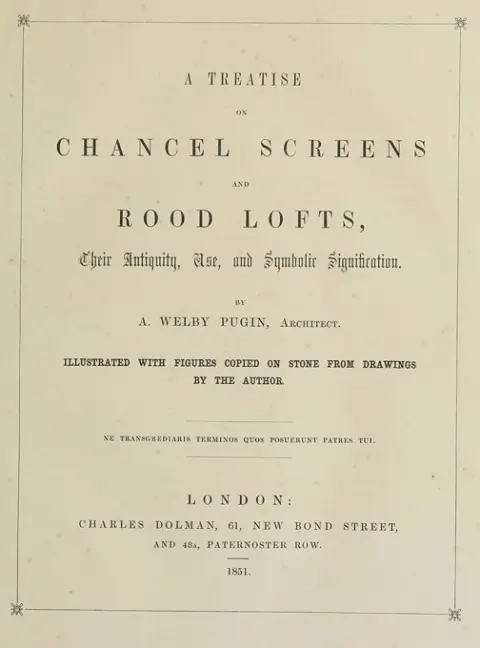
THE CLASSIC COLLECTION · 1851
"A Treatise on Chancel Screens and Rood Lofts" by Augustus Welby Northmore Pugin is a scholarly work focused on ecclesiastical architecture, probably written in the mid-19th century. The book examines the historical significance, design, and function of chancel screens and rood lofts in churches, emphasizing their importance in maintaining tradition and reverence in worship settings. The opening of the treatise establishes the importance of the subject, arguing against modern innovations that detract from the sacredness of church spaces. Pugin discusses the significance of screens in Ecclesiastical architecture, tracing their historical presence back to early Christian practices and emphasizing their role in separating the sanctified areas of worship from the congregation. He critiques contemporary practices that obscure the traditional roles of these architectural features, which he believes are vital for preserving the solemnity of the Mass and the reverence due to the altar and choir, recalling the historical practices of earlier centuries to bolster his arguments.
Introduction adapted from the source catalogue; source summaries may be automatically generated.
Free to read · English · 41,404 words · No account needed
MAKE TIME FOR A GOOD BOOK
On by default. Untick to stop anonymous reading totals. Each page counts after 10 seconds in view. How this works.
Anonymous counting is on unless you have switched it off.
The Catholic body in England is now suddenly become the spectacle of the world. An immense responsibility has been incurred; how will it be supported? Our episcopal rulers bear titles which are associated with the most venerable men and places in the history of the English church,—names associated with the first planting of Christianity in this land,—names known far and wide as pertaining to some of the fairest fabrics that Catholic hands ever raised to the honour of their Creator,—and names the very possession of which in a manner demand a conduct and principles in accordance with their import. May we not then hope, nay, expect, that better times are approaching; that our spiritual rulers will, in very deed, set forth, if not the full glories of the ancient men, at least a continuation of their principles, so that, in all the works undertaken under their auspices, the old spirit and intention may be evident. Christian architecture must now become a principle, and not a mere matter of whim and caprice of individuals, or its advocacy or rejection treated as a mere jest. Architects may suggest and execute, but the moving power must come from episcopal authority—that is the legitimate source. The finest churches, unless the ecclesiastics enter into the spirit of the arrangement and construction, are only so many evidences of modern degeneracy; and the erection of a choral church for an orchestral service is a farce, and a prostitution of ancient symbolism to a profane and irreverent purpose, even more painful than when it is carried on in a meeting-house with an altar in it. And as for those men who would import the debased modern externals of Italy into this land for religious purposes, whatever their intentions may be, they can only be practically considered as the greatest and worst enemies with which we have to contend, for they lower the majesty of religion to the level of a common show, and degrade the sacrament before the people, giving occasion for scoffing and ridicule, and putting stumbling-blocks in the way of our separated countrymen, dressing up the altar of God like a mountebank's show, and imparting a strange and modern appearance to that which was indeed the ancient faith of this land. What a mockery would it be to lead those devout men, (who though separated in position, have been united in heart with the ancient religion, who have prayed in deserted aisles and chapels, kissed the prostrate consecrated stones of ancient sacrifice, and mourned over desecrated shrines and rifled tombs of holy dead,) up to the threshold of that very gate within which they fondly hoped for the realization of all those glories on which they have existed for years, on its being opened, to introduce them into a sort of drawing-room chapel with a deal altar hung with gauze, lace, and ribands, surmounted by a chiaro oscuro of an ecstatic friar dancing a naked Bambino in his arms, and a bason on a neat stool for a font. "Impostors," they would exclaim, "is this the realization of the ancient faith? why, the wreck we have left savours more of the old spirit than this miserable show." But let us reverse the scene, and introduce our pilgrims into a church, raised after the ancient fashion of those in which they had been used to worship, but restored to life and beauty. First, that veiled altar and ardent lamps tell of the divine presence abiding among men: ecce tabernaculum Dei cum hominibus. What sanctity this imparts to the whole fabric, and how dead do even the most stupendous churches appear when denuded of the sacramental presence; the ground itself in such a place is holy: not only the disposition of the fabrick itself, but every enrichment, every detail harmonises in setting forth one grand illustration of the faith. The windows sparkle in saintly imagery and sacred mysteries, the very light of heaven enters through a medium which diffuses it in soft and mellowed hues. What a perspective is presented to the sight, of successive pillars supporting intersecting arches, leaving distant openings into aisles and chapels! Then the chancel, with its stalled quire seen through the traceried panels of the sculptured screen, above which, in solemn majesty, rises the great event of our redemption, treated after a glorified and mystical manner, the ignominious cross of punishment changed into the budding tree of life, while, from the tesselated pavement to the sculptured roof, every detail sets forth some beautiful and symbolical design; how would such a fabric strike to the heart of a devout soul, seeking for the realization of ancient solemnities! And is it not a case of gross infatuation for men professing the old faith to reject what we may truly imagine to be a revelation made by the mercy of God for the consolation of his servants upon earth, and to turn back to the old vomit of Pagan design, associated only with the infernal orgies of false gods and heathen corruptions? Does it not show an utter loss of all appreciation of the beautiful and the true, and a state of mental degradation as deplorable, as it is alarming in its practical results?
Your reading position is saved on this browser. Take it to another device with a library code. Reading pages adapt to text, rather than matching a printed edition.
BEHIND THE BOOK
This eBook is for the use of anyone anywhere in the United States and most other parts of the world at no cost and with almost no restrictions whatsoever. You may copy it, give it away or re-use it under the terms of the Project Gutenberg License included with this eBook or online at www.gutenberg.org. If you are not located in the United States, you will have to check the laws of the country where you are located before using this eBook. Read the source licence.
The original source file, including credits and licence, is retained by this library. Request an original-format copy at no charge. Please include the book title and Project Gutenberg identifier #51875.
KEEP YOUR CURIOSITY GOING
Cécile Tormay

Moritz Busch
John L. Ransom
Frances Wright
Cécile Tormay

Mabel Potter Daggett