READ · DISCOVER · ENJOYClassic literature · Always free
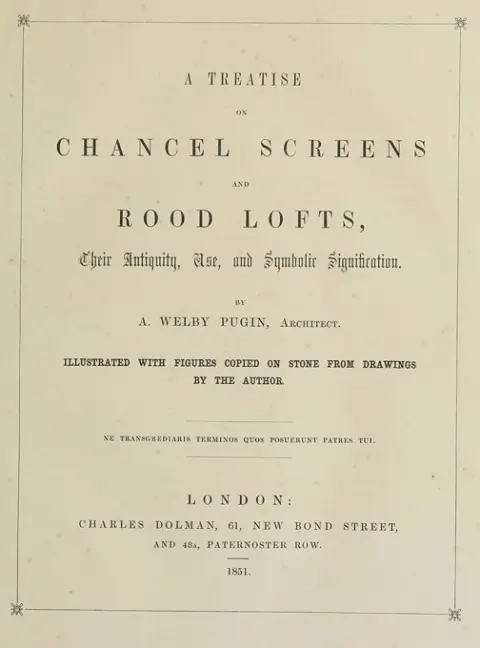
A Treatise on Chancel Screens and Rood Lofts Their Antiquity, Use, and Symbolic Signification — digital edition cover

THE CLASSIC COLLECTION · 1851

A Treatise on Chancel Screens and Rood Lofts Their Antiquity, Use, and Symbolic Signification

"A Treatise on Chancel Screens and Rood Lofts" by Augustus Welby Northmore Pugin is a scholarly work focused on ecclesiastical architecture, probably written in the mid-19th century. The book examines the historical significance, design, and function of chancel screens and rood lofts in churches, emphasizing their importance in maintaining tradition and reverence in worship settings. The opening of the treatise establishes the importance of the subject, arguing against modern innovations that detract from the sacredness of church spaces. Pugin discusses the significance of screens in Ecclesiastical architecture, tracing their historical presence back to early Christian practices and emphasizing their role in separating the sanctified areas of worship from the congregation. He critiques contemporary practices that obscure the traditional roles of these architectural features, which he believes are vital for preserving the solemnity of the Mass and the reverence due to the altar and choir, recalling the historical practices of earlier centuries to bolster his arguments.

Introduction adapted from the source catalogue; source summaries may be automatically generated.

Start reading ↓

Free to read · English · 41,404 words · No account needed

MAKE TIME FOR A GOOD BOOK

A Treatise on Chancel Screens and Rood Lofts Their Antiquity, Use, and Symbolic Signification

On by default. Untick to stop anonymous reading totals. Each page counts after 10 seconds in view. How this works.

Anonymous counting is on unless you have switched it off.

A Treatise on Chancel Screens and Rood Lofts Their Antiquity, Use, and Symbolic Signification

[20] The choir of S. Denis, near Paris, had been modernised a few years
previous.

CONCLUSION.

It now only remains to make some remarks on the recent revival of Catholic art and architecture, the difficulties with which it has to contend in England, and the opposition that has been raised against it. As the enclosures of the sanctuary can be traced from the erection of the earliest Christian churches, and as they are inseparably connected with reverence and solemnity, we might have hoped, and indeed expected, that the restoration would have been hailed by all who profess the ancient religion as an evidence of returning faith. But, alas, we have a class of men to oppose the revival of ancient symbolism, on whom the examples of fifteen centuries of Catholic antiquity fail to produce the slightest recognition of respect. The past is to them a nullity, and they would fain have us believe that the present debased externals of religion are to be equally received and propagated as those which were generated during the finest ages of Christian art. Now, knowing the whole history of this debasement in religious art, its origin and progress, and the general decline of Catholic faith and Catholic principles, corresponding to its increasing influence, it is impossible for us to regard its very existence otherwise than as an intolerable evil, and we must labour incessantly for its utter expulsion from our churches. The decline of true Christian art and architecture may be dated from a most corrupt era in the history of the church; and ever since that most unnatural adoption of Pagan externals for Catholic rites, we mourn the loss of those reverend and solemn structures which so perfectly embodied the faith for which they were raised. Bad as was the Paganism of the fifteenth and sixteenth centuries, it was dressed out in much external majesty and richness; but now nothing is left but the fag end of this system; bronze and marble are replaced by calico and trimmings; the works of the sculptor and the goldsmith are succeeded by the milliner and the toyshop; and the rottenness of the Pagan movement is thinly concealed by gilt paper and ribands,—the nineteenth century apeings of the dazzling innovations of the Medician era. Cheap magnificence, meretricious show, is the order of the day; something pretty, something novel, calico hangings, sparkling lustres, paper pots, wax dolls, flounces and furbelows, glass cases, ribands, and lace, are the ornaments and materials usually employed to decorate, or rather disfigure, the altar of sacrifice and the holy place. It is impossible for church furniture and decoration to attain a lower depth of degradation, and it is one of the greatest impediments to the revival of Catholic truth. It is scarcely possible for men to realize the awful doctrines and the majestic ritual of the Church under such a form; and yet these wretched novelties are found on the altars of some of the most venerable temples, equally as in the abortions of modern erection. They disfigure alike the cathedral of the city and the wayside chapel of the mountain-pass; they flourish in religious communities, and are even tolerated in the seminaries for the education of the priests of the sanctuary. Bad, paltry, miserable taste has overrun the externals of religion like a plague; and to this state of deplorable degradation would these new men bind our desires and intellects, as if it were of God, and on a par with the noble works achieved in times of zeal and faith, and at a period when all the art and talent of Christendom was devoted to the one object of increasing the glory and magnificence of the great edifices devoted to the worship of Almighty God. Moreover, it is very important to observe the extraordinary similarity of idea that actuated the artists of all Christian countries during the middle ages. Making due allowance for climate and materials, the same ruling spirit presided over the arts of Italy and England. The same devout effigies, recumbent and praying, each robed in the flowing ecclesiastical habits of the order, may be seen in every old Italian church, as in our own cathedrals. There was no difference then between a Roman chasuble and an English chasuble, between a Roman mitre and an English mitre. The same beautiful forms and proportions reigned universal. Even where the Christians extended their conquests in the East, in the city of Jerusalem itself, the edifices they raised were in architecture Pointed and Christian; some of which even still remain. Everywhere the Catholic might be traced by the works he raised; but now, alas, excepting by the extreme ugliness, and deformity, and paltry ornament, that are the usual characteristics of modern Catholic erections, it would be difficult to distinguish them from the recent productions of modern sects. Is it not a consideration that should fill every true Catholic heart with grief, that the propagation of the faith is no longer attended by the propagation of ecclesiastical traditions? Every year what zealous missionaries depart for distant climes, bearing with them, indeed, the true principles of faith, but with it the most degraded externals possible. The sources from whence they supply themselves are the magazines of Lyons and Paris, places filled with objects made entirely on the principle of cheap magnificence, uncanonical in form and often in material, hideous in design, utter departures from the beautiful models of mediæval antiquity, calculated only to please the vulgar and the ignorant, dazzling in the eyes of savages, but revolting to every man of true ecclesiastical knowledge and feeling. These things are not only expedited to the colonies and even to the antipodes to form in any mission a fresh nucleus of deplorable taste and ideas, but they inundate the sister island itself; yes, in Ireland, where, even in times considered barbarous, the ancient goldsmiths wrought exquisitely cunning work for the altar and the shrine, they now deck out her sanctuaries in Parisian trumpery, and borrow the model of her churches from the preaching-house of the Presbyterian settler; and to such a low ebb is all feeling for ecclesiastical art and architecture fallen—that when a cathedral is raised after the old form of the cross of Christ, its very bishop walls off the holy place, and converts it into a room! Room-worship, where all see, is the modern shell in which innovators and nineteenth-century men could exhibit those sacred mysteries for which Catholic antiquity raised those glorious choirs and chancels, witnesses of their reverence and our degeneracy. But sad to relate, this principle of room-worship is gradually extending itself into those majestic edifices of antiquity by the manner in which they are perverted to the modern system. The month of May is more especially devoted to the honour of our Blessed Lady, an excellent devotion, but how is it carried out? All who have had the misfortune of travelling on the continent during this month must have noticed an unusual disfigurement of the fabric in the shape of enormous festoons of red calico or some other material, as the case may be, pendent from the groining over a catafalque of painted canvass, flower-pots, and glass cases, surmounted by an image intended for our Blessed Lady herself, in the most meretricious attire covered with gauze and spangles. This miserable representation is usually set up in the very centre of the transept or the last bay of the nave, completely altering the whole disposition of a church. Great devotion to the blessed mother of our Lord, was a striking feature in mediæval antiquity. Almost every cathedral was dedicated in honour of Notre Dame, and where was the parish church of any size that did not possess its Lady chapel set apart for her peculiar honour? What beautiful examples have we of these in England, though, grievous to relate, some of them are converted to unworthy purposes, and all disused; but in many of the continental churches it is little better; for, except an occasional mass, Lady chapels, as such, are no longer kept up. In one of the finest churches of Liege I saw an altar set up for the month of May, a heap of paltry showy materials; but on getting to the other side I discovered this gilded front to be sustained by old packing-cases, trestles, casks, and planks, hastily piled up, and not even concealed from those who might penetrate eastward of the nave. Further on was the real Lady chapel in a very neglected state, without furniture or decoration: this was undoubtedly the portion of the church where the devotions of May should be celebrated; but the nave is more like a room, and is therefore used in preference to that portion of the fabric which the devout builders had set apart for the purpose. And what majestic Lady chapels did the old churches contain! usually the most eastward portion of the church,—the refugium peccatorum; they displayed in their windows and their sculptures all those edifying—those touching mysteries of our Lady's history which are so fruitful for contemplation, and the tryptych altar unfolded its gilded doors when adorned for sacrifice, with many a saint and angel depicted on its painted panels, and the office was sung by our Lady's chaplains, all in their stalls of quire, and the morrow mass-priest celebrated most solemnly, and many a taper burnt brightly before her image, and our Lady's chapel was one of the fairest portions of these fair churches. But now, alas, while these chapels are in a great measure abandoned to neglect, a wretched piece of scenery is substituted, and this is set up in the centre of the nave, to the disguise of the architecture and the impediment of its proper use. Even making all allowances for the reduced revenues of the continental churches, it must be admitted that they are for the most part most miserably neglected, and in a great measure disused. There are splendid crypts where no rites are ever celebrated. Lateral chapels turned into confessionals, or what is much worse, into deposits for lumber; everything is carried on on the smallest scale, and with the least trouble, and not only are the generality of modern Catholic churches on the continent most miserable abortions, but every year sad mutilations are permitted in many of those sacred buildings that are still preserved for religious purposes.

Your reading position is saved on this browser. Take it to another device with a library code. Reading pages adapt to text, rather than matching a printed edition.

BEHIND THE WORDS

About Augustus Welby Northmore Pugin

Augustus Welby Northmore Pugin (1812–1852). Explore A Treatise on Chancel Screens and Rood Lofts Their Antiquity, Use, and Symbolic Signification in this collection. These books span history.

Explore this author’s books →

THE READERS’ VERDICT

How did this story stay with you?

Not rated yet
Your rating for A Treatise on Chancel Screens and Rood Lofts Their Antiquity, Use, and Symbolic Signification

Be the first to share your verdict.

One rating per browser, which you can change or remove. A necessary browser identifier remembers your vote. How ratings work

A GOOD STORY DESERVES COMPANY

Pass this book along.

A great read is even better when it’s shared.

SEND A LITTLE INSPIRATION

Share this book

BEHIND THE BOOK

Edition & source details.

Title
A Treatise on Chancel Screens and Rood Lofts Their Antiquity, Use, and Symbolic Signification
Author
Augustus Welby Northmore Pugin
First publication (Open Library catalogue match)
1851
Digital edition publisher
Project Gutenberg
Gutenberg release date
2016-04-27
Language
English
Source edition imprint
Not stated in source catalogue
Source identifier
Project Gutenberg #51875
Contributors
No additional named contributors in source metadata

Public-domain source & licence

This eBook is for the use of anyone anywhere in the United States and most other parts of the world at no cost and with almost no restrictions whatsoever. You may copy it, give it away or re-use it under the terms of the Project Gutenberg License included with this eBook or online at www.gutenberg.org. If you are not located in the United States, you will have to check the laws of the country where you are located before using this eBook. Read the source licence.

Full source licence and obtaining an original copy

The original source file, including credits and licence, is retained by this library. Request an original-format copy at no charge. Please include the book title and Project Gutenberg identifier #51875.

the full Project Gutenberg License must appear
prominently whenever any copy of a Project Gutenberg work (any work
on which the phrase “Project Gutenberg” appears, or with which the
phrase “Project Gutenberg” is associated) is accessed, displayed,
performed, viewed, copied or distributed:

This eBook is for the use of anyone anywhere in the United States and most
other parts of the world at no cost and with almost no restrictions
whatsoever. You may copy it, give it away or re-use it under the terms
of the Project Gutenberg™ License included with this eBook or online
at www.gutenberg.org. If you
are not located in the United States, you will have to check the laws
of the country where you are located before using this eBook.

1.E.2. If an individual Project Gutenberg electronic work is
derived from texts not protected by U.S. copyright law (does not
contain a notice indicating that it is posted with permission of the
copyright holder), the work can be copied and distributed to anyone in
the United States without paying any fees or charges. If you are
redistributing or providing access to a work with the phrase “Project
Gutenberg” associated with or appearing on the work, you must comply
either with the requirements of paragraphs 1.E.1 through 1.E.7 or
obtain permission for the use of the work and the Project Gutenberg
trademark as set forth in paragraphs 1.E.8 or 1.E.9.

1.E.3. If an individual Project Gutenberg electronic work is posted
with the permission of the copyright holder, your use and distribution
must comply with both paragraphs 1.E.1 through 1.E.7 and any
additional terms imposed by the copyright holder. Additional terms
will be linked to the Project Gutenberg License for all works
posted with the permission of the copyright holder found at the
beginning of this work.

1.E.4. Do not unlink or detach or remove the full Project Gutenberg
License terms from this work, or any files containing a part of this
work or any other work associated with Project Gutenberg.

1.E.5. Do not copy, display, perform, distribute or redistribute this
electronic work, or any part of this electronic work, without
prominently displaying the sentence set forth in paragraph 1.E.1 with
active links or immediate access to the full terms of the Project
Gutenberg License.

1.E.6. You may convert to and distribute this work in any binary,
compressed, marked up, nonproprietary or proprietary form, including
any word processing or hypertext form. However, if you provide access
to or distribute copies of a Project Gutenberg work in a format
other than “Plain Vanilla ASCII” or other format used in the official
version posted on the official Project Gutenberg website
(www.gutenberg.org), you must, at no additional cost, fee or expense
to the user, provide a copy, a means of exporting a copy, or a means
of obtaining a copy upon request, of the work in its original “Plain
Vanilla ASCII” or other form. Any alternate format must include the
full Project Gutenberg License as specified in paragraph 1.E.1.

1.E.7. Do not charge a fee for access to, viewing, displaying,
performing, copying or distributing any Project Gutenberg works
unless you comply with paragraph 1.E.8 or 1.E.9.

1.E.8. You may charge a reasonable fee for copies of or providing
access to or distributing Project Gutenberg electronic works
provided that:

• You pay a royalty fee of 20% of the gross profits you derive from
the use of Project Gutenberg works calculated using the method
you already use to calculate your applicable taxes. The fee is owed
to the owner of the Project Gutenberg trademark, but he has
agreed to donate royalties under this paragraph to the Project
Gutenberg Literary Archive Foundation. Royalty payments must be paid
within 60 days following each date on which you prepare (or are
legally required to prepare) your periodic tax returns. Royalty
payments should be clearly marked as such and sent to the Project
Gutenberg Literary Archive Foundation at the address specified in
Section 4, “Information about donations to the Project Gutenberg
Literary Archive Foundation.”

• You provide a full refund of any money paid by a user who notifies
you in writing (or by e-mail) within 30 days of receipt that s/he
does not agree to the terms of the full Project Gutenberg™
License. You must require such a user to return or destroy all
copies of the works possessed in a physical medium and discontinue
all use of and all access to other copies of Project Gutenberg™
works.

• You provide, in accordance with paragraph 1.F.3, a full refund of
any money paid for a work or a replacement copy, if a defect in the
electronic work is discovered and reported to you within 90 days of
receipt of the work.

• You comply with all other terms of this agreement for free
distribution of Project Gutenberg™ works.


1.E.9. If you wish to charge a fee or distribute a Project
Gutenberg™ electronic work or group of works on different terms than
are set forth in this agreement, you must obtain permission in writing
from the Project Gutenberg Literary Archive Foundation, the manager of
the Project Gutenberg™ trademark. Contact the Foundation as set
forth in Section 3 below.

1.F.

1.F.1. Project Gutenberg volunteers and employees expend considerable
effort to identify, do copyright research on, transcribe and proofread
works not protected by U.S. copyright law in creating the Project
Gutenberg™ collection. Despite these efforts, Project Gutenberg™
electronic works, and the medium on which they may be stored, may
contain “Defects,” such as, but not limited to, incomplete, inaccurate
or corrupt data, transcription errors, a copyright or other
intellectual property infringement, a defective or damaged disk or
other medium, a computer virus, or computer codes that damage or
cannot be read by your equipment.

1.F.2. LIMITED WARRANTY, DISCLAIMER OF DAMAGES - Except for the “Right
of Replacement or Refund” described in paragraph 1.F.3, the Project
Gutenberg Literary Archive Foundation, the owner of the Project
Gutenberg™ trademark, and any other party distributing a Project
Gutenberg™ electronic work under this agreement, disclaim all
liability to you for damages, costs and expenses, including legal
fees. YOU AGREE THAT YOU HAVE NO REMEDIES FOR NEGLIGENCE, STRICT
LIABILITY, BREACH OF WARRANTY OR BREACH OF CONTRACT EXCEPT THOSE
PROVIDED IN PARAGRAPH 1.F.3. YOU AGREE THAT THE FOUNDATION, THE
TRADEMARK OWNER, AND ANY DISTRIBUTOR UNDER THIS AGREEMENT WILL NOT BE
LIABLE TO YOU FOR ACTUAL, DIRECT, INDIRECT, CONSEQUENTIAL, PUNITIVE OR
INCIDENTAL DAMAGES EVEN IF YOU GIVE NOTICE OF THE POSSIBILITY OF SUCH
DAMAGE.

1.F.3. LIMITED RIGHT OF REPLACEMENT OR REFUND - If you discover a
defect in this electronic work within 90 days of receiving it, you can
receive a refund of the money (if any) you paid for it by sending a
written explanation to the person you received the work from. If you
received the work on a physical medium, you must return the medium
with your written explanation. The person or entity that provided you
with the defective work may elect to provide a replacement copy in
lieu of a refund. If you received the work electronically, the person
or entity providing it to you may choose to give you a second
opportunity to receive the work electronically in lieu of a refund. If
the second copy is also defective, you may demand a refund in writing
without further opportunities to fix the problem.

1.F.4. Except for the limited right of replacement or refund set forth
in paragraph 1.F.3, this work is provided to you ‘AS-IS’, WITH NO
OTHER WARRANTIES OF ANY KIND, EXPRESS OR IMPLIED, INCLUDING BUT NOT
LIMITED TO WARRANTIES OF MERCHANTABILITY OR FITNESS FOR ANY PURPOSE.

1.F.5. Some states do not allow disclaimers of certain implied
warranties or the exclusion or limitation of certain types of
damages. If any disclaimer or limitation set forth in this agreement
violates the law of the state applicable to this agreement, the
agreement shall be interpreted to make the maximum disclaimer or
limitation permitted by the applicable state law. The invalidity or
unenforceability of any provision of this agreement shall not void the
remaining provisions.

1.F.6. INDEMNITY - You agree to indemnify and hold the Foundation, the
trademark owner, any agent or employee of the Foundation, anyone
providing copies of Project Gutenberg™ electronic works in
accordance with this agreement, and any volunteers associated with the
production, promotion and distribution of Project Gutenberg™
electronic works, harmless from all liability, costs and expenses,
including legal fees, that arise directly or indirectly from any of
the following which you do or cause to occur: (a) distribution of this
or any Project Gutenberg work, (b) alteration, modification, or
additions or deletions to any Project Gutenberg work, and (c) any
Defect you cause.

Section 2. Information about the Mission of Project Gutenberg

Project Gutenberg is synonymous with the free distribution of
electronic works in formats readable by the widest variety of
computers including obsolete, old, middle-aged and new computers. It
exists because of the efforts of hundreds of volunteers and donations
from people in all walks of life.

Volunteers and financial support to provide volunteers with the
assistance they need are critical to reaching Project Gutenberg’s
goals and ensuring that the Project Gutenberg collection will
remain freely available for generations to come. In 2001, the Project
Gutenberg Literary Archive Foundation was created to provide a secure
and permanent future for Project Gutenberg and future
generations. To learn more about the Project Gutenberg Literary
Archive Foundation and how your efforts and donations can help, see
Sections 3 and 4 and the Foundation information page at www.gutenberg.org.

Section 3. Information about the Project Gutenberg Literary Archive Foundation

The Project Gutenberg Literary Archive Foundation is a non-profit
501(c)(3) educational corporation organized under the laws of the
state of Mississippi and granted tax exempt status by the Internal
Revenue Service. The Foundation’s EIN or federal tax identification
number is 64-6221541. Contributions to the Project Gutenberg Literary
Archive Foundation are tax deductible to the full extent permitted by
U.S. federal laws and your state’s laws.

The Foundation’s business office is located at 41 Watchung Plaza #516,
Montclair NJ 07042, USA, +1 (862) 621-9288. Email contact links and up
to date contact information can be found at the Foundation’s website
and official page at www.gutenberg.org/contact

Section 4. Information about Donations to the Project Gutenberg
Literary Archive Foundation

Project Gutenberg™ depends upon and cannot survive without widespread
public support and donations to carry out its mission of
increasing the number of public domain and licensed works that can be
freely distributed in machine-readable form accessible by the widest
array of equipment including outdated equipment. Many small donations
($1 to $5,000) are particularly important to maintaining tax exempt
status with the IRS.

The Foundation is committed to complying with the laws regulating
charities and charitable donations in all 50 states of the United
States. Compliance requirements are not uniform and it takes a
considerable effort, much paperwork and many fees to meet and keep up
with these requirements. We do not solicit donations in locations
where we have not received written confirmation of compliance. To SEND
DONATIONS or determine the status of compliance for any particular state
visit www.gutenberg.org/donate.

While we cannot and do not solicit contributions from states where we
have not met the solicitation requirements, we know of no prohibition
against accepting unsolicited donations from donors in such states who
approach us with offers to donate.

International donations are gratefully accepted, but we cannot make
any statements concerning tax treatment of donations received from
outside the United States. U.S. laws alone swamp our small staff.

Please check the Project Gutenberg web pages for current donation
methods and addresses. Donations are accepted in a number of other
ways including checks, online payments and credit card donations. To
donate, please visit: www.gutenberg.org/donate.

Section 5. General Information About Project Gutenberg electronic works

Professor Michael S. Hart was the originator of the Project
Gutenberg concept of a library of electronic works that could be
freely shared with anyone. For forty years, he produced and
distributed Project Gutenberg eBooks with only a loose network of
volunteer support.

Project Gutenberg eBooks are often created from several printed
editions, all of which are confirmed as not protected by copyright in
the U.S. unless a copyright notice is included. Thus, we do not
necessarily keep eBooks in compliance with any particular paper
edition.

Most people start at our website which has the main PG search
facility: www.gutenberg.org.

This website includes information about Project Gutenberg,
including how to make donations to the Project Gutenberg Literary
Archive Foundation, how to help produce our new eBooks, and how to
subscribe to our email newsletter to hear about new eBooks.


KEEP YOUR CURIOSITY GOING

Your next chapter awaits.

Your privacy choices

Reading is always free. You can change these settings at any time.

Book banners link to our books on simonward.net. They do not use advertising cookies or tracking.

Privacy & cookie policy · Reading data and privacy controls