THE CLASSIC COLLECTION✦An outlaw’s diary: the CommuneCLASSIC FREE BOOKS
An outlaw’s diary: the Commune
Cécile Tormay
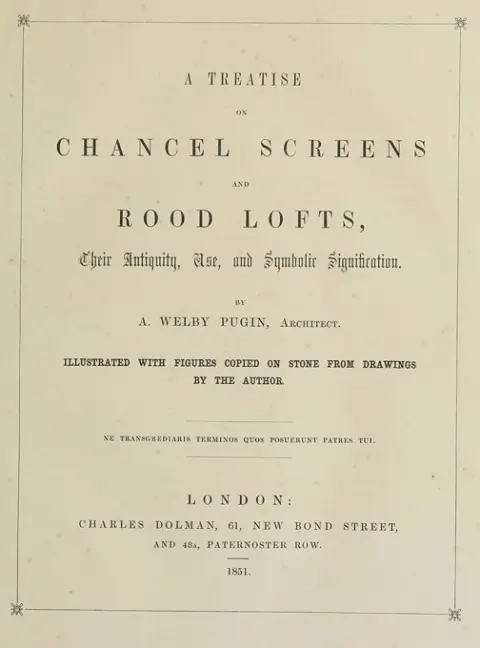
THE CLASSIC COLLECTION · 1851
"A Treatise on Chancel Screens and Rood Lofts" by Augustus Welby Northmore Pugin is a scholarly work focused on ecclesiastical architecture, probably written in the mid-19th century. The book examines the historical significance, design, and function of chancel screens and rood lofts in churches, emphasizing their importance in maintaining tradition and reverence in worship settings. The opening of the treatise establishes the importance of the subject, arguing against modern innovations that detract from the sacredness of church spaces. Pugin discusses the significance of screens in Ecclesiastical architecture, tracing their historical presence back to early Christian practices and emphasizing their role in separating the sanctified areas of worship from the congregation. He critiques contemporary practices that obscure the traditional roles of these architectural features, which he believes are vital for preserving the solemnity of the Mass and the reverence due to the altar and choir, recalling the historical practices of earlier centuries to bolster his arguments.
Introduction adapted from the source catalogue; source summaries may be automatically generated.
Free to read · English · 41,404 words · No account needed
MAKE TIME FOR A GOOD BOOK
On by default. Untick to stop anonymous reading totals. Each page counts after 10 seconds in view. How this works.
Anonymous counting is on unless you have switched it off.
About a furlong from the abbey-gate was the old parish church, a simple and unpretending structure, with its slate-topped steeple and gilded cock, a most fitting emblem of the exemplary and vigilant pastor, the Père Duchesne, a venerable priest, who for many years had most faithfully discharged the sacred duties of his cure; a man of most retired habits, who devoted that portion of his time that was not occupied by parochial cares to learned researches and pursuits. He was deeply read in liturgical lore, and held the ancient traditions and offices of the church in great veneration. Every Sunday and feast the most respected of his parishioners assembled round the lectern in the chancel, where they sang the praises of God in the old plain song, for no other music was tolerable to the ears of either priest or people. The interior of the church, though simple, was not devoid of interest. There were considerable remains of painted glass, especially towards the eastern end; the high altar was coeval with the erection of the church itself, and had been traditionally consecrated by a holy bishop, now numbered among the saints of God. The altar of the Lady chapel dated from the end of the fourteenth century, and was erected by a seigneur who lived in the old chateau on the hill, then in ruins. The rood loft was remarkable; the front was supported by four pillars, sustaining three equal arches; the space between these pillars was enclosed by a sort of iron trellis, set up with the original work, as a protection to two side altars, the reredoses of which formed a solid wall for nearly six feet high, and were then divided by mullions into lights, like a window; these were also secured by bars, and a massive pair of doors, with rich ornamental iron-work, closed the entrance to the chancel. I have been thus particular in the description of this screen, as it is important for a subsequent part of this history. Such was the church, and such its curé. The Abbé de Chantal, in ordinary courtesy to the old priest, determined to call at his residence previous to his departure. On arriving, he was ushered into a small chamber, where the curé was seated with a folio extended on the table before him. Somewhat surprised at the sudden entrance of the abbé, and not over well pleased, as he held such quasi ecclesiastics at the lowest estimation, he begged to know the reason for so unlooked-for a visit. "Oh, Monsieur le curé," carelessly exclaimed the abbé, "I have been making great improvements at the abbey, and I wish to know if you have seen what has been done?" "I have, indeed, seen what has been done, or rather undone," cried the old priest with increasing emotion, "but surely you cannot expect me to approve the destruction of Catholic antiquity and symbolism, and the substitution of unmeaning and offensive novelties." "Eh, patience, Monsieur le curé; why I was going to propose to you to reform your church à l'Italienne, and to get rid of the monstrous barrack in the middle, on les démonte partout." At these words, the curé, reddening with indignation, exclaimed, "Monsieur de Chantal, the present degraded state of ecclesiastical discipline permits you, a layman in every respect but in the fashion of your clothes and the form of your peruke, to hold the highest office in a foundation where, in more ancient and better days, you would not have been permitted to take part in the most menial duties. You have destroyed that which your predecessors respected; you have defaced and mangled the Temple of God; you have dressed it out à la mode; and its solemnity is departed for ever, to the sorrow and disgust of myself and my people. But allow me to tell you, the parish church is under my care, and while I live not one stone of that venerable enclosure of the holy place shall be touched or removed, or its sacred imagery injured." The abbé, deeply mortified at the reproaches of the curé, endeavoured to conceal his mortification by diverting the discourse on the times and his parishioners. The curé, however, turning to his visitor, said in a sad and solemn tone, "The times are full of sad presage. The riches, the corruptions, immunities, and extravagant privileges that disgrace even the highest ecclesiastics of the land, are the subject of deep and merited murmurs among the neglected people; men begin to hate religion for the vices of its ministers, and those who squander in worldly vanity the revenues intended for the service of religion and Christ's poor, will have to give a fearful reckoning." The abbé started to his feet: "Nay, hear me," continued the curé. "You are one of these spoilers; it is true the abbey was given to you as a heritage, but it was the gift of those who had no power to bestow. Think of that choir, once filled with a hundred devout servants of God chanting his praises by night and day, now debased and almost deserted. The vast refectory in ruins,—its vaulted gateway, where hundreds partook the hospitality and charity of the house, now scarcely shelters a single straying mendicant—all is neglect and decay, and how will it end?" "Ah, mon Dieu," cried the abbé, "I cannot bear this; how often have I thought and tried for better things! But no, impossible. My rank, my family honour, all must be supported." So, hastily departing, he summoned his servants and carriage.—"To Paris!" he exclaimed. That night the Hotel de Chantal was a blaze of light, the rendezvous of the élite of the capital; and among the many cavaliers who escorted the fair dames of Paris that graced the mirrored and lustred saloons, none could surpass the gallantry and devotion of the noble owner of the mansion, the commendatory abbot of Conques....
Your reading position is saved on this browser. Take it to another device with a library code. Reading pages adapt to text, rather than matching a printed edition.
BEHIND THE BOOK
This eBook is for the use of anyone anywhere in the United States and most other parts of the world at no cost and with almost no restrictions whatsoever. You may copy it, give it away or re-use it under the terms of the Project Gutenberg License included with this eBook or online at www.gutenberg.org. If you are not located in the United States, you will have to check the laws of the country where you are located before using this eBook. Read the source licence.
The original source file, including credits and licence, is retained by this library. Request an original-format copy at no charge. Please include the book title and Project Gutenberg identifier #51875.
KEEP YOUR CURIOSITY GOING
Cécile Tormay

Moritz Busch
John L. Ransom
Frances Wright
Cécile Tormay

Mabel Potter Daggett