THE CLASSIC COLLECTION✦An outlaw’s diary: the CommuneCLASSIC FREE BOOKS
An outlaw’s diary: the Commune
Cécile Tormay
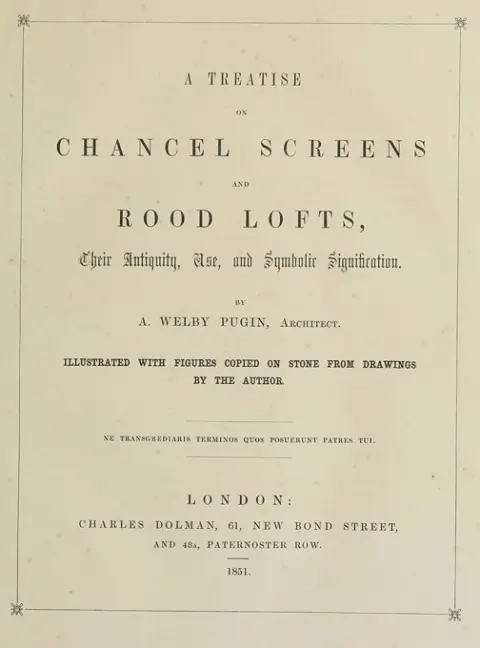
THE CLASSIC COLLECTION · 1851
"A Treatise on Chancel Screens and Rood Lofts" by Augustus Welby Northmore Pugin is a scholarly work focused on ecclesiastical architecture, probably written in the mid-19th century. The book examines the historical significance, design, and function of chancel screens and rood lofts in churches, emphasizing their importance in maintaining tradition and reverence in worship settings. The opening of the treatise establishes the importance of the subject, arguing against modern innovations that detract from the sacredness of church spaces. Pugin discusses the significance of screens in Ecclesiastical architecture, tracing their historical presence back to early Christian practices and emphasizing their role in separating the sanctified areas of worship from the congregation. He critiques contemporary practices that obscure the traditional roles of these architectural features, which he believes are vital for preserving the solemnity of the Mass and the reverence due to the altar and choir, recalling the historical practices of earlier centuries to bolster his arguments.
Introduction adapted from the source catalogue; source summaries may be automatically generated.
Free to read · English · 41,404 words · No account needed
MAKE TIME FOR A GOOD BOOK
On by default. Untick to stop anonymous reading totals. Each page counts after 10 seconds in view. How this works.
Anonymous counting is on unless you have switched it off.
Louis de Chantal was born in France, of noble parents, about the middle of the eighteenth century; being a younger brother, he was destined from his earliest years to the ecclesiastical state, but on arriving at a maturer age, his tastes and inclinations were so adverse to the sacred functions, that he proceeded no further than receiving the tonsure, which enabled him to hold the rich ecclesiastical preferment in the gift of his family, and entitled him to the appellation of Monsieur l'Abbé de Chantal. He soon became commendatory abbot of two once great religious establishments, then languishing under a sad decay of zeal and discipline consequent on the loss of a regular head. The great object of commendatory abbots was to keep the number of religious to the lowest possible amount, in order to profit the more by the revenues, which they diverted to their own private benefit and luxury. At Conques the decay of the temporal kept pace with that of the spiritual; the buildings which, for the most part, had been erected during the glorious period of S. Louis, were falling fast to ruin. The regular portions, now much too large for the habitations of the few religious that remained, exhibited the desolate appearance of neglect and emptiness. Verdure luxuriated in the untrodden courts, and sprung up even in the very cloister, whose vaults had long ceased to echo the regulated tread and solemn chaunt of the ancient Benedictines. It was evident that essential repairs could not long be postponed, and a bull issued by the Pope a few years previous, requiring the conventual buildings of France to be substantially repaired out of the revenues, was still in force. The matter was, however, deferred for a short time, as our young abbé was about to proceed on his travels to the more classic ground of Italy, at that period ignorantly regarded as the great repository and source of all art and taste. The noble mediæval cathedrals of France were considered by Monsieur de Chantal as so many specimens of ancient barbarism, but the extravagancies of Bernini and the distortions of Le Pautre were splendid achievements in his eyes. It may be readily conceived what class of objects arrested his attention in his travels: his enthusiasm on arriving at the Eternal City was boundless—he almost believed that the heathen mythology was revived, and that he was in the presence of those divinities whose exploits had been the study of his early youth. The splendid galleries of voluptuous art, where the metamorphoses and amatory combats of Ovid were depicted to the life. The marble goddesses in shady groves, and sporting tritons cooling the air in high and sparkling jets—the obelisks, the sarcophagi, the endless treasures of classic art. Then even the churches, they were scarcely to be distinguished from the exquisite taste of the heathens themselves. Thinly draperied saints were borne into paradise by hovering Cupids. Voluptuous female statues reclined on the sarcophagi of bishops and ecclesiastics,—herculean martyrs writhed like dying gladiators, while naked angels held aloft the victor's crown. Our abbé was ravished with astonishment and delight as the eager cicerone drew him from one far-famed object to another, each more wonderful than the last. In his perambulations he occasionally passed some venerable looking sanctuaries, but the usual exclamation of the guide, eh, una porcheria, was quite sufficient to repress any desire of examining them; and in a word, he returned from Italy like most of the ecclesiastics of that period, with a thorough contempt for the ancient traditions of church architecture, and a determination to Italianize, as far as possible, in any work with which he might be connected. The time had now arrived when the repairs of the abbey of Conques could be no longer delayed, and accompanied by an architect of the Souflot style, with a thickly curled wig reaching half-way down his shoulders, he one morning started from his hotel at Paris, and proceeded thither. Although only a few leagues distant, the bad roads so delayed their progress, that it was late in the afternoon when they attained the top of the descent that led down into the valley where the abbey was situated. A little to the eastward of the scattered houses which formed the village, and small but characteristic church, stood the then lofty and irregular abbatial buildings. High above the rest rose the long grey mass of the church, surmounted by a high leaden roof, whitened with age. A forest of pinnacles surrounded the apse, while buttress and arc buttant continued in regular succession to surround the vast fabric. At the western end were two towers, but the southern one alone had been carried up to its intended height, the other had received a temporary roof, when raised a few feet above the nave; the abbacy shortly after fell into commendam, and it rose no higher. A small but elegant leaded spire was placed at the intersection of the nave and transept, but it was evidently a substitute for some far grander design in the way of a centre lantern, as might be divined by the rising of angle masonry left incomplete.
Your reading position is saved on this browser. Take it to another device with a library code. Reading pages adapt to text, rather than matching a printed edition.
BEHIND THE BOOK
This eBook is for the use of anyone anywhere in the United States and most other parts of the world at no cost and with almost no restrictions whatsoever. You may copy it, give it away or re-use it under the terms of the Project Gutenberg License included with this eBook or online at www.gutenberg.org. If you are not located in the United States, you will have to check the laws of the country where you are located before using this eBook. Read the source licence.
The original source file, including credits and licence, is retained by this library. Request an original-format copy at no charge. Please include the book title and Project Gutenberg identifier #51875.
KEEP YOUR CURIOSITY GOING
Cécile Tormay

Moritz Busch
John L. Ransom
Frances Wright
Cécile Tormay

Mabel Potter Daggett