THE CLASSIC COLLECTION✦An outlaw’s diary: the CommuneCLASSIC FREE BOOKS
An outlaw’s diary: the Commune
Cécile Tormay
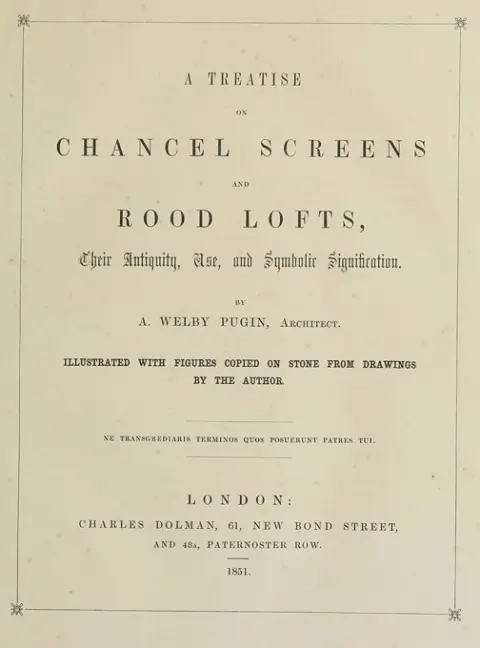
THE CLASSIC COLLECTION · 1851
"A Treatise on Chancel Screens and Rood Lofts" by Augustus Welby Northmore Pugin is a scholarly work focused on ecclesiastical architecture, probably written in the mid-19th century. The book examines the historical significance, design, and function of chancel screens and rood lofts in churches, emphasizing their importance in maintaining tradition and reverence in worship settings. The opening of the treatise establishes the importance of the subject, arguing against modern innovations that detract from the sacredness of church spaces. Pugin discusses the significance of screens in Ecclesiastical architecture, tracing their historical presence back to early Christian practices and emphasizing their role in separating the sanctified areas of worship from the congregation. He critiques contemporary practices that obscure the traditional roles of these architectural features, which he believes are vital for preserving the solemnity of the Mass and the reverence due to the altar and choir, recalling the historical practices of earlier centuries to bolster his arguments.
Introduction adapted from the source catalogue; source summaries may be automatically generated.
Free to read · English · 41,404 words · No account needed
MAKE TIME FOR A GOOD BOOK
On by default. Untick to stop anonymous reading totals. Each page counts after 10 seconds in view. How this works.
Anonymous counting is on unless you have switched it off.
When we now behold the city of London, with its narrow lanes, lined with lofty warehouses and gloomy stores, leading down to the banks of the muddy Thames, whose waters are blackened with foul discharges from gas-works and soap-boilers, while the air is darkened with the dense smoke of chimneys rising high above the parish steeples, which mark the site of some ancient church, destroyed in the great conflagration, it is difficult to realize the existence of those venerable and beautiful fabrics where the citizens of London assembled in daily worship, and whose rood lofts shone so gloriously on Easter and Christmas feasts. But this great and ancient city was inferior to none in noble religious buildings; and in the sixteenth century the traveller who approached London from the west, by the way called Oldbourne, and arriving at the brow of the steep hill, must have had a most splendid prospect before him; to the right the parish church of S. Andrew's, rising most picturesquely from the steep declivity, and surrounded by elms, with its massive tower, decorated nave, and still later chancel; on the left the extensive buildings of Ely-house, its great gateway, embattled walls, lofty chapel and refectory, and numerous other lodgings and offices, surrounded by pleasant gardens, as then unalienated from the ancient see after which it was called, it presented a most venerable and ecclesiastical appearance. Further in the same direction might be perceived the gilded spire of S. John's church of Jerusalem and the Norman towers of S. Bartholomew's priory. Immediately below was the Fleet river, with its bridge, and the masts of the various craft moored along the quays. At the summit of the opposite hill, the lofty tower of S. Sepulchre's, which though greatly deteriorated in beauty, still remains. In the same line, and over the embattled parapets of the Newgate, the noble church of the Grey Friars, inferior in extent only to the cathedral of S. Paul, whose gigantic spire, the highest in the world, rose majestically from the centre of a cruciform church nearly seven hundred feet in length, and whose grand line of high roofs and pinnacled buttresses stood high above the group of gable-houses, and even the towers of the neighbouring churches. If we terminate the panorama with the arched lantern of S. Mary-le-Bow, the old tower of S. Michael, Cornhill, and a great number of lesser steeples, we shall have a faint idea of the ecclesiastical beauty of Catholic London. But to return to our more immediate subject, each of these fine churches was provided with its screen and rood. Numerous are the entries in the old churchwardens' accounts yet remaining of pious offerings made by the citizens to beautify the devotional sculptures which decorated them, and to provide tapers and branches to deck them for the returning festivals. There were veils for Lent, when the glory of our Lord was partially obscured by his approaching Passion; and there were garlands for Easter, and paschal lights, and crowns, and diadems. The old parish church of S. Mary-at-Hill was inferior to none in the beautiful partition of its chancel; it was principally the work of a pious citizen, who, on the decay of the older work, renewed the same; or, as the old chronicle expresses it:—"For the love he bore to Jesu and his holy Modir did sett up at his own proper costes and charges, and most artificially dispensil, the image of Christ, Mary, and John, and many saynts and aungels, with the loft whereon they stood: and for the due maintainyng of a perpetual light to hang brenyng before the same, and for a priest to synge at his anniversary he also left two tenements in the paryshe of Barkynge; and when he died he was buried under a grey stone, over and against the holy doors of the chancel, and till the sad time of the civil wars, was his portraieture in brass, and that of his wife, and 3 sons and 5 daughters at their feet, and his shield of mark, and the arms of the honourable Company of the Fishmongers, and round the bordure, with an Evangelist at every corner, was this inscription: '✠ Good Christen people, of your charitie pray for the soulys of John Layton, citizen and fyshemonger of London, who deceeded on the feast of S. Stephen, in the yeare of our Lorde 1456, and of Margaret his wyffe, on whose sowlys and the sowlys of Christen men may Jesu have mercy. Pater, ave, Amen.'" And on the brestsumer of the rood loft were carved divers devices, such as S. Peter's keys for his Patron, and dolphins and sea-luces salterwise for the Company, and scrolls, with +Lays+ coming out of tuns for the founder, and above all was a most artificial bratishing, with large bowls of brass, with prickets for tapers on great feasts, and there was a staircase of freestone, closed by an oak door, set up on the south side of the aisle, for the convenience of ascending to the same; and on each of the lower panels of the holy doors and of the bays of the screen were pictures of saints and martyrs, on grounds of gold diaper, each with their legend. For nearly a century this goodly work had stood the pride and delight of the parishioners, who bestowed much cost on sustaining its lights and ornaments, as the church books yet testify. But a sad and fearful change was approaching—new and heretical doctrines were circulated and even heard at Paul's Cross; men became divided in heart and mind; the returning festivals exhibited no unity of joy and devotion; many gloomily stayed away; and it was currently reported that nocturnal meetings were privately held at some citizens' houses, where preachers from beyond sea taught novel opinions, and inveighed against altars and priests, and sacred images and ancient rites; and soon there was a quest to examine into the ornaments of the churches, and many a goodly pyx, and chalice, and chrismatory were seized by the sacrilegious spoilers for the state; and shortly after the ancient service was interrupted by scoffers and infidels, and they who adhered to the old faith of England's church were filled with sorrow and dismay, and they worshipped in fear and sadness, and every day brought new troubles and greater sacrilege.
Your reading position is saved on this browser. Take it to another device with a library code. Reading pages adapt to text, rather than matching a printed edition.
BEHIND THE BOOK
This eBook is for the use of anyone anywhere in the United States and most other parts of the world at no cost and with almost no restrictions whatsoever. You may copy it, give it away or re-use it under the terms of the Project Gutenberg License included with this eBook or online at www.gutenberg.org. If you are not located in the United States, you will have to check the laws of the country where you are located before using this eBook. Read the source licence.
The original source file, including credits and licence, is retained by this library. Request an original-format copy at no charge. Please include the book title and Project Gutenberg identifier #51875.
KEEP YOUR CURIOSITY GOING
Cécile Tormay

Moritz Busch
John L. Ransom
Frances Wright
Cécile Tormay

Mabel Potter Daggett