THE CLASSIC COLLECTION✦An outlaw’s diary: the CommuneCLASSIC FREE BOOKS
An outlaw’s diary: the Commune
Cécile Tormay
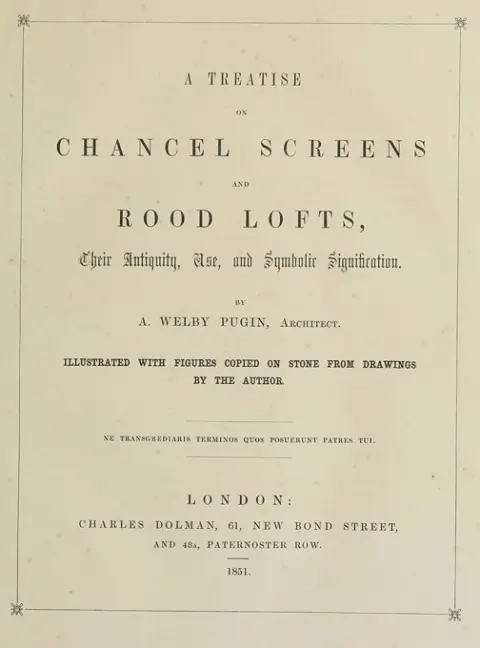
THE CLASSIC COLLECTION · 1851
"A Treatise on Chancel Screens and Rood Lofts" by Augustus Welby Northmore Pugin is a scholarly work focused on ecclesiastical architecture, probably written in the mid-19th century. The book examines the historical significance, design, and function of chancel screens and rood lofts in churches, emphasizing their importance in maintaining tradition and reverence in worship settings. The opening of the treatise establishes the importance of the subject, arguing against modern innovations that detract from the sacredness of church spaces. Pugin discusses the significance of screens in Ecclesiastical architecture, tracing their historical presence back to early Christian practices and emphasizing their role in separating the sanctified areas of worship from the congregation. He critiques contemporary practices that obscure the traditional roles of these architectural features, which he believes are vital for preserving the solemnity of the Mass and the reverence due to the altar and choir, recalling the historical practices of earlier centuries to bolster his arguments.
Introduction adapted from the source catalogue; source summaries may be automatically generated.
Free to read · English · 41,404 words · No account needed
MAKE TIME FOR A GOOD BOOK
On by default. Untick to stop anonymous reading totals. Each page counts after 10 seconds in view. How this works.
Anonymous counting is on unless you have switched it off.
Our parochial churches are yet rich in screens; of wooden rood-lofts we may particularize Sleaford, Newark, Bury St. Edmunds, Fairford, Tong, Lanryst, Sefton, Ranworth, and Southwold as some amongst the most remarkable. The countries most abounding in screens, are Norfolk, Suffolk, Lincolnshire, Cambridgeshire, and Devonshire, but each county presents many interesting examples, and it must be distinctly understood that every church, small or great, was originally provided with a screen.
In Norfolk, the churches of Cawston, Sall, N. Walsham, Worsted, Walcot, Trunch, Happisburgh, Bacton, Paston, Lynn, Ranworth, Cley, Castle Acre, Cressingham, Snetisham, and Ackle, &c., have all fine screens. Many of them are richly painted, and the lower panels filled with images of saints on gold and diapered grounds. The best preserved are those at Ranworth and Cawston. About five different painters were employed in the decoration of these, as the various styles may be distinctly traced over various parts of the country. Some of them exhibit far greater skill than others, but all have a deal of quaint character, and the images fill up the spaces in which they are placed, by the adjustment of drapery, &c.
There is a great deal of fine screen-work in Suffolk, at Woolpitt, Elmswell, Thurston, Lavenham, Long Melford, Brandon, Southwold, Blythburgh, Hawsted, and many other churches.
In Lincolnshire there are splendid screens at Winthorpe, Ingoldmills, Orby, Burgh, Croft, Boston, Hackington, Swineshead, Tattershall, Ewerby, Newark, Grantham.
In Devonshire the screens have been generally preserved, and on many of them the painted panels with saints and imagery are quite perfect. They are mostly constructed on one principle, with projecting wooden ribbed-work crossing the rood-loft; at Honiton, Feniton, Bradwinch, West Buckland, Columpton, Dartmouth, Kenton, Pinhoe, Plymtree, Tollaton, Tiverton, Atherington, Dawlish, &c., are screens surmounted by rood-lofts; but at Bridford, Burlescombe, Clayhanger, Dartington, Hempston, Plymstock, West Ogwell, &c., there are only screens without lofts, but of exceedingly elaborate design, and for the most part richly painted and gilt, some with saints in the lower panels, like those in Norfolk. A very numerous list, indeed, might be made of churches in this country, where screens of some kind are to be found; they are not always of the same material, for the examples of stone are numerous, as at Totness, Culmstock, Colyton, and Paignton, &c., this latter being monumental, and containing family tombs, introduced in the screen-work. Although the counties above mentioned are those which abound the most in fine examples of screen-work, yet most numerous and interesting specimens may be found in every county.
Sefton church, in Lancashire, has a splendid rood and side screens enclosing the chancel, of a later period, but most elaborate detail.
Your reading position is saved on this browser. Take it to another device with a library code. Reading pages adapt to text, rather than matching a printed edition.
BEHIND THE BOOK
This eBook is for the use of anyone anywhere in the United States and most other parts of the world at no cost and with almost no restrictions whatsoever. You may copy it, give it away or re-use it under the terms of the Project Gutenberg License included with this eBook or online at www.gutenberg.org. If you are not located in the United States, you will have to check the laws of the country where you are located before using this eBook. Read the source licence.
The original source file, including credits and licence, is retained by this library. Request an original-format copy at no charge. Please include the book title and Project Gutenberg identifier #51875.
KEEP YOUR CURIOSITY GOING
Cécile Tormay

Moritz Busch
John L. Ransom
Frances Wright
Cécile Tormay

Mabel Potter Daggett