THE CLASSIC COLLECTION✦An outlaw’s diary: the CommuneCLASSIC FREE BOOKS
An outlaw’s diary: the Commune
Cécile Tormay
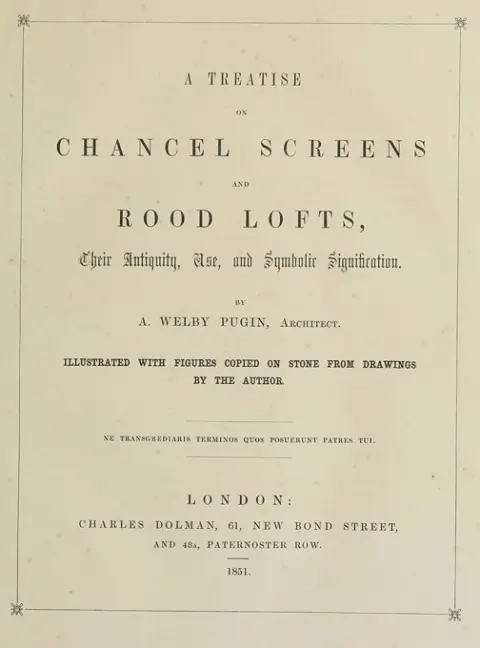
THE CLASSIC COLLECTION · 1851
"A Treatise on Chancel Screens and Rood Lofts" by Augustus Welby Northmore Pugin is a scholarly work focused on ecclesiastical architecture, probably written in the mid-19th century. The book examines the historical significance, design, and function of chancel screens and rood lofts in churches, emphasizing their importance in maintaining tradition and reverence in worship settings. The opening of the treatise establishes the importance of the subject, arguing against modern innovations that detract from the sacredness of church spaces. Pugin discusses the significance of screens in Ecclesiastical architecture, tracing their historical presence back to early Christian practices and emphasizing their role in separating the sanctified areas of worship from the congregation. He critiques contemporary practices that obscure the traditional roles of these architectural features, which he believes are vital for preserving the solemnity of the Mass and the reverence due to the altar and choir, recalling the historical practices of earlier centuries to bolster his arguments.
Introduction adapted from the source catalogue; source summaries may be automatically generated.
Free to read · English · 41,404 words · No account needed
MAKE TIME FOR A GOOD BOOK
On by default. Untick to stop anonymous reading totals. Each page counts after 10 seconds in view. How this works.
Anonymous counting is on unless you have switched it off.
But to return, I cannot too strongly impress on the minds of my readers that the very vitals of Catholic architecture are assailed by the opponents of screens.
Those who complain of not being able to see in a Pointed church should have assisted at an ancient service in a Roman basilica; the altar surrounded by pillars sustaining veils and curtains, and covered by a ciborium, was placed in front of the celebrant, of whom nothing could be discerned by the congregation except an occasional glimpse of his head; the space behind the altar was reserved for the bishop and his presbyters, while in front was the choir for those who sung, walled round to a considerable height, averaging five feet, and within, or occasionally outside, this space, were the ambones for the epistle and gospel, marble rostrums, ascended by steps, and usually of large dimensions; moreover, the basilicæ were constructed with aisles, like pointed churches, so that not one-tenth part of the congregation could have seen either the celebrant or the mensæ of the altar. And although it does not appear that the Latin church has purposely excluded the sight of the altar from the people, yet from the beginning the canonical arrangement of her sacred edifices has had the practical effect of cutting off its view from a very large portion of the assisting faithful.
Christians of the present time have but little idea of the solemnity of the ancient worship of the Catholic church; ordained ministers were alone permitted to fill the humblest offices about the sanctuary, every object connected with the sacred rites were considered deserving of the most loving care; even in the very early ages, the vessels of the altar were usually of precious metals, and studded with jewels. The books of the holy gospels were written in golden text on purple vellum, bound in plates of silver encasing ivory diptychs, and deposited in portable shrines, like relics. Though all this should fill us with admiration, there is nothing to excite surprise, when we reflect on the very sacred nature of the Christian mysteries—no sign typical and prophetic, as under the Mosaic law, but our blessed Lord truly present and abiding in the temple in the holy sacrament of the altar,—it is by no means wonderful that the Christian worship should assume a form of solemnity formerly unknown, and we are only astounded that with the perpetuation of the doctrine the practice of external solemnity should have so lamentably become decayed in the latter times; indeed, so sacred, so awful, so mysterious is the sacrifice of the mass, that if men were seriously to reflect on what it really consists, so far from advocating mere rooms for its celebration, they would hasten to restore the reverential arrangements of Catholic antiquity, and instead of striving for front seats and first places, they would hardly feel worthy to occupy the remotest corner of the temple. The form and arrangement of the ancient churches originated from the deepest feelings of reverence; the altar, or place of sacrifice, was accessible only to those who ministered, it was enclosed by pillars and veils; the sanctuary was veiled, the choir was enclosed, and the faithful adored at a respectful distance. All this, and the custom of every succeeding century, is in utter opposition to the modern all-seeing principle, and which, if it is carried out, ends in an absurd conclusion; for if it be essential for every worshipper to see, even a level room would not answer the purpose, and the floor must be raised like an amphitheatre to elevate the receding spectators, for unless the people be thus raised, they form a far greater barrier than any screen-work; and even at St. Peter's itself, when the Pope celebrates, there is a living screen of Swiss troops and noble guards that effectually shuts out the sight of what is going on, except to those taking part in the functions, or a favoured few, who by means of gold or interest are seated in raised loggia. If religious ceremonies are to be regarded as spectacles they should be celebrated in regular theatres, which have been expressly invented for the purpose of accommodating great assemblages of persons to hear and see well. It has been most justly said, that there is no legitimate halting-place between Catholic doctrine and positive infidelity, and I am quite certain that there is none between a church built on Christian tradition and symbolism and Covent Garden Theatre with its pit, boxes, and gallery.[3] It is only by putting the question in this forcible contrast that persons can really understand the danger of these new notions, or the lengths to which they may eventually lead; and I trust it may be the means of raising a feeling of the greatest repugnance to them in the hearts of every true Catholic.
Your reading position is saved on this browser. Take it to another device with a library code. Reading pages adapt to text, rather than matching a printed edition.
BEHIND THE BOOK
This eBook is for the use of anyone anywhere in the United States and most other parts of the world at no cost and with almost no restrictions whatsoever. You may copy it, give it away or re-use it under the terms of the Project Gutenberg License included with this eBook or online at www.gutenberg.org. If you are not located in the United States, you will have to check the laws of the country where you are located before using this eBook. Read the source licence.
The original source file, including credits and licence, is retained by this library. Request an original-format copy at no charge. Please include the book title and Project Gutenberg identifier #51875.
KEEP YOUR CURIOSITY GOING
Cécile Tormay

Moritz Busch
John L. Ransom
Frances Wright
Cécile Tormay

Mabel Potter Daggett