THE CLASSIC COLLECTION✦An outlaw’s diary: the CommuneCLASSIC FREE BOOKS
An outlaw’s diary: the Commune
Cécile Tormay
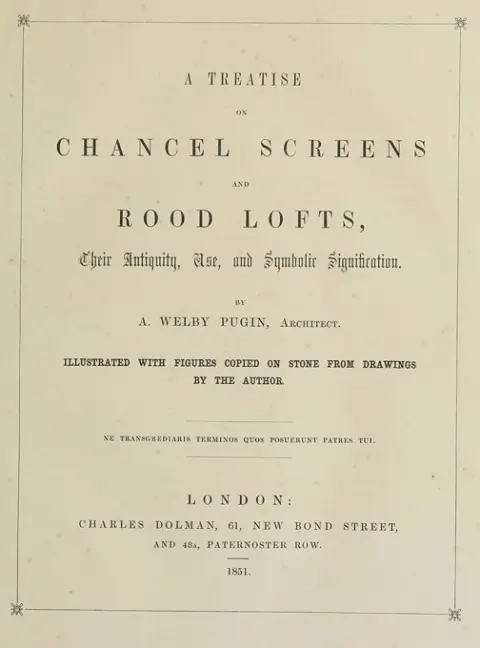
THE CLASSIC COLLECTION · 1851
"A Treatise on Chancel Screens and Rood Lofts" by Augustus Welby Northmore Pugin is a scholarly work focused on ecclesiastical architecture, probably written in the mid-19th century. The book examines the historical significance, design, and function of chancel screens and rood lofts in churches, emphasizing their importance in maintaining tradition and reverence in worship settings. The opening of the treatise establishes the importance of the subject, arguing against modern innovations that detract from the sacredness of church spaces. Pugin discusses the significance of screens in Ecclesiastical architecture, tracing their historical presence back to early Christian practices and emphasizing their role in separating the sanctified areas of worship from the congregation. He critiques contemporary practices that obscure the traditional roles of these architectural features, which he believes are vital for preserving the solemnity of the Mass and the reverence due to the altar and choir, recalling the historical practices of earlier centuries to bolster his arguments.
Introduction adapted from the source catalogue; source summaries may be automatically generated.
Free to read · English · 41,404 words · No account needed
MAKE TIME FOR A GOOD BOOK
On by default. Untick to stop anonymous reading totals. Each page counts after 10 seconds in view. How this works.
Anonymous counting is on unless you have switched it off.
The Dominican church had a fine rood and screen, of which there are still some remains, though greatly injured by the widening of the choir entrance.
A huge rood screen of black and white marble, erected in the seventeenth century, surmounted by a crucifix, and decorated with sculptures. Although erected at a very debased period, it still retains all the old traditional arrangements.
S. Salvator's.—A black and white marble screen and loft of the seventeenth century. It is divided into three arched compartments, but without altars; the side spaces are filled with open brass-work, and the choir gates, or holy doors, are of the same material.[12]
Notre Dame.—A screen of a very similar description, only of a plainer character. It is remarkable for having the altar erected in the centre of the loft, out of which grows the great rood, supporting the crucifix.
S. Giles's church has a very curious screen of the seventeenth century, exceedingly rich in carving, and supporting a rood loft. It is designed in perfect conformity to the ancient traditions, although the detail is necessarily of a debased period.
Must have had a very fine rood loft originally, but being a place of pilgrimage, it became most unfortunately very rich from offerings, which were employed (with the best possible intention) to destroy the ancient furniture of the church; the great rood itself, elaborately carved, hangs up on the south side of the great tower, and is a fine specimen of what the beauty of the loft must have been in the old time.
This great cathedral was completely sacked by the Calvinists, in the latter part of the sixteenth century, previous to which its fittings were in perfect unison with the edifice. But, unfortunately, when it was restored to Catholic worship, the spirit of Paganism had entered into the arts, and the new furniture exhibited all the marks of debasement. However, the old traditions still ruled the mind as regarded principles, and it will be seen, by reference to the plate, that the screens were conceived in the old spirit; and although the introduction of altars against the nave pillars was a great and distressing innovation, yet they were still protected by elevated screen-work, and not left open for profanation. There is a most striking correspondence between this screen-work and that round the altar of S. Michele, at Florence. The whole of these fittings have disappeared, partly during the occupation of the French, and partly by injudicious repairs. The choir is now being lined with stalls, some of the details of which are deserving of great commendation, but they have been designed in utter contradiction to ecclesiastical tradition. If this is to be made a cathedral church, the choir should be enclosed; but if it is to serve a parochial purpose, instead of the lofty canopies, and solid back, the choir should have been enclosed with open metal screens, like those at Lubeck, and an open rood loft across the choir; at present it is neither one thing nor the other. The whole entrance of the choir is open to the public, who crowd up to the high altar, and the stalls are filled with the first comers; the whole arrangement is disgraceful, unecclesiastical, and irregular, and loudly calls for reform. Frequented as this church is by such masses of people, the screen should certainly be an open one, and the back, above the stalls, should correspond. There are two enormous canopies, over nothing, that stand against the pillars; at first I imagined they indicated the seat of some dean or dignitary, but I soon found they projected only over a vacant space, by which the stalls were ascended, and were simply placed there as a vehicle for exhibiting a great assemblage of pinnacles and buttresses, and expending a sum of money unhappily, that would have half built the rood loft. The authority from which I have taken the representation of the old screen, &c., is a picture by Peter Neefs, preserved at Bicton, the seat of Lady Rolle.
Your reading position is saved on this browser. Take it to another device with a library code. Reading pages adapt to text, rather than matching a printed edition.
BEHIND THE BOOK
This eBook is for the use of anyone anywhere in the United States and most other parts of the world at no cost and with almost no restrictions whatsoever. You may copy it, give it away or re-use it under the terms of the Project Gutenberg License included with this eBook or online at www.gutenberg.org. If you are not located in the United States, you will have to check the laws of the country where you are located before using this eBook. Read the source licence.
The original source file, including credits and licence, is retained by this library. Request an original-format copy at no charge. Please include the book title and Project Gutenberg identifier #51875.
KEEP YOUR CURIOSITY GOING
Cécile Tormay

Moritz Busch
John L. Ransom
Frances Wright
Cécile Tormay

Mabel Potter Daggett