THE CLASSIC COLLECTION✦An outlaw’s diary: the CommuneCLASSIC FREE BOOKS
An outlaw’s diary: the Commune
Cécile Tormay
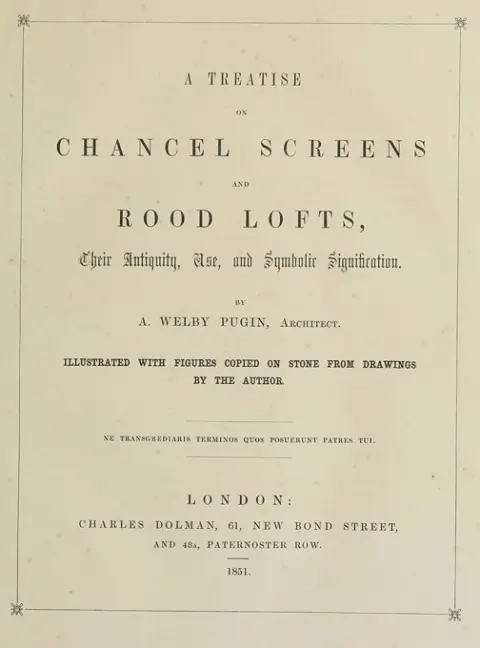
THE CLASSIC COLLECTION · 1851
"A Treatise on Chancel Screens and Rood Lofts" by Augustus Welby Northmore Pugin is a scholarly work focused on ecclesiastical architecture, probably written in the mid-19th century. The book examines the historical significance, design, and function of chancel screens and rood lofts in churches, emphasizing their importance in maintaining tradition and reverence in worship settings. The opening of the treatise establishes the importance of the subject, arguing against modern innovations that detract from the sacredness of church spaces. Pugin discusses the significance of screens in Ecclesiastical architecture, tracing their historical presence back to early Christian practices and emphasizing their role in separating the sanctified areas of worship from the congregation. He critiques contemporary practices that obscure the traditional roles of these architectural features, which he believes are vital for preserving the solemnity of the Mass and the reverence due to the altar and choir, recalling the historical practices of earlier centuries to bolster his arguments.
Introduction adapted from the source catalogue; source summaries may be automatically generated.
Free to read · English · 41,404 words · No account needed
MAKE TIME FOR A GOOD BOOK
On by default. Untick to stop anonymous reading totals. Each page counts after 10 seconds in view. How this works.
Anonymous counting is on unless you have switched it off.
{ Marble Screen in the Basilica of SS. Nerei and Achille. III. { Iron Screen from an ancient painting at Sienna, representing { the Life of Pius II., by Pinturicchio.
IV. { Marble Screen in the Church of the Frairi, Venice. { Detached Altar of S. Michele, Florence, with its Brass Screen.
V. { Rood Screen of the Marienkirche, Lubeck.
{ Rood Loft, Cathedral, Munster.
VI. { Screen in the Dom-Kirche, Lubeck.
{ Screen and Rood Loft, Hospital, Lubeck.
VII. { Rood Loft, S. Katherine's Church, Lubeck.
{ Screen and Rood Loft, Dom, Hildesheim.
VIII. { Screen at Glenhausen.
{ S. Elisabeth's Church, Marburg.
{ Screen at Oberwesel.
IX. { Plan of the Jubé, Cathedral, Metz.
{ Plan of the Jubé, Cathedral, Toul.
{ Screen of S. Nicholas's Church, Lorraine.
{ Rood Screen, Cathedral, Antwerp: seventeenth century. X. { One of the Altars erected against the Nave Pillars, with its { Brass Screen-work.
XI. { Iron Screen, Choir of S. Sernin, Toulouse.
{ Iron Screen at Toledo.
XII. { Screen in the Cathédrale de Sens.
{ Screen in S. Agnes, Picardy.
{ Screen in S. Fiacre le Faouet.
XIII. { Screen in S. Folgoet.
{ Screen in S. Germain, in Ribermont.
{ Plan of Jubé, Notre Dame de l'Epine.
{ Lambader, Brittany.
XIV. { Iron Screen at S. Riquier: eighteenth century.
{ Wooden Screen in the Church of Urnes, near Bergen.
A
TREATISE ON ROOD SCREENS,
&c.
The subject on which I am about to treat is one of far more importance than the generality of men may be willing to admit; it is not a mere question of architectural detail, respecting a few mullions and a transverse beam, but it involves great principles connected with discipline, and even faith, and it is a question in which all those who either wish for the revival of ancient solemnity and reverence, or even the preservation of what yet remains, are most deeply interested. The contest that has been raised by the restoration of screens in England is not altogether new; it occurred in France during the latter part of the last century, when a vile spirit of modern innovation appears to have arisen among a portion of the French clergy, chiefly in the capitular bodies, and more injury was then inflicted on the great churches of that country than was caused by the outrages of the Calvinists and Huguenots in the civil wars of the sixteenth century. The traditions of the church, as regards the disposition and arrangement of ecclesiastical buildings in the northern countries, do not appear to have been much affected by the revived paganism of the sixteenth century; the details were debased and incongruous, but the things remained unaltered in principle,—rood lofts were erected, choirs were stalled, cruciform churches, with aisles and lateral and lady chapels, and transepts, were the general type followed,[1] and screens for choirs, side chapels, and altars were universal. But gradually, from the adoption of the details of classic antiquity, the buildings themselves became objects of imitation, till revived paganism displayed its full absurdity in the substitution of a temple of Jupiter for a church of the crucified Redeemer in the huge room called the Madeleine. Designed by infidels, built by infidels, and suited only for infidel purposes, and then turned over, for want of another use, to become a church!
Your reading position is saved on this browser. Take it to another device with a library code. Reading pages adapt to text, rather than matching a printed edition.
BEHIND THE BOOK
This eBook is for the use of anyone anywhere in the United States and most other parts of the world at no cost and with almost no restrictions whatsoever. You may copy it, give it away or re-use it under the terms of the Project Gutenberg License included with this eBook or online at www.gutenberg.org. If you are not located in the United States, you will have to check the laws of the country where you are located before using this eBook. Read the source licence.
The original source file, including credits and licence, is retained by this library. Request an original-format copy at no charge. Please include the book title and Project Gutenberg identifier #51875.
KEEP YOUR CURIOSITY GOING
Cécile Tormay

Moritz Busch
John L. Ransom
Frances Wright
Cécile Tormay

Mabel Potter Daggett