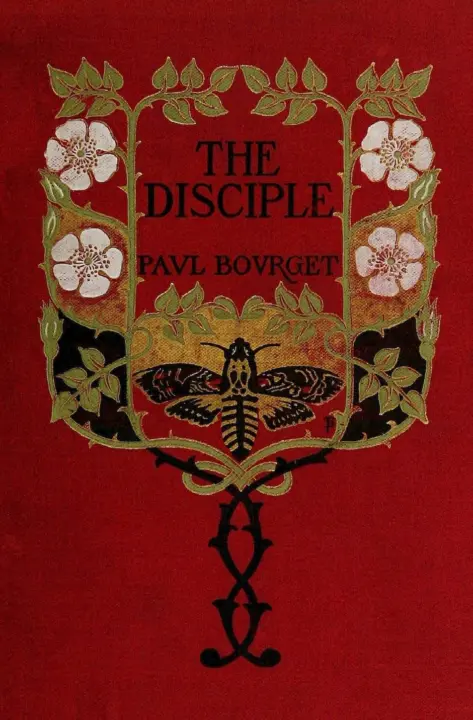
The disciple
Paul Bourget
THE CLASSIC COLLECTION · 1896
"A Tragic Idyl" by Paul Bourget is a novel written in the late 19th century. The book opens at the Casino of Monte Carlo during a bustling night, setting the stage for a rich tapestry of characters intertwined in a world of luxury, gambling, and social intrigue. Central to the story are a group of three individuals, including the Viscount de Corancez, who is orchestrating a secret marriage with the wealthy widow, Marquise Andryana Bonnacorsi, while a young man, Pierre Hautefeuille, is caught in a web of love and longing for another woman. The opening of "A Tragic Idyl" introduces readers to the chaotic and extravagant atmosphere of Monte Carlo's gaming houses, bustling with various characters from all walks of life, showcasing the contrasts of wealth and despair. The narrative cleverly weaves the plans for a clandestine marriage between Corancez and the Marquise amidst the bustling crowd, revealing the depth of their emotional stakes as well as Hautefeuille's hidden affection for the enchanting Baroness Ely de Carlsberg who remains oblivious to the turmoil her beauty inspires in him. As the story unfolds, the intricate dynamics and conflicts among these characters hint at the tragic idyls that will develop, juxtaposing their desires against the backdrop of societal expectations and personal ambitions.
Introduction adapted from the source catalogue; source summaries may be automatically generated.
Free to read · English · 110,968 words · No account needed
MAKE TIME FOR A GOOD BOOK
On by default. Untick to stop anonymous reading totals. Each page counts after 10 seconds in view. How this works.
Anonymous counting is on unless you have switched it off.
"How well I understand that!" he answered, with the quick and tender glance of a lover who is delighted to find his own ways of feeling in the woman he loves. "I am so much like you in that; the presence of a person whom I know to be despicable gives me a physical oppression of the heart. The other evening at your house, when I met that Navagero of whom Corancez had so often spoken, he poisoned my visit, although I had with me that dear, dear letter which you had written the night before." Then, dreamily following this train of thought, he continued: "It is strange that every one does not feel the same about this. To some people, and excellent ones too, a proof of human infamy is almost a joy. I have a friend like that--Olivier du Prat, of whom I spoke to you and whom you knew at Rome. I have never seen him so gay as when he had proved some villainy. How he has made me suffer by that trait of his! And he was one of the most delicate of men, with the tenderest of hearts and finest of minds. Can you explain that?"
The name of Olivier du Prat, pronounced by that voice which had been moving Ely to the heart--what an answer to the wish sighed by the amorous woman that this divine moment should not be spoiled! These simple words were enough to dissipate her enchantment, and to interrupt her happiness with a pain so acute that she almost cried aloud. Alas! she was but at the very beginning of her love's romance, and already that which had been predicted by Louise Brion, her faithful and too lucid friend, had come true--she was shut in the strange and agonizing inferno of silence which must avoid, as the most terrible of dangers, the solace of confession. How many times already in like moments had a similar allusion evoked between her and Pierre the image of that other lover! Pierre had very soon alluded lightly and gayly to his friend, and as the Baroness had thought it best not to conceal the fact that she had met him in Rome, he continued to recall memories of Du Prat, without suspecting that his words entered like a knife into the poor woman's heart. To see how much Hautefeuille loved Du Prat--with a friendship equal to that which the latter had for him--how could she help feeling anew the constant menace hanging over her? And then, as at the present, she was filled with an inexpressible anguish. It was as though all the blood in her veins had suddenly flowed out through some deep and invisible wound. At other times it was not even necessary that the redoubtable name should be mentioned in their conversation. It sufficed that the young man, in the course of the intimate talks which she encouraged as often as her social servitude permitted, should ingenuously express his opinion on some of the love-affairs reported by the gossips of the coast. She would then insist upon his talking in order to measure his uncompromising morality. She would have been pained if he had felt differently, for then he would not have been that noble and pure conscience unspotted by life; and she suffered because he did feel thus, and so unconsciously condemned her past. She made him open his mind to her, and always she found at the bottom this idea, natural to an innocent soul, that if love may be pardoned for everything, nothing should be pardoned to caprice, and that a woman of noble heart could not love a second time. When Hautefeuille would make some remark like this, which revealed his absolute and naïve faith in the singleness and uniqueness of true love, inevitably, implacably, Olivier would reappear before the inward eye of the poor woman. Wherever they were, in the silent patio strewn with camellia leaves, under the murmuring pines of the Villa Ellenrock, on the field at La Napoule, where the golf players moved amid the freshest and softest of landscapes, all the marvellous scenery of the South would vanish, disappear--the palms and orange trees, the ravines, the blue sky and the luminous sea, and the man she loved. She would see nothing before her but the cruel eyes and evil smile of her old lover at Rome. In a sudden half hallucination she would hear him speaking to Pierre. Then all her happy forces would suddenly be arrested. Her eyelids would quiver, her mouth gasp for air, her features contract with pain, her breast shudder as though pierced by a knife; and, as at present, her tender and unconscious tormentor would ask, "What is the matter?" with an eager solicitude that at the same time tortured and consoled her; and she would answer, as now, with one of those little falsehoods for which true love cannot forgive itself. For hearts of a certain depth of feeling, complete and total sincerity is a need that is almost physical, like hunger and thirst. What an inoffensive deception it was! And yet Ely had once more a feeling of remorse at giving this explanation of her sudden distress:--
Your reading position is saved on this browser. Take it to another device with a library code. Reading pages adapt to text, rather than matching a printed edition.
Paul Bourget
Paul Bourget
Paul Bourget
Paul Bourget
BEHIND THE BOOK
This eBook is for the use of anyone anywhere in the United States and most other parts of the world at no cost and with almost no restrictions whatsoever. You may copy it, give it away or re-use it under the terms of the Project Gutenberg License included with this eBook or online at www.gutenberg.org. If you are not located in the United States, you will have to check the laws of the country where you are located before using this eBook. Read the source licence.
The original source file, including credits and licence, is retained by this library. Request an original-format copy at no charge. Please include the book title and Project Gutenberg identifier #66517.
KEEP YOUR CURIOSITY GOING
Coulson Kernahan

Maurice Baring
Frances Wright
Cécile Tormay

Frederic Jesup Stimson

W. H. P. (William Henry Pope) Jarvis