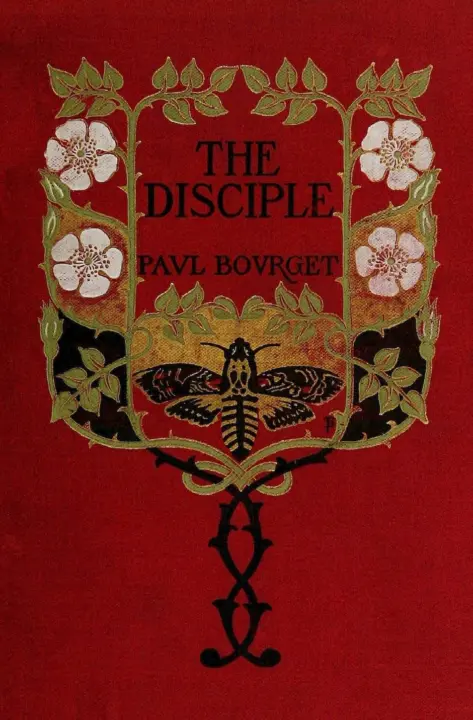
The disciple
Paul Bourget
THE CLASSIC COLLECTION · 1896
"A Tragic Idyl" by Paul Bourget is a novel written in the late 19th century. The book opens at the Casino of Monte Carlo during a bustling night, setting the stage for a rich tapestry of characters intertwined in a world of luxury, gambling, and social intrigue. Central to the story are a group of three individuals, including the Viscount de Corancez, who is orchestrating a secret marriage with the wealthy widow, Marquise Andryana Bonnacorsi, while a young man, Pierre Hautefeuille, is caught in a web of love and longing for another woman. The opening of "A Tragic Idyl" introduces readers to the chaotic and extravagant atmosphere of Monte Carlo's gaming houses, bustling with various characters from all walks of life, showcasing the contrasts of wealth and despair. The narrative cleverly weaves the plans for a clandestine marriage between Corancez and the Marquise amidst the bustling crowd, revealing the depth of their emotional stakes as well as Hautefeuille's hidden affection for the enchanting Baroness Ely de Carlsberg who remains oblivious to the turmoil her beauty inspires in him. As the story unfolds, the intricate dynamics and conflicts among these characters hint at the tragic idyls that will develop, juxtaposing their desires against the backdrop of societal expectations and personal ambitions.
Introduction adapted from the source catalogue; source summaries may be automatically generated.
Free to read · English · 110,968 words · No account needed
MAKE TIME FOR A GOOD BOOK
On by default. Untick to stop anonymous reading totals. Each page counts after 10 seconds in view. How this works.
Anonymous counting is on unless you have switched it off.
"You will have a magnificent passage to Genoa. You will find me you know where with Dom Fortunato Lagumina, for the old abbé is eager to act as chaplain in this matrimonio segreto. You will return to Cannes without any one in the world suspecting that Mme. la Marquise Bonnacorsi has become Mme. la Vicomtesse de Corancez, excepting the Vicomte, who will find some way of making our little combinazione acceptable to the good Alvise. Until then you will write to me at Genoa, poste restante, and I to you, in care of our dear Miss Florence."
"Whose name is also Miss Prudence," said the young girl, "and she thinks you are talking too long for conspirators. Beware of pickpockets," she added in English.
This was the signal agreed upon to warn them of the approach of some
acquaintance.
"Bah, that pickpocket is not dangerous," said Corancez, following the direction of Miss Marsh's fan, and recognizing the person who had attracted her attention. "It is Pierre Hautefeuille, my old friend. He doesn't even notice us. Marquise, do you wish to see a lover desperate at not finding his loved one? And to think that I should be like him," he added, in a lower tone, "if you were not here to intoxicate me with your beauty." Then, raising his voice, "Watch him sit down on that lounge in the corner, unconscious of the three pairs of eyes that are observing him. A ruined gambler might blow out his brains beside him and he would not turn his head. He would not even hear."
The young man had at this moment an air of absorption so profound, so complete, that he justified the laughing raillery of Corancez. If the plot of a secret marriage, mapped out in these surroundings and amid this crowd, appear strangely paradoxical, the reveries of this man whom Corancez had called his "old friend"--they had been at school together in Paris for two years--were still stranger and more paradoxical. The contrast was too strong between the crowd swarming around Pierre Hautefeuille and the hypnotism that appeared to be upon him. Evidently the two thousand people scattered through these rooms ceased to exist for him as soon as he had discovered the absence of a certain person. And who could this be if not a woman? The disappointed lover had fallen, rather than seated himself, upon the lounge in front of Corancez and his fellow-conspirators. With his elbow on the arm of the divan, he pressed his hand over his forehead, disconsolately. His slender fingers, pushing back his hair, disclosed the noble outline of his brow, revealed his profile, the slightly arched nose, the severe lips, whose proud expression would have been almost fierce were it not for the tender softness of his eyes. This look of strangely intense meditation in a face so exhausted and pale, with its small, dark mustache, gave him a resemblance to the classic portrait of Louis XIII. in his youth. His narrow shoulders, his slightly angular limbs, the evident delicacy of his whole body indicated one of those fragile organizations whose force lies wholly in the nerves, a physique with no vital power of resistance, ravaged eternally by emotions, down to the obscure and quivering centre of consciousness, and as easily exhausted by sentiment as muscular natures are by action and sensation. Although Pierre Hautefeuille was, in his dress and manner, indistinguishable from Corancez and the countless men of pleasure in the rooms, yet either his physiognomy was very deceptive or he did not belong to the same race morally as these cavaliers of the white waistcoat and the varnished pumps, who encircled the ladies dressed like demi-mondaines, and the demi-mondaines dressed like ladies, or crowded around the tables, amid the throng of gentlemen and swindlers. The melancholy in the curve of his lips and in his tired eyelids revealed a sadness, not momentary, but habitual, an abiding gloom, and if it were true that he had come to this place in search of a woman whom he loved, this sadness was too naturally explained. He must suffer from the life that this woman was leading, from her surroundings, her pleasures, her habits, her inconsistencies--suffer even to the extent of illness, and, perhaps, without knowing why, for he had not the eyes that judge of one they love. In any case, if he was, as Corancez said, a lover, he was certainly not a successful one. His face showed neither the pride nor the bitterness of a man to whom the loved woman has given herself, and who believes in her or suspects her. Even the simplicity with which he indulged his reveries in the midst of this crowd and on the lounge of a gaming-house was enough to prove a youthfulness of heart and imagination rare at his age. Corancez's companions were struck at the same time with this naïve contrast, and each made to herself a little exclamation in her native tongue:--
Your reading position is saved on this browser. Take it to another device with a library code. Reading pages adapt to text, rather than matching a printed edition.
Paul Bourget
Paul Bourget
Paul Bourget
Paul Bourget
BEHIND THE BOOK
This eBook is for the use of anyone anywhere in the United States and most other parts of the world at no cost and with almost no restrictions whatsoever. You may copy it, give it away or re-use it under the terms of the Project Gutenberg License included with this eBook or online at www.gutenberg.org. If you are not located in the United States, you will have to check the laws of the country where you are located before using this eBook. Read the source licence.
The original source file, including credits and licence, is retained by this library. Request an original-format copy at no charge. Please include the book title and Project Gutenberg identifier #66517.
KEEP YOUR CURIOSITY GOING
Coulson Kernahan

Maurice Baring
Frances Wright
Cécile Tormay

Frederic Jesup Stimson

W. H. P. (William Henry Pope) Jarvis