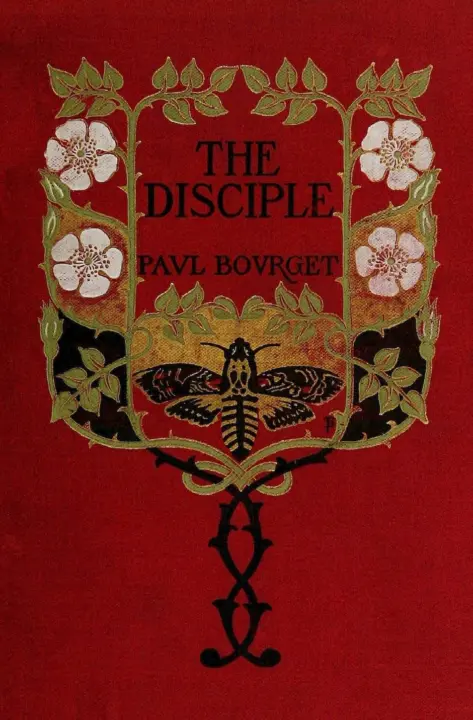
The disciple
Paul Bourget
THE CLASSIC COLLECTION · 1896
"A Tragic Idyl" by Paul Bourget is a novel written in the late 19th century. The book opens at the Casino of Monte Carlo during a bustling night, setting the stage for a rich tapestry of characters intertwined in a world of luxury, gambling, and social intrigue. Central to the story are a group of three individuals, including the Viscount de Corancez, who is orchestrating a secret marriage with the wealthy widow, Marquise Andryana Bonnacorsi, while a young man, Pierre Hautefeuille, is caught in a web of love and longing for another woman. The opening of "A Tragic Idyl" introduces readers to the chaotic and extravagant atmosphere of Monte Carlo's gaming houses, bustling with various characters from all walks of life, showcasing the contrasts of wealth and despair. The narrative cleverly weaves the plans for a clandestine marriage between Corancez and the Marquise amidst the bustling crowd, revealing the depth of their emotional stakes as well as Hautefeuille's hidden affection for the enchanting Baroness Ely de Carlsberg who remains oblivious to the turmoil her beauty inspires in him. As the story unfolds, the intricate dynamics and conflicts among these characters hint at the tragic idyls that will develop, juxtaposing their desires against the backdrop of societal expectations and personal ambitions.
Introduction adapted from the source catalogue; source summaries may be automatically generated.
Free to read · English · 110,968 words · No account needed
MAKE TIME FOR A GOOD BOOK
On by default. Untick to stop anonymous reading totals. Each page counts after 10 seconds in view. How this works.
Anonymous counting is on unless you have switched it off.
The group of three persons who had been compelled to choose a corner of this mundane caravansary for that romantic conspiracy was composed of a young man and two women. The young man appeared to be thirty-two years old. That was also the age of one of the women, who was, as they say in America, the chaperon of the other, a girl ten years younger. To complete the paradoxical character of this matrimonial conference in the long room that separates the roulette halls from those of the trente-et-quarante, it is only necessary to add that the young girl, an American, was in reality chaperoning the official chaperon, and that the project of this secret marriage did not concern her in the least. She was seated at the end of the divan, unmistakably a sentinel, while her friend and the young man talked together. Her beautiful brown eyes fearlessly scrutinized the passing crowd with the energy and confidence natural to a girl of the United States, accustomed from her childhood to realize her individuality, and who, if she dispenses with certain conventionalities, at least knows why, and is not ashamed of it. She was beautiful, with that beauty already so ripe which, accentuated by a toilet almost too fashionable, gives to so many American women the air of a creature on exhibition. Her features were delicate, even too small for the powerful moulding of her face and the strength of her chin. On her thick, chestnut-colored hair she wore a round hat of black velvet, with a rim too wide and with plumes too high, which rose in the back over a cachepeigne of artificial orchids. It was the hat of a young girl and a hat for the afternoon, but, in its excess, it was quite in keeping with her dress of glossy cloth and her corsage, or rather cuirass, trimmed with silver, which the most celebrated couturier in Paris had designed for her. Thus adorned, and with the superabundance of jewellery that accompanied this toilet, Miss Florence Marsh--that was her name--might have passed for anything in the world except what she really was--the most straightforward and honest of young girls, helping to prepare for the conjugal happiness of a woman equally honest and irreproachable. This woman was the Marquise Andryana Bonnacorsi, a Venetian by birth, belonging to the ancient and illustrious dogal family of the Navagero. Her dress, though it, too, came from Paris, bore the marks of that taste for tinsel peculiar to Italian finery, which gives it that fufu air, to employ an untranslatable term, with which our provincial bourgeoisie ridicules these unsubstantial ornaments. A flock of butterflies in black jet rested upon her black satin dress. The same butterflies appeared on the satin of her small shoes and among the pink roses of her hat, above her beautiful light hair of that red gold so dear to the painters of her country. The voluptuous splendor of her complexion, the nobility of her somewhat heavy features, the precocious development of her bust accorded well with her origin, and even more the soft blue of her eyes, in which there floated all the passion and languor of the lagoons. The light of her blue eyes enveloped the young man who was now speaking to her, and with whom she was visibly in love, madly in love. He, in the full maturity of his strength, justified that adoration more sensual than sentimental. He was a remarkable type of the manly beauty peculiar to our Provence, which attests that for centuries it was the land where the Roman race left its deepest imprint. His short, black hair, over the straight, white forehead; his pointed, slightly curling beard, the firm line if his nose, and the deep curve of his brows, gave him a profile like that of a medal, which would have been severe, if all the energy of a born lover had not burned in his soft eyes, and all the gayety of the South sparkled in his smile. His robust and supple physique could be divined even under his coat and white waistcoat, and these signs of animal health were so evident, his somewhat excessive gestures seemed to evince such exuberance, such perfect joy in living, that one failed to notice how impenetrable were those ardent eyes, how shrewd the smiling mouth, and how all the signs of cunning calculation were imprinted on that face, so reflective under its mobility.
Your reading position is saved on this browser. Take it to another device with a library code. Reading pages adapt to text, rather than matching a printed edition.
Paul Bourget
Paul Bourget
Paul Bourget
Paul Bourget
BEHIND THE BOOK
This eBook is for the use of anyone anywhere in the United States and most other parts of the world at no cost and with almost no restrictions whatsoever. You may copy it, give it away or re-use it under the terms of the Project Gutenberg License included with this eBook or online at www.gutenberg.org. If you are not located in the United States, you will have to check the laws of the country where you are located before using this eBook. Read the source licence.
The original source file, including credits and licence, is retained by this library. Request an original-format copy at no charge. Please include the book title and Project Gutenberg identifier #66517.
KEEP YOUR CURIOSITY GOING
Coulson Kernahan

Maurice Baring
Frances Wright
Cécile Tormay

Frederic Jesup Stimson

W. H. P. (William Henry Pope) Jarvis