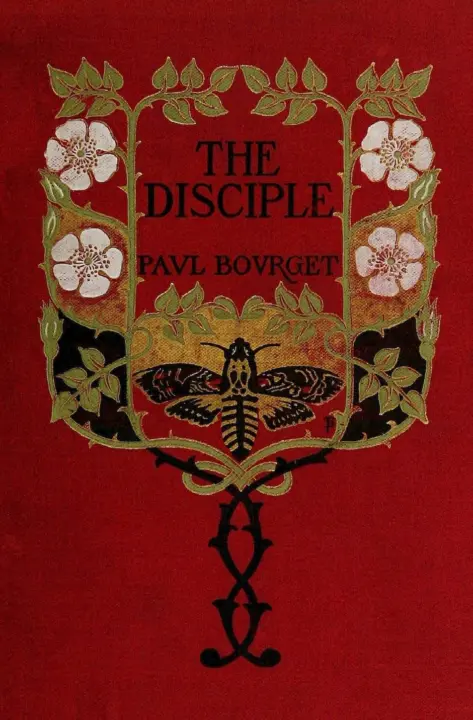
The disciple
Paul Bourget
THE CLASSIC COLLECTION · 1896
"A Tragic Idyl" by Paul Bourget is a novel written in the late 19th century. The book opens at the Casino of Monte Carlo during a bustling night, setting the stage for a rich tapestry of characters intertwined in a world of luxury, gambling, and social intrigue. Central to the story are a group of three individuals, including the Viscount de Corancez, who is orchestrating a secret marriage with the wealthy widow, Marquise Andryana Bonnacorsi, while a young man, Pierre Hautefeuille, is caught in a web of love and longing for another woman. The opening of "A Tragic Idyl" introduces readers to the chaotic and extravagant atmosphere of Monte Carlo's gaming houses, bustling with various characters from all walks of life, showcasing the contrasts of wealth and despair. The narrative cleverly weaves the plans for a clandestine marriage between Corancez and the Marquise amidst the bustling crowd, revealing the depth of their emotional stakes as well as Hautefeuille's hidden affection for the enchanting Baroness Ely de Carlsberg who remains oblivious to the turmoil her beauty inspires in him. As the story unfolds, the intricate dynamics and conflicts among these characters hint at the tragic idyls that will develop, juxtaposing their desires against the backdrop of societal expectations and personal ambitions.
Introduction adapted from the source catalogue; source summaries may be automatically generated.
Free to read · English · 110,968 words · No account needed
MAKE TIME FOR A GOOD BOOK
On by default. Untick to stop anonymous reading totals. Each page counts after 10 seconds in view. How this works.
Anonymous counting is on unless you have switched it off.
This friendship, like most lasting affections, began early, when the two women were but sixteen. They had ended their girlhood together in the intimacy of a convent, which is usually terminated at the entrance into society. But when these attachments endure, when they survive through absence, unaffected by difference of surroundings, or by new engagements, they become as instinctive and indestructible as family ties. When the two friends first met, the name of one was Ely de Sallach, the other, Louise Rodier of the old family of Catholic bankers, now extinct, the Rodier-Vimal. Certainly from their birthplaces, one the Château de Sallach in the heart of the Styrian Alps, the other the Hôtel Rodier in the Rue du Faubourg St. Honoré, it would seem that their paths of life must forever separate. A similar misfortune brought them together. They lost their mothers at the same time, and almost at once their fathers both married again. Each of the young girls, during the months that followed these second marriages, had had trouble with her step-mother; and each had finally been exiled to the Convent du Sacré-Cœur at Paris. The banker had chosen this establishment because he managed the funds and knew the superioress. General Sallach had been urged to this choice by his wife, who thus got rid of her step-daughter and gained a pretext for coming often to Paris. Entering the same day the old convent in the Rue de Varenne, the two orphans felt an attraction toward each other which their mutual confidences soon deepened into passionate friendship; and this friendship had lasted because it was based upon the profoundest depths of their characters and was strengthened by time.
The classic tragedy was not so far from nature as hostile critics pretend, when it placed beside its protagonists those personages whose single duty was to receive their confidences. There are in the reality of daily life souls that seem to be but echoes, ever ready to listen to the sighs and moans of others--soul-mirrors whose entire life is in the reflection they receive, whose personality is but the image projected upon them. On her entrance into the convent Louise Brion had become one of this race, whose adorable modesty Shakespeare has embodied in Horatio, the heroic and loyal second in Hamlet's duel with the assassin of his father. At sixteen as at thirty, it was only necessary to look at her to divine the instinctive self-effacement of a timidly sensitive character, incapable of asserting itself, or of living its own life. Her face was a delicate one, but its fineness passed unnoticed, so great was the reserve in her modest features, in her eyes of ashen gray, the simple folds of her brown hair. She spoke but little, and in a voice without accent; she had the genius for simplicity in dress, the style of dress that in the argot of women has the pretty epithet "tranquille." Whether man or woman, these beings, so weak and delicate, with their fine shades of sentiment, unfitted for active life, their desires instinctively attenuated, usually attach themselves, in a seeming contradiction which is at bottom logical, to some ardent and impetuous character, whose audacity fascinates them. They feel an irresistible desire to participate, through sympathy and imagination, in the joy and pain which they have not the force to encounter in their own experience. That was the secret of the relations between Madame Brion and the Baroness de Carlsberg. From the first week of their girlish intimacy, the passionate and fantastic Ely had bewitched the reasonable and quiet Louise, and this witchery had continued through the years, gaining from the fact that after their departure from the convent the two friends had once more experienced an analogous misfortune. They had both been in their marriage victims of paternal ambition. Louise Rodier had become Madame Brion, because old Rodier, having fallen into secret difficulties, thought that he could save himself by accepting Horace Brion as a son-in-law and partner. The latter, after his father had been ruined in the Bourse, had, in fifteen energetic years, not only made a fortune, but won a kind of financial fame by re-establishing affairs supposed to be hopeless, such as the Austro-Dalmatian Railway, so feloniously launched and abandoned by the notorious Justus Hafner (vide "Cosmopolis"). To efface the memory of his father Brion needed to ally himself with one of those families of finance whose professional honor is an equivalent of a noble title. The chief of the house of Rodier-Vimal needed an aide-de-camp of distinguished superiority in the secret crisis of his affairs. Louise, knowing the necessity of this union, had accepted it, and had been horribly unhappy.
Your reading position is saved on this browser. Take it to another device with a library code. Reading pages adapt to text, rather than matching a printed edition.
Paul Bourget
Paul Bourget

Paul Bourget

Paul Bourget
BEHIND THE BOOK
This eBook is for the use of anyone anywhere in the United States and most other parts of the world at no cost and with almost no restrictions whatsoever. You may copy it, give it away or re-use it under the terms of the Project Gutenberg License included with this eBook or online at www.gutenberg.org. If you are not located in the United States, you will have to check the laws of the country where you are located before using this eBook. Read the source licence.
The original source file, including credits and licence, is retained by this library. Request an original-format copy at no charge. Please include the book title and Project Gutenberg identifier #66517.
KEEP YOUR CURIOSITY GOING
Coulson Kernahan

Maurice Baring
Frances Wright
Cécile Tormay

Frederic Jesup Stimson

W. H. P. (William Henry Pope) Jarvis