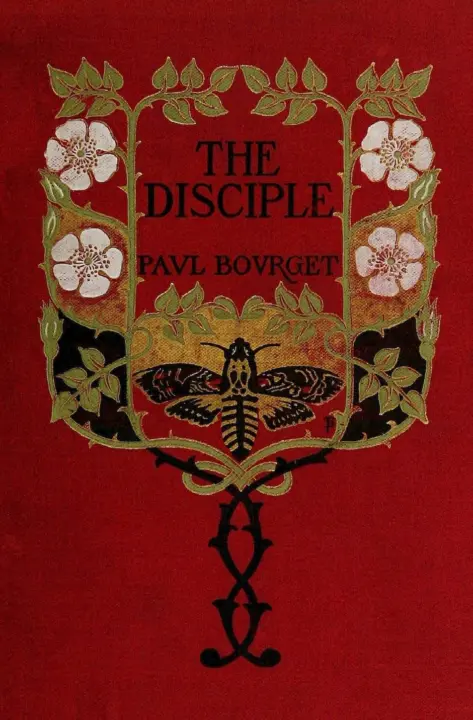
The disciple
Paul Bourget
THE CLASSIC COLLECTION · 1896
"A Tragic Idyl" by Paul Bourget is a novel written in the late 19th century. The book opens at the Casino of Monte Carlo during a bustling night, setting the stage for a rich tapestry of characters intertwined in a world of luxury, gambling, and social intrigue. Central to the story are a group of three individuals, including the Viscount de Corancez, who is orchestrating a secret marriage with the wealthy widow, Marquise Andryana Bonnacorsi, while a young man, Pierre Hautefeuille, is caught in a web of love and longing for another woman. The opening of "A Tragic Idyl" introduces readers to the chaotic and extravagant atmosphere of Monte Carlo's gaming houses, bustling with various characters from all walks of life, showcasing the contrasts of wealth and despair. The narrative cleverly weaves the plans for a clandestine marriage between Corancez and the Marquise amidst the bustling crowd, revealing the depth of their emotional stakes as well as Hautefeuille's hidden affection for the enchanting Baroness Ely de Carlsberg who remains oblivious to the turmoil her beauty inspires in him. As the story unfolds, the intricate dynamics and conflicts among these characters hint at the tragic idyls that will develop, juxtaposing their desires against the backdrop of societal expectations and personal ambitions.
Introduction adapted from the source catalogue; source summaries may be automatically generated.
Free to read · English · 110,968 words · No account needed
MAKE TIME FOR A GOOD BOOK
On by default. Untick to stop anonymous reading totals. Each page counts after 10 seconds in view. How this works.
Anonymous counting is on unless you have switched it off.
"As she does everything," Corancez answered, "capriciously and to beguile her ennui. And her marriage justifies her only too well. You know the prince? No? But you know his habits. Is it worth while to belong to the house of Hapsburg-Lorraine, to be called the Archduke Henry Francis, and to have a wife like that, if one is to profess the opinions of an anarchist, and spend sixteen hours out of the twenty-four in a laboratory, burning one's hands and beard and eyes over furnaces, and receive the friends of the Baroness in the way he does?"
"Then," said Hantefeuille, his arm trembling a little, as he asked his naïve question, "you think she is not happy?"
"You have only to look at her," replied Corancez, who, rising on his toes, had just recognized Madame de Carlsberg.
It was the one table that Pierre had not approached, on account of the crowd, which had been thicker around it than elsewhere. He signed to his companion that he was not tall enough to see over the mass of shoulders and heads; and Corancez, preceding his timid friend, began again to glide through the living wall of spectators, whose curiosity was evidently excited to the highest degree. The young men understood why, when, after several minutes of breathless struggling, they succeeded in gaining once more the place behind the croupier which they had had at the table of trente-et-quarante. There was taking place, in fact, one of those extraordinary events which become a legend on the coast and spread their fame through Europe and the two Americas; and Hautefeuille was shocked to discover that the heroine of this occasion was none else than the Baroness Ely, whose adorable name echoed in his heart with the sweetness of music. Yes, it was indeed Madame de Carlsberg who was the focus of all the eyes in this blasé multitude, and she employed in the caprices of her extravagant play the same gentle yet imposing grace that had inspired the young man with his passionate idolatry. Ah, she was so proud even at this moment, and so beautiful. Her delicate bust, the only part of her body he could see, was draped in a corsage of violet silk, covered with a black plaited mousseline de soie, with sleeves of the same stuff which seemed to tremble at every movement. A set of Danube pearls, enormous and set with brilliants, formed a clasp for this corsage, over which fell a thin watch-chain of gold studded with various stones. She wore a diminutive hat, composed of two similar wings, spangled with silver and with violet sequins. This stylish trinket, resting on her black hair, divided simply into two heavy folds, contrasted, like her dress and like her present occupation, with the character of her physiognomy. Her face was one of those, so rare in our aging civilization, imprinted with la grande beauté, the beauty that is unaffected by age, for it lies in the essential lines of the features, the shape of the head, the form of the brow, the curve of the chin, the droop of the eyelids. To those who knew of the Greek blood in her veins, the classic nobility of her face explained itself. Her father, General de Sallach, when aide-de-camp of the Commander-in-Chief at Zara, had married for love a Montenegrin girl at Bocca da Cattaro, who was the daughter of a woman of Salonica. This blood alone could have moulded a face at the same time so magnificent and so delicate, whose warm pallor added to its vague suggestion of the Orient. But her eyes lacked the happy and passionate lustre of the East. They were of an indefinable color, brown verging upon yellow, with something dim about them, as though perpetually obscured by an inner distress. One read in them an ennui so profound, a lassitude so incurable, that after perceiving this expression one began in spite of one's self to pity this woman apparently so fortunate, and to feel an impulse to obey her slightest whim if so her admirable face might lose that look, if but for a second. Yet doubtless it was one of those effects of the physiognomy which signify nothing of the soul, for her eyes retained the same singular expression at this moment while she abandoned herself to the wild fancies of the play. She must have gained an enormous sum since Corancez had left her, for a pile of thousand-franc notes--fifty perhaps--lay before her, and many columns of twenty-franc and hundred-franc pieces. Her gloved hands, armed with a little rake, manipulated this mass of money with dexterous grace. The cause of the feverish curiosity around her was that she risked at every turn the maximum stake: nine napoleons on a single number, that of her age, thirty-one, an equal number of napoleons on the squares, and six thousand francs on the black. The alternations of loss and gain were so great, and she met them with such evident impassibility, that she naturally had become the centre of interest. Oblivious to the comments that were whispered around her, she seemed scarcely to interest herself even in the ball that bounded over the numbered compartments.
Your reading position is saved on this browser. Take it to another device with a library code. Reading pages adapt to text, rather than matching a printed edition.
Paul Bourget
Paul Bourget
Paul Bourget
Paul Bourget
BEHIND THE BOOK
This eBook is for the use of anyone anywhere in the United States and most other parts of the world at no cost and with almost no restrictions whatsoever. You may copy it, give it away or re-use it under the terms of the Project Gutenberg License included with this eBook or online at www.gutenberg.org. If you are not located in the United States, you will have to check the laws of the country where you are located before using this eBook. Read the source licence.
The original source file, including credits and licence, is retained by this library. Request an original-format copy at no charge. Please include the book title and Project Gutenberg identifier #66517.
KEEP YOUR CURIOSITY GOING
Coulson Kernahan

Maurice Baring
Frances Wright
Cécile Tormay

Frederic Jesup Stimson

W. H. P. (William Henry Pope) Jarvis