THE CLASSIC COLLECTION✦An outlaw’s diary: the CommuneCLASSIC FREE BOOKS
An outlaw’s diary: the Commune
Cécile Tormay
THE CLASSIC COLLECTION · 1911
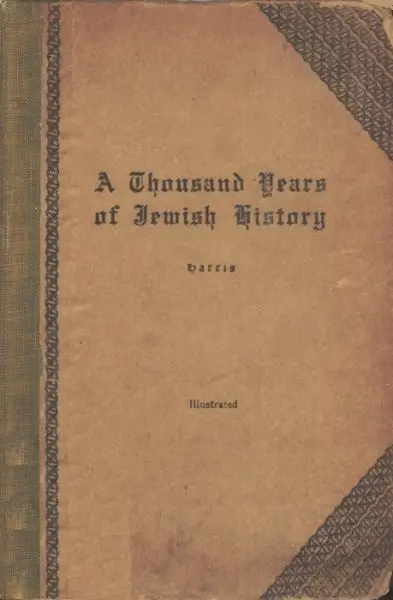
"A Thousand Years of Jewish History" by Maurice H. Harris is a historical account written in the early 20th century. The work spans over a millennium, focusing on Jewish history from the time of Alexander the Great to the Muslim Conquest of Spain. Harris explores the evolution of the Jewish people, highlighting significant events, figures, and the development of religious and cultural identity amidst challenges and changes in governance. The opening portion of the work introduces the reader to the historical context following the return of the Jews to Judea after the Babylonian exile. It discusses the challenges faced under Persian rule, particularly political silence and restrictions on their statehood, juxtaposed with a flourishing of religious life and legalism that defined post-exilic Judaism. The chapters reveal the significant role of figures such as Ezra and Nehemiah in rebuilding the Temple and establishing religious law, setting the stage for an exploration of subsequent interactions with Greek and Roman influences, as well as internal strife within the Jewish community itself. This foundational context promises a deep and engaging narrative of survival, adaptation, and faith throughout Jewish history.
Introduction adapted from the source catalogue; source summaries may be automatically generated.
Free to read · English · 73,254 words · No account needed
MAKE TIME FOR A GOOD BOOK
On by default. Untick to stop anonymous reading totals. Each page counts after 10 seconds in view. How this works.
Anonymous counting is on unless you have switched it off.
It was the spread of this great power that was to bring relief to the Jews of Spain, persecuted almost unto death. Verily the Moslem was unto them as a savior--for his arrival brought liberty, light and peace. After having subjected a large part of Asia, the sway of Islam spread unresistingly westward. All the north coast of Africa was soon under both its temporal and spiritual control. Christendom was alarmed at the rise of this new star and the checking of the advancing hosts from making inroad into Europe became now the first duty of every Christian monarch. Any warrior who could throw them back from his country's border at once sprang into fame.
In the meantime, however, none could withstand them. Nearer and nearer they approached the borders of Spain. There the outrageously treated Jews (pp. 291-2) awaited their arrival as any besieged city at the mercy of a relentless foe awaits the coming of its army of release. Already across the narrow Straits of Gibraltar on the African side, they were making common cause with the Moslem and were prepared for the invasion of the Peninsula.
The destined hour arrived. In the year 711 a great battle was fought in Xeres, in which the last Visigothic king fell before the army of Tarik. City after city--Cordova, Granada, Malaga, Toledo--fell before them, the Jews rendering valuable aid from within. The Mohammedans found they could not entrust their conquered towns into more faithful hands than these Jewish allies. Thus the Jews were raised at once from degration and thraldom to liberty and prestige. A new light had dawned and under the broad and cultured regime of the Moors, as these Western Mohammedans were called, a golden age was now to dawn for the Jews of Spain.
The Koran:
The Moslem Scripture is called the Koran, meaning readings; compare the derivation of Karaites. The Koran was not written by Mohammed, who could not write, but it contains his teachings.
Theme for discussion:
Amplify the probable consequences of the acceptance of Mohammed by
the Jews.
Index
Abbahu, R., Agadist, 221.
Ab Beth Din, office of, 88, 191.
Academies, Palestinian, 190;
Jamnia, 183;
Sepphoris, 190;
Tiberias, 190;
Lydda, 191;
Bekiim, 137, 192;
Oosha, 217;
Babylonian, 229;
in the Diaspora, 194.
Agada, narrative, 64;
contrasted with Halacha, 187, 256;
note, 277.
Agrippa, last Jewish King, 147;
kingdom vaster than Herod's, 150;
father to his people, 150, 151;
assassinated, 151;
coin of, 148.
Agrippa II., 152;
coin of, 152.
Akabiah b. Mehalalel, conscientiousness of, 191.
Akiba, R., Tanna, 206;
his wife's loyalty, 206, 207;
classifies Halachoth, 207, 208;
maxims, 208;
supports Bar Cochba, 211;
martyrdom, 215, 216.
Alabarch or Arabarch, 120;
Onias appointed, 71.
Albinus, procurator, 156.
Alexander the Great, 26, 27;
his empire divided, 28;
stories about, 28, 267.
Alexander Janneus, reign of, 85-87;
conflict with Pharisees, 86.
Alexandria, capital of Greco-Egypt, 28;
intellectual centre, 67, 68;
Delta, Jewish quarter of, 68;
school of, 136.
Am-haaretz, the ignorant, 195.
Your reading position is saved on this browser. Take it to another device with a library code. Reading pages adapt to text, rather than matching a printed edition.
BEHIND THE BOOK
This eBook is for the use of anyone anywhere in the United States and most other parts of the world at no cost and with almost no restrictions whatsoever. You may copy it, give it away or re-use it under the terms of the Project Gutenberg License included with this eBook or online at www.gutenberg.org. If you are not located in the United States, you will have to check the laws of the country where you are located before using this eBook. Read the source licence.
The original source file, including credits and licence, is retained by this library. Request an original-format copy at no charge. Please include the book title and Project Gutenberg identifier #44409.
KEEP YOUR CURIOSITY GOING
Cécile Tormay

Moritz Busch
John L. Ransom
Frances Wright
Cécile Tormay

Mabel Potter Daggett