THE CLASSIC COLLECTION✦My diaries, being a personal narrative of events 1888-1914, Part 2 (1900-1914)CLASSIC FREE BOOKS
My diaries, being a personal narrative of events 1888-1914, Part 2 (1900-1914)
Wilfrid Scawen Blunt
THE CLASSIC COLLECTION · 1877
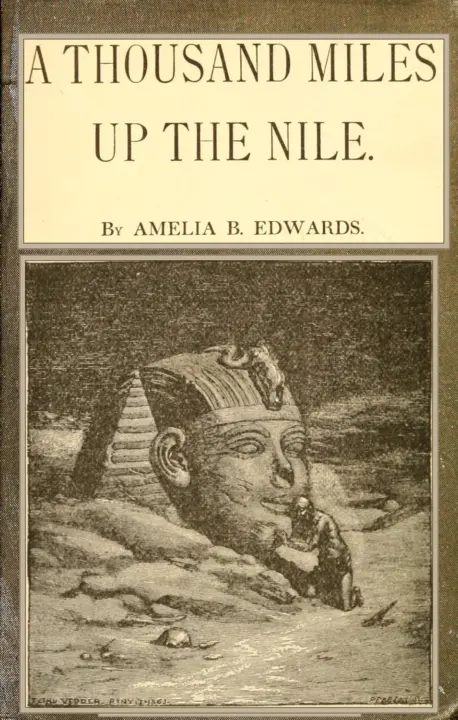
"A Thousand Miles Up the Nile" by Amelia B. Edwards is a travel narrative and exploration account written in the late 19th century. The book chronicles the author’s journey up the Nile River in Egypt, vividly depicting the landscapes, cultures, and historic sites encountered along the way. The narrative likely focuses on the experiences of the author and her companion as they delve into the wonders of ancient Egypt, blending personal anecdotes with observations about the local customs and historical significance of the sites they visit. The opening of the book sets the stage for a grand adventure, starting with the author's arrival in Cairo and the bustling atmosphere of Shepheard’s Hotel, where travelers from various backgrounds converge. The initial chapters describe the author's impressions of the rich culture, vibrant bazaars, and monumental landmarks like the Great Pyramid. Through detailed descriptions and personal reflections, Edwards captures the essence of Egyptian life, highlighting the contrast between modern travelers and the timelessness of the ancient world. The narrative promises a journey that combines historical insights with the excitement of exploration along the legendary Nile.
Introduction adapted from the source catalogue; source summaries may be automatically generated.
Free to read · English · 188,295 words · No account needed
MAKE TIME FOR A GOOD BOOK
On by default. Untick to stop anonymous reading totals. Each page counts after 10 seconds in view. How this works.
Anonymous counting is on unless you have switched it off.
We left Abou Simbel just as the moon was rising on the evening of the 18th of February, and dropped down with the current for three or four miles before mooring for the night. At six next morning the men began rowing; and at half-past eight the heads of the colossi were still looking placidly after us across a ridge of intervening hills. They were then more than five miles distant in a direct line; but every feature was still distinct in the early daylight. One went up again and again, as long as they remained in sight, and bade good-by to them at last with that same heartache which comes of a farewell view of the Alps.
When I say that we were seventeen days getting from Abou Simbel to Philæ, and that we had the wind against us from sunrise till sunset almost every day, it will be seen that our progress was of the slowest. To those who were tired of temples, and to the crew who were running short of bread, these long days of lying up under the bank, or of rocking to and fro in the middle of the river, were dreary enough.
Slowly but surely, however, the hard-won miles go by. Sometimes the barren desert hems us in to right and left, with never a blade of green between the rock and the river. Sometimes, as at Tosko,[153] we come upon an open tract, where there are palms and castor-berry plantations and corn-fields alive with quail. The idle man goes ashore at Tosko with his gun, while the little lady and the writer climb a solitary rock about two hundred feet above the river. The bank shelves here, and a crescent-like wave of inundation, about three miles in length, overflows it every season. From this height one sees exactly how far the wave goes, and how it must make a little bay when it is there. Now it is a bay of barley, full to the brim, and rippling to the breeze. Beyond the green comes the desert; the one defined against the other as sharply as water against land. The desert looks wonderfully old beside the young green of the corn, and the Nile flows wide among sand-banks, like a tidal river near the sea. The village, squared off in parallelograms like a cattle market, lies mapped out below. A field-glass shows that the houses are simply cloistered court-yards roofed with palm-thatch; the sheik’s house being larger than the rest, with the usual open space and spreading sycamore in front. There are women moving to and fro in the court-yards, and husbandmen in the castor-berry patches. A funeral with a train of wailers goes out presently toward the burial-ground on the edge of the desert. The idle man, a slight figure with a veil twisted round his hat, wades, half-hidden, through the barley, signaling his whereabouts every now and then by a puff of white smoke. A cargo-boat, stripped and shorn, comes floating down the river, making no visible progress. A native felucca, carrying one tattered brown sail, goes swiftly up with the wind at a pace that will bring her to Abou Simbel before nightfall. Already she is past the village; and those black specks yonder, which we had never dreamed were crocodiles, have slipped off into the water at her approach. And now she is far in the distance--that glowing, illimitable distance--traversed by long silvery reaches of river, and ending in a vast flat, so blue and aerial that, but for some three or four notches of purple peaks on the horizon, one could scarcely discern the point at which land and sky melt into each other. Ibrim comes next; then Derr; then Wady Sabooyah. At Ibrim, as at Derr, there are “fair” families, whose hideous light hair and blue eyes (grafted on brown-black skins) date back to Bosnian forefathers of three hundred and sixty years ago. These people give themselves airs, and are the haute noblesse of the place. The men are lazy and quarrelsome. The women trail longer robes, wear more beads and rings, and are altogether more unattractive and castor-oily than any we have seen elsewhere. They keep slaves, too. We saw these unfortunates trotting at the heels of their mistresses, like dogs. Knowing slavery to be officially illegal in the dominions of the khedive, the M. B.’s applied to a dealer, who offered them an Abyssinian girl for ten pounds. This useful article--warranted a bargain--was to sweep, wash, milk, and churn; but was not equal to cooking. The M. B.’s, it is needless to add, having verified the facts, retired from the transaction.
Your reading position is saved on this browser. Take it to another device with a library code. Reading pages adapt to text, rather than matching a printed edition.
BEHIND THE BOOK
This eBook is for the use of anyone anywhere in the United States and most other parts of the world at no cost and with almost no restrictions whatsoever. You may copy it, give it away or re-use it under the terms of the Project Gutenberg License included with this eBook or online at www.gutenberg.org. If you are not located in the United States, you will have to check the laws of the country where you are located before using this eBook. Read the source licence.
The original source file, including credits and licence, is retained by this library. Request an original-format copy at no charge. Please include the book title and Project Gutenberg identifier #70565.
KEEP YOUR CURIOSITY GOING
Wilfrid Scawen Blunt
Wilfrid Scawen Blunt

E. W. (Edgar Watson) Howe
Cécile Tormay

Moritz Busch
John L. Ransom