THE CLASSIC COLLECTION✦My diaries, being a personal narrative of events 1888-1914, Part 2 (1900-1914)CLASSIC FREE BOOKS
My diaries, being a personal narrative of events 1888-1914, Part 2 (1900-1914)
Wilfrid Scawen Blunt
THE CLASSIC COLLECTION · 1877
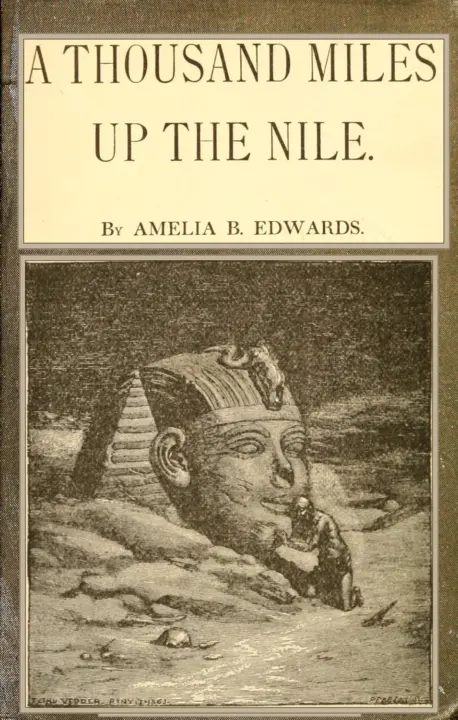
"A Thousand Miles Up the Nile" by Amelia B. Edwards is a travel narrative and exploration account written in the late 19th century. The book chronicles the author’s journey up the Nile River in Egypt, vividly depicting the landscapes, cultures, and historic sites encountered along the way. The narrative likely focuses on the experiences of the author and her companion as they delve into the wonders of ancient Egypt, blending personal anecdotes with observations about the local customs and historical significance of the sites they visit. The opening of the book sets the stage for a grand adventure, starting with the author's arrival in Cairo and the bustling atmosphere of Shepheard’s Hotel, where travelers from various backgrounds converge. The initial chapters describe the author's impressions of the rich culture, vibrant bazaars, and monumental landmarks like the Great Pyramid. Through detailed descriptions and personal reflections, Edwards captures the essence of Egyptian life, highlighting the contrast between modern travelers and the timelessness of the ancient world. The narrative promises a journey that combines historical insights with the excitement of exploration along the legendary Nile.
Introduction adapted from the source catalogue; source summaries may be automatically generated.
Free to read · English · 188,295 words · No account needed
MAKE TIME FOR A GOOD BOOK
On by default. Untick to stop anonymous reading totals. Each page counts after 10 seconds in view. How this works.
Anonymous counting is on unless you have switched it off.
To estimate the cost at which these things were done is now impossible. Every temple, every palace, represented a hecatomb of human lives. Slaves from Ethiopia, captives taken in war, Syrian immigrants settled in the delta, were alike pressed into the service of the state. We know how the Hebrews suffered, and to what extremity of despair they were reduced by the tasks imposed upon them. Yet even the Hebrews were less cruelly used than some who were kidnaped beyond the frontiers. Torn from their homes, without hope of return, driven in herds to the mines, the quarries, and the brick-fields, these hapless victims were so dealt with that not even the chances of desertion were open to them. The negroes from the south were systematically drafted to the north; the Asiatic captives were transported to Ethiopia. Those who labored underground were goaded on without rest or respite, till they fell down in the mines and died.
That Rameses II was the Pharaoh of the captivity,[83] and that Meneptah, his son and successor, was the Pharaoh of the exodus,[84] are now among the accepted presumptions of Egyptological science. The Bible and the monuments confirm each other upon these points, while both are again corroborated by the results of recent geographical and philological research. The “treasure-cities Pithom and Raamses” which the Israelites built for Pharaoh with bricks of their own making, are the Pa-Tum and Pa-Rameses, of the inscriptions, and both have recently been identified by M. Naville, in the course of his excavations conducted in 1883 and 1886 for the Egypt Exploration Fund.
The discovery of Pithom, the ancient biblical “treasure-city” of the first chapter of Exodus, has probably attracted more public attention and been more widely discussed by European savants than any archæological event since the discovery of Nineveh. It was in February, 1883, that M. Naville opened the well-known mound of Tel-el-Maskhutah, on the south bank of the new sweet-water canal in the Wady Tûmilât, and there discovered the foundations and other remains of a fortified city of the kind known in Egyptian as a bekhen, or store-fort. This bekhen, which was surrounded by a wall thirty feet in thickness, proved to be about twelve acres in extent. In one corner of the inclosure were found the ruins of a temple built by Rameses II. The rest of the area consisted of a labyrinth of subterraneous rectangular cellars, or store-chambers, constructed of sun-dried bricks of large size and divided by walls varying from eight to ten feet in thickness. In the ruins of the temple were discovered several statues more or less broken, a colossal hawk inscribed with the royal ovals of Rameses II, and other works of art dating from the reigns of Osorkon II, Nectanebo and Ptolemy Philadelphus. The hieroglyphic legends engraved upon the statues established the true value of the discovery by giving both the name of the city and the name of the district in which the city was situated; the first being Pa-Tum (Pithom), the “Abode of Tum,” and the second being Thuku-t (Succoth); so identifying “Pa-Tum, in the district of Thuku-t,” with Pithom, the treasure-city built by the forced labor of the Hebrews and Succoth, the region in which they made their first halt on going forth from the land of bondage. Even the bricks with which the great wall and the walls of the store-chambers are built bear eloquent testimony to the toil of the suffering colonists and confirm in its minutest details the record of their oppression; some being duly kneaded with straw; others, when the straw was no longer forthcoming, being mixed with the leafage of a reed common to the marsh lands of the delta; and the remainder, when even this substitute ran short, being literally “bricks without straw,” molded of mere clay crudely dried in the sun. The researches of M. Naville further showed that the temple to Tum, founded by Rameses II, was restored, or rebuilt, by Osorkon II, of the twenty-second dynasty; while at a still higher level were discovered the remains of a Roman fortress. That Pithom was still an important place in the time of the Ptolemies is proved by a large and historically important tablet found by M. Naville in one of the store-chambers, where it had been thrown in with other sculptures and rubbish of various kinds. This tablet records repairs done to the canal, an expedition to Ethiopia and the foundation of the city of Arsinoë. Not less important from a geographical point of view was the finding of a Roman milestone which identifies Pithom with Hero (Heroöpolis), where, according to the Septuagint, Joseph went forth to meet Jacob. This milestone gives nine Roman miles as the distance from Heroöpolis to Clysma. A very curious manuscript lately discovered by Sig. Gamurrini in the library of Arezzo, shows that even so late as the fourth century of the Christian era this ancient walled inclosure--the camp, or “Ero Castra,” of the Roman period, the “Pithom” of the Bible--was still known to pious pilgrims as “the Pithom built by the children of Israel;” that the adjoining town, external to the camp, at that time established within the old Pithom boundaries, was known as “Heroöpolis;” and that the town of Rameses was distant from Pithom about twenty Roman miles.[85]
Your reading position is saved on this browser. Take it to another device with a library code. Reading pages adapt to text, rather than matching a printed edition.
BEHIND THE BOOK
This eBook is for the use of anyone anywhere in the United States and most other parts of the world at no cost and with almost no restrictions whatsoever. You may copy it, give it away or re-use it under the terms of the Project Gutenberg License included with this eBook or online at www.gutenberg.org. If you are not located in the United States, you will have to check the laws of the country where you are located before using this eBook. Read the source licence.
The original source file, including credits and licence, is retained by this library. Request an original-format copy at no charge. Please include the book title and Project Gutenberg identifier #70565.
KEEP YOUR CURIOSITY GOING
Wilfrid Scawen Blunt
Wilfrid Scawen Blunt

E. W. (Edgar Watson) Howe
Cécile Tormay

Moritz Busch
John L. Ransom