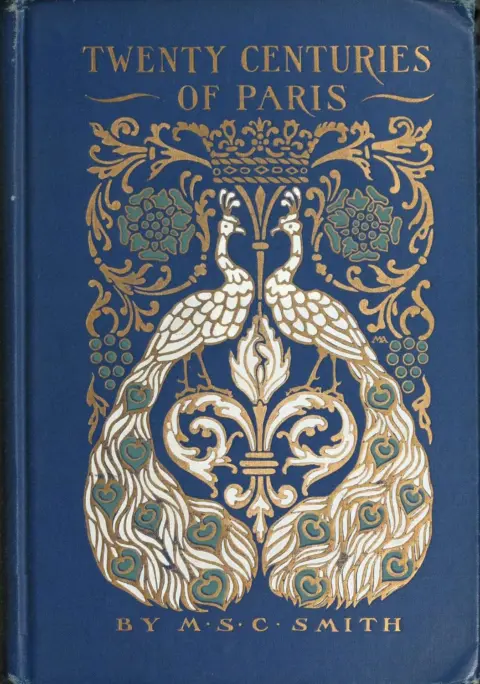
Twenty Centuries of Paris
Mabell S. C. (Mabell Shippie Clarke) Smith
THE CLASSIC COLLECTION · 1903
"A Tar-Heel Baron" by Mabell Shippie Clarke Pelton is a novel written in the early 20th century. The story centers around Baron Friedrich von Rittenheim, a foreign aristocrat who finds himself struggling with poverty as he tries to adapt to life on a small farm in North Carolina. As he navigates his new surroundings, he grapples with challenges stemming from cultural differences, economic hardships, and personal ambitions, providing readers a glimpse into the complexities of class and identity in the early southern U.S. At the start of the book, we are introduced to Friedrich von Rittenheim, who appears out of place among the mountaineers of North Carolina. Despite his noble background, he is poor and engages in agricultural work while attempting to earn the respect of his neighbors. The opening describes his humble efforts to fit in, highlights the warmth with which he is received, and foreshadows the struggles he faces, both financially and emotionally. His situation is exacerbated by the arrival of a deputy marshal who arrests him for selling homemade whisky, illustrating the conflicts between his old-world values and the harsh realities of his new life. This set-up not only establishes the baron as a sympathetic character but also hints at the social tensions that will develop throughout the novel.
Introduction adapted from the source catalogue; source summaries may be automatically generated.
Free to read · English · 61,496 words · No account needed
MAKE TIME FOR A GOOD BOOK
On by default. Untick to stop anonymous reading totals. Each page counts after 10 seconds in view. How this works.
Anonymous counting is on unless you have switched it off.
"But I was walking on the carriage-road to meet you."
"You were?" Friedrich's gloomy face was alive again. "Then why did you
r-run?"
"I don't know. For the same reason a kitten won't come when she's
called, I suppose."
"Even though she wants to?"
"Who knows what a kitten wants?"
"It would give me the gr-reatest of pleasure, Miss Car-roll, to shake
you!"
"I don't doubt it."
"It is such a hard blow to my vanity that you r-ran. See, I tr-ry to comfort myself in this question: Perhaps you did not know it was I whose horse you heard?"
"Of course I knew it was you."
"Oh, Sydney, dear Sydney, did your heart tell you that your lover was
on the r-road?"
The girl blushed hotly at this bold speech, but she declined to be
sentimental.
"Not at all," she said. "There was other evidence. Who else could sing like you, 'Oh, I wees' I was in Deexie'?"
Her mimicry of his pronunciation was so good, and at the same time so absurd, that they both laughed joyously.
They walked slowly towards the gate, behind which Gray Eagle was waiting with what patience he might.
"Tell me, my pr-rincess, why have you not allowed me to see you since that evening, though I have come every day?"
"That terrible evening! Oh, Friedrich----"
"Say that again!"
"What? Friedrich?"
"Yes. Now just one time more."
"How absurd you are, Friedrich!"
"I thank you. Now tell me."
"Why, for the first day or two there was so much to do in getting them away in their different directions--Hilda and John. Grandmother has had a letter from John, from Palm Beach. He has joined Baron von Sternburg there. And then--oh, Friedrich, perhaps it was foolish, but I could not feel as if we ought to be happy, you and I, so soon after that."
"What a dear, sensitive child you are! And you thought the time of mourning was up to-day, did you?"
"No, but--you won't make fun of me if I tell you?"
"I have al-ways supposed that it was you who teased me."
"But you might think it was funny ever so many years from now!"
"Ah, now there are going to be years in the future. Only a little while ago the future was made up of thousands and thousands and thousands of inter-rminable days."
"I know."
"You felt it so, too?"
"Yes. That's the reason why--you won't ever laugh at me, will you?--I wanted the years to begin to-day. I couldn't wait another twenty-four hours."
"My dar-rling!"
They stopped, and Friedrich drew her gently into his arms.
"Will you let me kiss you?"
Your reading position is saved on this browser. Take it to another device with a library code. Reading pages adapt to text, rather than matching a printed edition.
Mabell S. C. (Mabell Shippie Clarke) Smith
Mabell S. C. (Mabell Shippie Clarke) Smith
BEHIND THE BOOK
This eBook is for the use of anyone anywhere in the United States and most other parts of the world at no cost and with almost no restrictions whatsoever. You may copy it, give it away or re-use it under the terms of the Project Gutenberg License included with this eBook or online at www.gutenberg.org. If you are not located in the United States, you will have to check the laws of the country where you are located before using this eBook. Read the source licence.
The original source file, including credits and licence, is retained by this library. Request an original-format copy at no charge. Please include the book title and Project Gutenberg identifier #26112.
KEEP YOUR CURIOSITY GOING
Coulson Kernahan

Maurice Baring
Frances Wright
Cécile Tormay

Frederic Jesup Stimson

W. H. P. (William Henry Pope) Jarvis