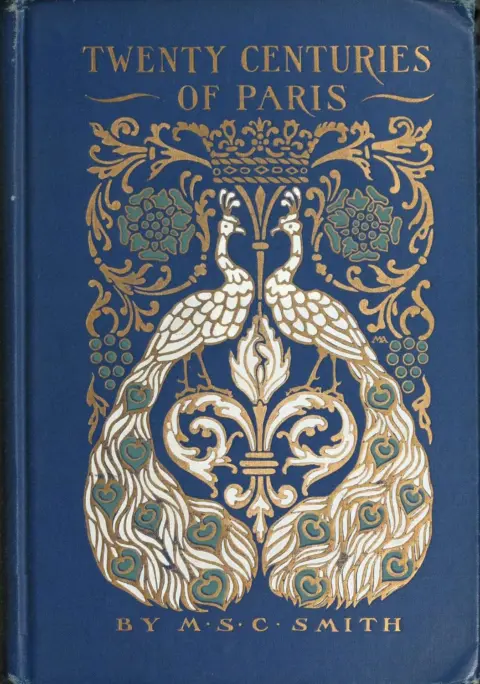
Twenty Centuries of Paris
Mabell S. C. (Mabell Shippie Clarke) Smith
THE CLASSIC COLLECTION · 1903
"A Tar-Heel Baron" by Mabell Shippie Clarke Pelton is a novel written in the early 20th century. The story centers around Baron Friedrich von Rittenheim, a foreign aristocrat who finds himself struggling with poverty as he tries to adapt to life on a small farm in North Carolina. As he navigates his new surroundings, he grapples with challenges stemming from cultural differences, economic hardships, and personal ambitions, providing readers a glimpse into the complexities of class and identity in the early southern U.S. At the start of the book, we are introduced to Friedrich von Rittenheim, who appears out of place among the mountaineers of North Carolina. Despite his noble background, he is poor and engages in agricultural work while attempting to earn the respect of his neighbors. The opening describes his humble efforts to fit in, highlights the warmth with which he is received, and foreshadows the struggles he faces, both financially and emotionally. His situation is exacerbated by the arrival of a deputy marshal who arrests him for selling homemade whisky, illustrating the conflicts between his old-world values and the harsh realities of his new life. This set-up not only establishes the baron as a sympathetic character but also hints at the social tensions that will develop throughout the novel.
Introduction adapted from the source catalogue; source summaries may be automatically generated.
Free to read · English · 61,496 words · No account needed
MAKE TIME FOR A GOOD BOOK
On by default. Untick to stop anonymous reading totals. Each page counts after 10 seconds in view. How this works.
Anonymous counting is on unless you have switched it off.
"You don' know what hit is to wan' hit so bad, Mr. Baron."
"Do I not know? Good God! Bud, it was because I wanted half that sum so much that I couldn't r-resist the temptation of it shining in a man's hand, that I did the thing for which never shall I for-rgive myself. You know, Bud; you r-recollect----"
He hid his face in his hands and gave a sob of tortured remembrance. Bud's easy sympathies were strained almost to the point of tears.
"Ah know," he responded, hastily; "you hadn' oughter 'a' done hit. Don', Mr. Baron, don'! Ah'll think about stoppin', Ah certainly will. Sit up, Mr. Baron," he cried, agitatedly, "here's folkses comin',--Mrs. Baron an' Miss Sydney."
Von Rittenheim raised his head, hardly believing Bud's cry to be other than an excuse to rouse him from his emotion. But he saw in the road below him a party of four people on horseback approaching his cabin. Even from his elevation he could recognize Sydney's erect carriage, and the white habit that it pleased Hilda to wear. He rose to his feet.
"Think of what I say, boy," he said to Yarebrough. "I am older than you, and God knows I've earned my experience."
Bud watched him down the hill. When he was greeting his guests at the door of his cabin, Yarebrough picked up the jug and the coin, and disappeared into the woods.
Wendell was taking the baroness off her horse, and Bob was performing the same office for Sydney, when Von Rittenheim reached them.
"We are come to beg a welcome fr-rom you for a few minutes, dear Friedrich," said Hilda, in English.
"Which surely is yours," returned Von Rittenheim, kissing her hand. He turned to Sydney, but she was busy doing something to her saddle, and greeted him over her shoulder. His hand dropped to his side.
"Let me help you tie the horses, Bob," he insisted, and took Sydney's
animal from him.
"Dear Yonny," he murmured, in the unresponsive ear, as he fastened him in the shade, and gave him a pat and a lump of sugar from his pocket.
"May we go in?" asked Hilda. "I want to see the state of your storeroom," she added, with an air of protecting care that sat prettily on her youthful face.
"Natuerlich," called Friedrich from Johnny's side. "The key of the cupboard is in the table-drawer."
Sydney was alone on the porch when Friedrich came up the steps.
"Your view is lovely," she said. "I think I like Pisgah better from this angle than from any other."
Your reading position is saved on this browser. Take it to another device with a library code. Reading pages adapt to text, rather than matching a printed edition.
Mabell S. C. (Mabell Shippie Clarke) Smith
Mabell S. C. (Mabell Shippie Clarke) Smith
BEHIND THE BOOK
This eBook is for the use of anyone anywhere in the United States and most other parts of the world at no cost and with almost no restrictions whatsoever. You may copy it, give it away or re-use it under the terms of the Project Gutenberg License included with this eBook or online at www.gutenberg.org. If you are not located in the United States, you will have to check the laws of the country where you are located before using this eBook. Read the source licence.
The original source file, including credits and licence, is retained by this library. Request an original-format copy at no charge. Please include the book title and Project Gutenberg identifier #26112.
KEEP YOUR CURIOSITY GOING
Coulson Kernahan

Maurice Baring
Frances Wright
Cécile Tormay

Frederic Jesup Stimson

W. H. P. (William Henry Pope) Jarvis