
The unhallowed harvest
Homer Greene
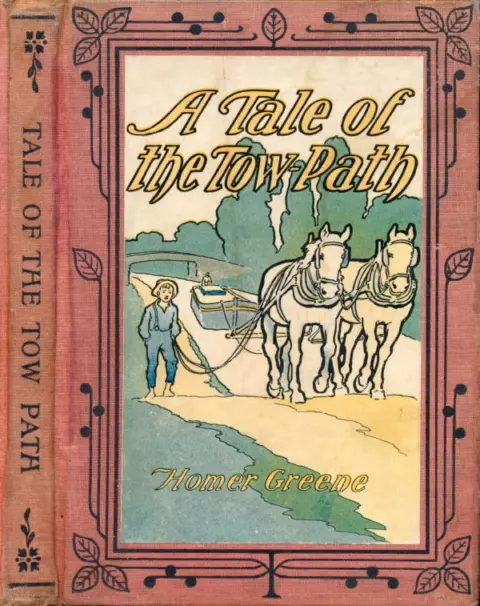
THE CLASSIC COLLECTION · 1892
"A Tale of the Tow-Path" by Homer Greene is a novel written in the late 19th century. The story centers around a fourteen-year-old boy named Joe Gaston, who is struggling with feelings of rebellion and frustration towards his strict father. After a severe punishment for disobeying his father's commands and sneaking off to go fishing, Joe makes a rash decision to run away from home, setting off an adventure filled with challenges and self-discovery. The opening portion of the book introduces Joe as he grumbles about the hard labor of hoeing corn and dreams of the summer activities he wishes he could partake in instead. After sneaking away for a fishing trip, he is caught by his father, leading to a punishment that leaves him feeling hurt and resentful. This encounter plants the seed for Joe's decision to flee from home, aiming to reclaim his freedom. The narrative quickly unfolds into a poignant portrayal of his internal conflict as he grapples with the consequences of his disobedience and the love for his family, hinting at the trials he will face on his journey.
Introduction adapted from the source catalogue; source summaries may be automatically generated.
Free to read · English · 18,169 words · No account needed
MAKE TIME FOR A GOOD BOOK
On by default. Untick to stop anonymous reading totals. Each page counts after 10 seconds in view. How this works.
Anonymous counting is on unless you have switched it off.
A heavy, well-built man, with a closely cropped beard and a kindly face, stepped from the deck to the tow-path. He was followed by a man who carried a heavy valise, and by one or two other men.
They were the canal superintendent and the paymaster and their
assistants.
“What’s the matter here, Matthew?” asked the superintendent,
approaching the group.
“This boy is charged with stealing this horse,” replied the operator. “Here’s the message.”
The superintendent took the telegram and read it.
“Is this Bill Rosencamp’s horse?” he asked, turning to Joe.
“No, sir!” repeated Joe. “He isn’t. He’s my father’s horse.”
“But he acknowledges having taken him from Rosencamp,” the operator
explained.
“Well,” said the superintendent, “Rosencamp is coming. When he gets here we shall find out whose horse it is.”
“But I don’t want to stay here till he comes,” said Joe.
“Probably not,” remarked the operator, sarcastically.
The superintendent, who seemed to perceive that this was not an ordinary case of horse-stealing, now looked more closely at Joe, and noticed the boy’s haggard, hungry look.
“He won’t hurt you,” he said. “Rosencamp’s a rough fellow, but he won’t hurt any one around here; and if it turns out that the horse is yours or your father’s, you will get possession of him, of course. Meantime we shall have to find out the exact truth of the matter. Have you had any breakfast?”
“No, sir,” replied Joe, “I haven’t had any, nor Old Charlie either.”
The superintendent smiled. “Matthew,” he said, “tell the stable-man to take this horse up to the barn and feed him and rub him down. And you,” turning to the boy, who was not a little bewildered by the invitation, “come with me.”
He led the way across the street into a large boarding-house. There, in a warm and pleasant dining-room, Joe ate the first good meal he had taken in several weeks.
Under its cheering influence his heart warmed, his tongue was loosened, and to Mrs. Jones, the kind landlady, who sat by and served him, he told the story of his folly, his suffering, and his desire.
When he had finished his breakfast, Mrs. Jones went with him to the office, and calling the superintendent aside, said,--
“This boy is no thief. He is honest and right in what he has done.”
“We shall soon find out about it,” was the reply. “Here comes
Rosencamp.”
Your reading position is saved on this browser. Take it to another device with a library code. Reading pages adapt to text, rather than matching a printed edition.
Homer Greene

Homer Greene

Homer Greene
Homer Greene
BEHIND THE BOOK
This eBook is for the use of anyone anywhere in the United States and most other parts of the world at no cost and with almost no restrictions whatsoever. You may copy it, give it away or re-use it under the terms of the Project Gutenberg License included with this eBook or online at www.gutenberg.org. If you are not located in the United States, you will have to check the laws of the country where you are located before using this eBook. Read the source licence.
The original source file, including credits and licence, is retained by this library. Request an original-format copy at no charge. Please include the book title and Project Gutenberg identifier #46172.
KEEP YOUR CURIOSITY GOING
Coulson Kernahan

Maurice Baring
Frances Wright
Cécile Tormay

Frederic Jesup Stimson

W. H. P. (William Henry Pope) Jarvis