
The unhallowed harvest
Homer Greene
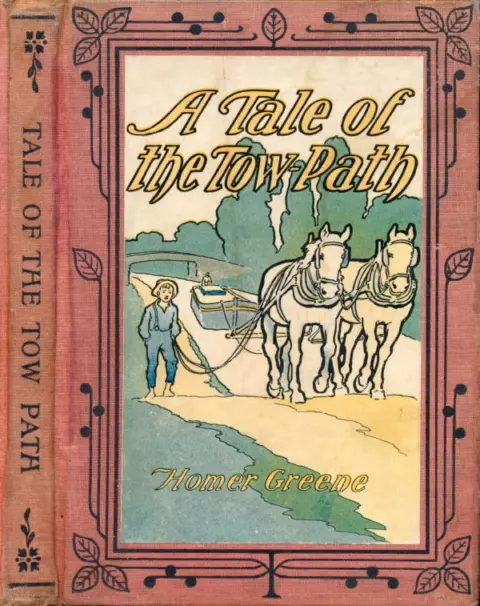
THE CLASSIC COLLECTION · 1892
"A Tale of the Tow-Path" by Homer Greene is a novel written in the late 19th century. The story centers around a fourteen-year-old boy named Joe Gaston, who is struggling with feelings of rebellion and frustration towards his strict father. After a severe punishment for disobeying his father's commands and sneaking off to go fishing, Joe makes a rash decision to run away from home, setting off an adventure filled with challenges and self-discovery. The opening portion of the book introduces Joe as he grumbles about the hard labor of hoeing corn and dreams of the summer activities he wishes he could partake in instead. After sneaking away for a fishing trip, he is caught by his father, leading to a punishment that leaves him feeling hurt and resentful. This encounter plants the seed for Joe's decision to flee from home, aiming to reclaim his freedom. The narrative quickly unfolds into a poignant portrayal of his internal conflict as he grapples with the consequences of his disobedience and the love for his family, hinting at the trials he will face on his journey.
Introduction adapted from the source catalogue; source summaries may be automatically generated.
Free to read · English · 18,169 words · No account needed
MAKE TIME FOR A GOOD BOOK
On by default. Untick to stop anonymous reading totals. Each page counts after 10 seconds in view. How this works.
Anonymous counting is on unless you have switched it off.
Now, however, the case was quite different. Joe tried to make these interruptions as short as possible, so that they should not interfere seriously with the passage of the boat; but the horse’s conduct soon attracted Captain Bill’s attention.
“Tryin’ to loaf, eh? Well, I’ll cure the lazy old beast o’ that,” he
said.
He took a whip from the cabin and tossed it out to Joe.
“Next time that hoss does that,” he said, “whip ’im! Don’t let him do
it again.”
“No, sir! I--I’ll try not to.”
Even as Joe spoke Old Charlie stopped, turned, and looked back at him
with melancholy eyes.
“Go on, Charlie!” entreated Joe; “that’s a good fellow, go on!”
But Charlie stood still, half-turned in his tracks, in mute remonstrance. It was new business to him, and he had not a favorable opinion regarding it. The leading horse, nothing loath, had also stopped.
“Whip ’im!” shouted Captain Bill from the boat, which, with its impetus, was bearing rapidly down on horse and boy. “Thrash ’im!”
Joe lifted the whip and let it fall lightly on the horse’s back.
“Get up, Charlie!” he cried; “get up now, quick!”
“Oh, whip ’im!” cried the captain. “Give ’im a good un!”
Again the whip descended lightly on Old Charlie’s back; but the horse did not move. This, too, was new treatment, which he did not seem in the least to understand.
By this time Captain Bill was very angry. He seized the tiller, and swept it back till the stern of the boat touched the bank. “Whip that hoss!” he cried, leaping to the tow-path, “or I’ll whip you!”
For an instant Joe stood irresolute; then, with sudden determination, he passed the handle of the whip to the angry man who faced him.
“I won’t,” he said slowly, with set teeth; “I won’t whip Old Charlie. I’ll die first!”
Infuriated beyond measure, Captain Bill seized the whip and raised it swiftly in the air. Just as it was about to descend on Joe’s head and shoulders, the frightened horse, swinging his body around nervously, caught the full force of the blow.
But it mattered little to Captain Bill. The beast was as much an object of his wrath as was the boy.
Again the whip cut the air and curled cruelly about the horse’s body. Again and again it fell, while Old Charlie, frightened and tortured, leaped and struggled for release.
Your reading position is saved on this browser. Take it to another device with a library code. Reading pages adapt to text, rather than matching a printed edition.
Homer Greene

Homer Greene

Homer Greene
Homer Greene
BEHIND THE BOOK
This eBook is for the use of anyone anywhere in the United States and most other parts of the world at no cost and with almost no restrictions whatsoever. You may copy it, give it away or re-use it under the terms of the Project Gutenberg License included with this eBook or online at www.gutenberg.org. If you are not located in the United States, you will have to check the laws of the country where you are located before using this eBook. Read the source licence.
The original source file, including credits and licence, is retained by this library. Request an original-format copy at no charge. Please include the book title and Project Gutenberg identifier #46172.
KEEP YOUR CURIOSITY GOING
Coulson Kernahan

Maurice Baring
Frances Wright
Cécile Tormay

Frederic Jesup Stimson

W. H. P. (William Henry Pope) Jarvis