School Reading By Grades: Fifth Year
James Baldwin
THE CLASSIC COLLECTION · 1887
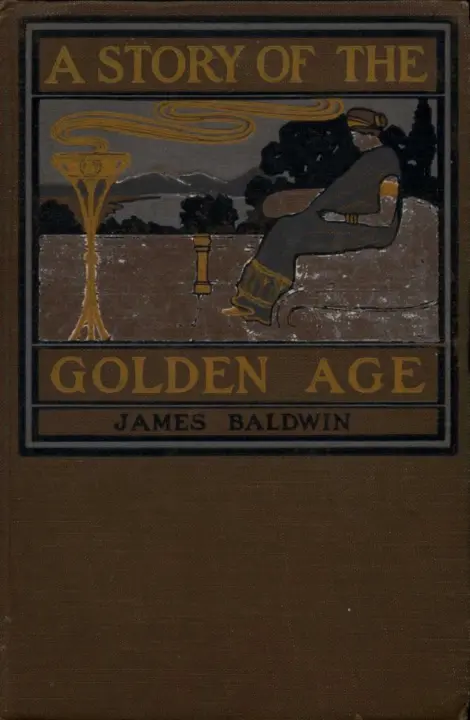
"A Story of the Golden Age" by James Baldwin is a children's historical fiction book written in the late 19th century. The narrative focuses on the legendary hero Odysseus during his youth, exploring the myths and legends that surround the events leading up to the Trojan War while weaving a continuous story that introduces young readers to classical Greek mythology. The opening of the story sets the scene on the idyllic island of Ithaca, where young Odysseus lives with his parents, Laertes and Anticleia. As he gazes out over the world from Mount Neritus on his twelfth birthday, he becomes captivated by the grandeur of the lands beyond his home, sparking a desire to explore. His yearning leads him to express his wish to visit his grandfather at Mount Parnassus, and this is met with encouragement from his mother and father, highlighting the anticipation of adventure that fuels the tale. The narrative skillfully blends themes of family, exploration, and mythical elements, promising a captivating journey into the rich tapestry of Greek mythology for young readers.
Introduction adapted from the source catalogue; source summaries may be automatically generated.
Free to read · English · 72,216 words · No account needed
MAKE TIME FOR A GOOD BOOK
On by default. Untick to stop anonymous reading totals. Each page counts after 10 seconds in view. How this works.
Anonymous counting is on unless you have switched it off.
Soon after this, there came a herald to the king, saying, "Behold, your daughter Iphigenia has come as you directed, and with her mother and her little brother Orestes she rests by the spring close to the outer line of tents. And the warriors have gathered around them, and are praising her loveliness, and asking many questions; and some say, 'The king is sick to see his daughter whom he loves so deeply, and he has made up some excuse to bring her to the camp.' But I know why you have brought her here; for I have been told about the wedding, and the noble groom who is to lead her in marriage; and we will rejoice and be glad, because this is a happy day for the maiden."
Then the king was sorely distressed, and knew not what to do. "Sad, sad indeed," said he, "is the wedding to which the maiden cometh. For the name of the bridegroom is Death."
At the same time Menelaus came back, sorrowful and repentant. "You were right, my brother," said he. "What, indeed, has Iphigenia to do with Helen, and why should the maiden die for me? Send the Hellenes to their homes, and let not this great wrong be done."
"But how can I do that now?" asked Agamemnon. "The warriors, urged on by Odysseus and Calchas, will force me to do the deed. Or, if I flee to Mycenae, they will follow me, and slay me, and destroy my city. Oh, woe am I, that such a day should ever dawn upon my sight!"
Even while they spoke together, the queen's chariot drove up to the tent door, and the queen and Iphigenia and the little Orestes alighted quickly, and merrily greeted the king.
"It is well that you have sent for me, my father," said Iphigenia,
caressing him.
"It may be well, and yet it may not," said Agamemnon. "I am exceeding glad to see thee alive and happy."
"If you are glad, why then do you weep?"
"I am sad because thou wilt be so long time away from me."
"Are you going on a very long voyage, father?"
"A long voyage and a sad one, my child. And thou, also, hast a journey
to make."
"Must I make it alone, or will my mother go with me?"
"Thou must make it alone. Neither father nor mother nor any friend can
go with thee, my child."
"But when shall it be? I pray that you will hasten this matter with Troy, and return home ere then."
"It may be so. But I must offer a sacrifice to the gods, before we sail
from Aulis."
Your reading position is saved on this browser. Take it to another device with a library code. Reading pages adapt to text, rather than matching a printed edition.
James Baldwin

James Baldwin
James Baldwin
James Baldwin
BEHIND THE BOOK
This eBook is for the use of anyone anywhere in the United States and most other parts of the world at no cost and with almost no restrictions whatsoever. You may copy it, give it away or re-use it under the terms of the Project Gutenberg License included with this eBook or online at www.gutenberg.org. If you are not located in the United States, you will have to check the laws of the country where you are located before using this eBook. Read the source licence.
The original source file, including credits and licence, is retained by this library. Request an original-format copy at no charge. Please include the book title and Project Gutenberg identifier #54214.
KEEP YOUR CURIOSITY GOING
Wilfrid Scawen Blunt
Wilfrid Scawen Blunt

E. W. (Edgar Watson) Howe
Cécile Tormay

Moritz Busch
Coulson Kernahan