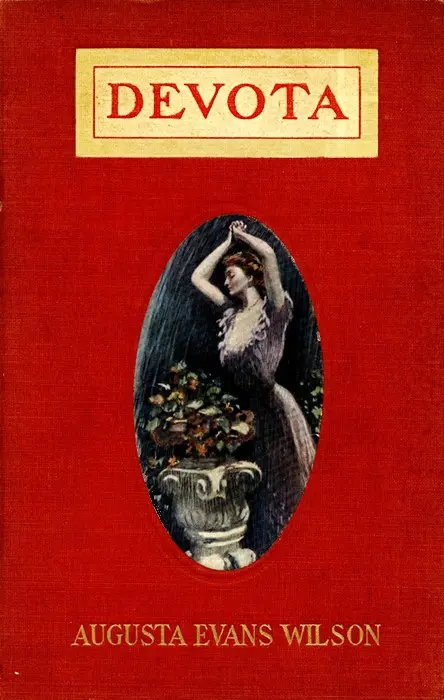
Devota
Augusta J. (Augusta Jane) Evans

THE CLASSIC COLLECTION · 1902
"A Speckled Bird" by Augusta J. Evans Wilson is a Southern novel written in the early 20th century. This work explores themes of family, social standing, and the complexities of human relationships in a post-Civil War South, focusing on the life of Eglah, a child navigating the challenging dynamics between her strict grandmother, Mrs. Maurice, and her absentee father, Judge Kent, amid the backdrop of historical conflict and personal drama. The opening of "A Speckled Bird" introduces us to Eglah, a spirited young girl grappling with her name and her connection to her family legacy. Through a dialogue with her grandmother, we learn about her familial ties, her mother Marcia's turbulent past, and the unresolved tensions stemming from her father's position as a Federal judge. As Eglah seeks understanding and acceptance, her grandmother battles her own grief and societal expectations, setting the stage for a narrative that promises to delve deeply into the struggles of identity, love, and the longing for familial bonds. Eglah's relationship with her grandmother is fraught with misunderstanding, yet imbued with a touch of tenderness that hints at the complexities of their family history and the societal pressures they face.
Introduction adapted from the source catalogue; source summaries may be automatically generated.
Free to read · English · 115,708 words · No account needed
MAKE TIME FOR A GOOD BOOK
On by default. Untick to stop anonymous reading totals. Each page counts after 10 seconds in view. How this works.
Anonymous counting is on unless you have switched it off.
Some overwhelming memory arrested the narrative, and Father Temple held the portrait sketch toward the light. Then he crossed his arms on the table and bowed his face upon them. The room was very still, and there seemed suddenly a startling insistence in the harsh sound of an organ that began to grind out "O promise me," on the pavement below. Mr. Herriott threw down a coin, closed the window, and resumed his seat.
"Noel, you must think me weak and unmanly. You are so strong yourself,
you can scarcely----"
"Strong? I think if I had to carry your burden I should go out and hang
myself."
"That last interview is a perpetual nightmare no noon sunshine ever dispels. Nona was frantic at the unexpectedly sudden separation, and she clung to me like a drowning child; but by degrees she accepted the inevitable, and her trust in me was supreme. She would be patient, and study books the chaplain would provide, and rely on him to forward her letters, and receive and find means to deliver mine. A full moon showed me her tearful face when we stood up to say good-bye. Oh, beautiful, tender, devoted, and pure as any lily God ever set to bloom in a wicked world! As I took her in my arms, she kissed me repeatedly, and I felt her lips tremble on mine as she sobbed:
"'No matter what happens, you must trust me as perfectly as I trust you. If we keep true to each other, all the world can't part us long.'
"That farewell vision abides with me--sleeping, it walks as a living presence through my dreams; waking, it thrusts itself between me and my God; and when I kneel before the marble image of the Mother of my Lord, her holy face is hidden by that of my fair, sweet young wife. It has become an obsession from which I cannot escape. After I went east, two letters reached me; then, in the late autumn when father had sailed, I was stricken with typhoid fever, that kept me prisoner for three months, and the inflammatory rheumatism that followed it so completely wrecked me, I was carried to the country home of an aunt in Massachusetts, in whose care father left me when he went to Europe. In my convalescence I wrote repeatedly under cover to the chaplain, signing only my middle name, Pembroke, but heard nothing until the next June. While still on crutches, I went for a day's visit to college to collect and pack my belongings, and there I found one dusty, mislaid letter from Nona, full of sad forebodings. The chaplain had wandered too far away to a mountain range, accompanied only by an orderly, who reported on his return that his companion had been scalped by Indians while he was examining some rock ledges, and that he had barely escaped by desperate riding. A cavalry troop, sent out to recover the body and avenge the death, was ambushed in a wooded defile and four troopers were killed, among the number Hill. The letter had been written in January--five months before. Both witnesses of our marriage in the grave! Anxiety and distress brought on renewal of rheumatic fever, and I was crippled in hands and feet for six terrible weeks. One day, as I was trying my ability to walk about the room, a delayed letter was forwarded from college--the last I ever received from Nona. Her father had died very suddenly from congestion of the lungs, and his wife returned immediately to her family in Arkansas; but because of my poor Nona's condition, which had subjected her to severe abuse and horrible accusations, the stepmother had cast her off, refused her recognition, and abandoned her. Because she refused to divulge the name of her husband, her declaration that she was a wife only increased the torrent of insults that swept her beyond the pale of respectability. She wrote that one friend--the only person who believed her assertion that she had been lawfully married--was just then leaving the Post for his old home, his time of service having expired, and he had kindly carried her in a covered wagon to a small village some days' travel east of the Post, where he found shelter for her until after the birth of her child. She begged I would send money to pay her board and also to enable her to travel east and live near me, because she was so terror-stricken among strangers. The same day my father summoned me to Europe, having decided I should attend lectures in Germany and at Oxford. By express, I forwarded the money to Nona, in accordance with her directions--"Care of Delia Brown, Thompsonville, ---- Territory"--and I wrote her, explaining all the circumstances, assuring her I would join her as soon as I could travel, and that henceforth we should never be separated. A few hours later I was laid up with a severe relapse, and when, finally, I started west in September, I was still so lame any movement was torture. At last the stage coach put me down at the cluster of log houses called Thompsonville, and by the aid of crutches I found my way to a low, dark cabin of two rooms, where Delia Brown made a scanty living by washing and ironing for men attached to a party of prospecting miners. She was a gaunt, sinister looking woman from Maine, with small, deep-set, faded yellow eyes that bored like a gimlet, and as she took a pipe from her ugly bluish lips and greeted me my heart sank. Where was Nona? Gone--with the man who brought her there, and who 'paid well for her keep.' When? Several weeks ago. Did she receive my letter, and had the money reached her? Yes, the money had been delivered to her--Delia Brown--and she had given it to the woman Nona, in the presence of one Josh' Smith. My letter had seemed to terrify the woman, and as soon as she knew I was coming she went away suddenly, saying she was going to New Orleans, and she and the man could take care of the baby. What was the man's name? He called himself Lay' Walker, but she doubted 'if he was not somebody else, and folks had their suspicions about the whole affair.' The baby boy was four months old when the man and woman took it away, but it was 'such a poor, puny, ailing child it had little chance to live.' What I suffered then only God will ever know, but faith in Nona sustained me while I went from cabin to cabin, receiving on all sides confirmation of Delia Brown's statements from women who had met her, and also from the mail and express agent--Josh' Smith--who assured me he had delivered the letter and package of money addressed to Nona Moorland, care of Delia Brown, to the latter, and exhibited her receipt. Lay' Walker was described as a very 'handsome Spanish-looking young fellow,' and he and the woman seemed fond of each other. He spent his money freely on her, and talked about Florida and banana growing, and said they wanted to get to New Orleans, where his friends had a schooner running in the West India fruit trade. After an exhaustive search, I made my way to New Orleans and engaged police assistance, but no clue could be found. Then I arranged advertisements to run six months, and went on to Pensacola and to Tampa. I advertised in two Florida newspapers, asking Nona Moorland to write to me, care of my father's lawyer in Boston. No response, no word, no hint ever reached me. When December arrived and I had no tidings, I deposited money in a Boston bank to the credit of Nona Moorland, and leaving instructions that all mail matter should be forwarded promptly to me, I sailed for Europe, shattered in body, almost hopeless, and the tortured prey of remorseful regret at the awful consequence of my midsummer madness."
Your reading position is saved on this browser. Take it to another device with a library code. Reading pages adapt to text, rather than matching a printed edition.
Augusta J. (Augusta Jane) Evans
BEHIND THE BOOK
This eBook is for the use of anyone anywhere in the United States and most other parts of the world at no cost and with almost no restrictions whatsoever. You may copy it, give it away or re-use it under the terms of the Project Gutenberg License included with this eBook or online at www.gutenberg.org. If you are not located in the United States, you will have to check the laws of the country where you are located before using this eBook. Read the source licence.
The original source file, including credits and licence, is retained by this library. Request an original-format copy at no charge. Please include the book title and Project Gutenberg identifier #36029.
KEEP YOUR CURIOSITY GOING
Coulson Kernahan

Maurice Baring
Frances Wright
Cécile Tormay

Frederic Jesup Stimson

W. H. P. (William Henry Pope) Jarvis