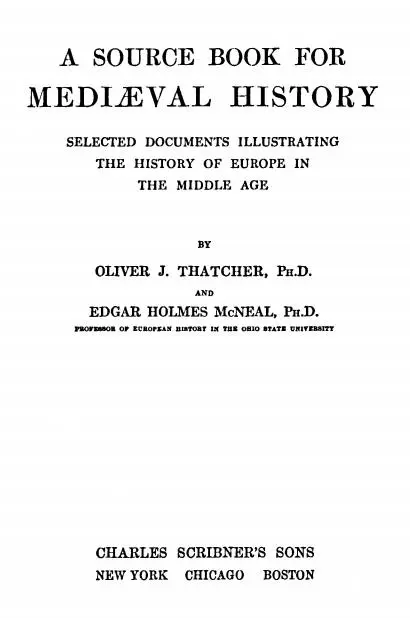
"A Source Book for Mediæval History" by Oliver J. Thatcher and Edgar Holmes McNeal is a historical account written in the early 20th century. This work serves as a collection of translated documents that illustrate the history of Europe during the Middle Ages, focusing on key events, figures, and movements that shaped the period. The authors present this material with the intent to provide educators and students with essential sources that are both accessible and informative, thus enriching the study of medieval history. The opening of the book outlines the rationale behind its compilation, emphasizing the scarcity of original sources that are suitable for teaching medieval history. Thatcher and McNeal convey their intent to select important documents that not only bring together previously inaccessible material but also include essential notes and explanations for clarity. They acknowledge that their chosen documents are illustrative of key aspects of the medieval period, particularly the development of the Holy Roman Empire and the legacies of significant leaders like Karl the Great. The authors also caution against over-generalizing from the limited selections in this sourcebook, underscoring its role as a complementary educational tool rather than a comprehensive historical account.
Introduction adapted from the source catalogue; source summaries may be automatically generated.
Free to read · English · 219,964 words · No account needed
MAKE TIME FOR A GOOD BOOK
A Source Book for Mediæval History Selected Documents illustrating the History of Europe in the Middle Age
View all chapters
On by default. Untick to stop anonymous reading totals. Each page counts after 10 seconds in view. How this works.
Anonymous counting is on unless you have switched it off.
A Source Book for Mediæval History Selected Documents illustrating the History of Europe in the Middle Age
We have received the letter which you sent us by your ambassador Rufinus. We are deeply grieved that you should persist in your error, that you should refuse to recognize the things which are Christ's, and to accept the teaching and follow the example of the holy fathers, the saintly miracle-workers and learned doctors. I refer not only to foreign doctors, but also to those of your own country. For what men are more learned than Gregory the worker of miracles, Gregory of Nyssa, Gregory the theologian, Basil of Cappadocia, or John Chrysostom--not to mention thousands of others of our holy fathers and doctors, who, like these, were filled with the spirit of God? But you have followed the guidance of your own wayward spirit and have allowed the exigencies of the political situation at your own court to lead you astray. You say: "I am both emperor and bishop." But the emperors who were before you, Constantine the Great, Theodosius the Great, Valentinian the Great, and Constantine the father of Justinian, who attended the sixth synod, proved themselves to be both emperors and bishops by following the true faith, by founding and fostering churches, and by displaying the same zeal for the faith as the popes. These emperors ruled righteously; they held synods in harmony with the popes, they tried to establish true doctrines, they founded and adorned churches. Those who claim to be both emperors and priests should demonstrate it by their works; you, since the beginning of your rule, have constantly failed to observe the decrees of the fathers. Wherever you found churches adorned and enriched with hangings you despoiled them. For what are our churches? Are they not made by hand of stones, timbers, straw, plaster, and lime? But they are also adorned with pictures and representations of the miracles of the saints, of the sufferings of Christ, of the holy mother herself, and of the saints and apostles; and men expend their wealth on such images. Moreover, men and women make use of these pictures to instruct in the faith their little children and young men and maidens in the bloom of youth and those from heathen nations; by means of these pictures the hearts and minds of men are directed to God. But you have ordered the people to abstain from the pictures, and have attempted to satisfy them with idle sermons, trivialities, music of pipe and zither, rattles and toys, turning them from the giving of thanks to the hearing of idle tales. You shall have your part with them, and with those who invent useless fables and babble of their ignorance. Hearken to us, emperor: abandon your present course and accept the holy church as you found her, for matters of faith and practice concern not the emperor, but the pope,{58} since we have the mind of Christ [1 Cor. 2:16]. The making of laws for the church is one thing and the governing of the empire another; the ordinary intelligence which is used in administering worldly affairs is not adequate to the settlement of spiritual matters. Behold, I will show you now the difference between the palace and the church, between the emperor and the pope; learn this and be saved; be no longer contentious. If anyone should take from you the adornments of royalty, your purple robes, diadem, sceptre, and your ranks of servants, you would be regarded by men as base, hateful, and abject; but to this condition you have reduced the churches, for you have deprived them of their ornaments and made them unsightly. Just as the pope has not the right to interfere in the palace or to infringe upon the royal prerogatives, so the emperor has not the right to interfere in the churches, or to conduct elections among the clergy, or to consecrate, or to administer the sacraments, or even to participate in the sacraments without the aid of a priest; let each one of us abide in the same calling wherein he is called of God [1 Cor. 7:20]. Do you see, emperor, the difference between popes and emperors? If anyone has offended you, you confiscate his house and take everything from him but his life, or you hang him or cut off his head, or you banish him, sending him far from his children and from all his relatives and friends. But popes do not so; when anyone has sinned and has confessed, in place of hanging him or cutting off his head, they put the gospel and the cross about his neck, and imprison him, as it were, in the sacristy or the treasure chamber of the sacred vessels; they put him into the part of the church reserved for the deacons and the catechumens; they prescribe for him fasting, vigils, and praise. And after they have chastened and punished him with fasting, then they give him of the precious body of the Lord and of the holy blood. And when they have restored him as a chosen vessel, free from sin, they hand him over to the Lord pure and unspotted. Do you see now, emperor, the difference between the church and the empire? Those emperors who have lived piously in Christ have obeyed the popes, and not vexed them. But you, emperor, since you have transgressed and gone astray, and since you have written with your own hand and confessed that he who attacks the fathers is to be execrated, have thereby condemned yourself by your own sentence and have driven from you the Holy Spirit. You persecute us and vex us tyrannically with violent and carnal hand. We, unarmed and defenseless, possessing no earthly armies, call now upon the prince of all the armies of creation, Christ seated in the heavens, commanding all the hosts of celestial beings, to send a demon upon you;{59} as the apostle says: "To deliver such an one unto Satan for the destruction of the flesh, that the spirit may be saved" [1 Cor. 5:5]. Do you see now, emperor, to what a pitch of impudence and inhumanity you have gone? You have driven your soul headlong into the abyss, because you would not humble yourself and bend your stubborn neck. When a pope is able by his teaching and admonition to bring the emperor of his time before God, guiltless and cleansed from all sin, he gains great glory from Him on the holy day of resurrection, when all our secrets and all our works are brought to light to our confusion in the presence of his angels. But we shall blush for shame, because you will have lost your soul by your disobedience, while the popes that preceded us have won over to God the emperors of their times. How ashamed we will be on that day, that the emperor of our time is false and ignominious, instead of great and glorious. Now, therefore, we exhort you to do penance; be converted and turn to the truth; obey the truth as you found and received it. Honor and glorify our holy and glorious fathers and doctors who dispelled the blindness from our eyes and restored us to sight. You ask: "How was it that nothing was said about images in six councils?"{60} What then? Nothing was said about bread or water, whether that should be eaten or not; whether this should be drunk or not; yet these things have been accepted from the beginning for the preservation of human life. So also images have been accepted; the popes themselves brought them to councils, and no Christian would set out on a journey without images, because they were possessed of virtue and approved of God. We exhort you to be both emperor and bishop, as you have called yourself in your letter. But if you are ashamed to take this upon yourself as emperor, then write to all the regions to which you have given offence, that Gregory the pope and Germanus the patriarch of Constantinople are at fault in the matter of the images [that is, are responsible for the destruction of the images],{61} and we will take upon ourselves the responsibility for the sin, as we have authority from God to loose and to bind all things, earthly and celestial; and we will free you from responsibility in this matter. But no, you will not do this! Knowing that we would have to render account to Christ the Lord for our office, we have done our best to convert you from your error, by admonition and warning, but you have drawn back, you have refused to obey us or Germanus or our fathers, the holy and glorious miracle-workers and doctors, and you have followed the teaching of perverse and wicked men who wander from the truth. You shall have your lot with them. As we have already informed you, we shall proceed on our way to the extreme western regions, where those who are earnestly seeking to be baptized are awaiting us. For although we have sent them bishops and clergymen from our church, their princes have not yet been induced to bow their heads and be baptized, because they hope to be received into the church by us in person. Therefore we gird ourselves for the journey in the goodness of God, lest perchance we should have to render account for their condemnation and for our faithlessness. May God give you prudence and patience, that you may be turned to the truth from which you have departed; may he again restore the people to their one shepherd, Christ, and to the one fold of the orthodox churches and prelates, and may the Lord our God give peace to all the earth now and forever to all generations. Amen.
Edgar Holmes McNeal (1874–1955). Explore A Source Book for Mediæval History Selected Documents illustrating the History of Europe in the Middle Age in this collection. These books span history.
Oliver J. (Oliver Joseph) Thatcher (1857–1937). Explore A Source Book for Mediæval History Selected Documents illustrating the History of Europe in the Middle Age in this collection. These books span history.
One rating per browser, which you can change or remove. A necessary browser identifier remembers your vote. How ratings work
A GOOD STORY DESERVES COMPANY
Pass this book along.
A great read is even better when it’s shared.
BEHIND THE BOOK
Edition & source details.
Title
A Source Book for Mediæval History Selected Documents illustrating the History of Europe in the Middle Age
Author
Oliver J. (Oliver Joseph) Thatcher & Edgar Holmes McNeal
Publication year
1905
Digital edition publisher
Project Gutenberg
Gutenberg release date
2013-05-16
Language
English
Source edition imprint
Not stated in source catalogue
Source identifier
Project Gutenberg #42707
Contributors
No additional named contributors in source metadata
Public-domain source & licence
This eBook is for the use of anyone anywhere in the United States and most other parts of the world at no cost and with almost no restrictions whatsoever. You may copy it, give it away or re-use it under the terms of the Project Gutenberg License included with this eBook or online at www.gutenberg.org. If you are not located in the United States, you will have to check the laws of the country where you are located before using this eBook. Read the source licence.
Full source licence and obtaining an original copy
The original source file, including credits and licence, is retained by this library. Request an original-format copy at no charge. Please include the book title and Project Gutenberg identifier #42707.
the full Project Gutenberg License must appear
prominently whenever any copy of a Project Gutenberg work (any work
on which the phrase “Project Gutenberg” appears, or with which the
phrase “Project Gutenberg” is associated) is accessed, displayed,
performed, viewed, copied or distributed:
This eBook is for the use of anyone anywhere in the United States and most
other parts of the world at no cost and with almost no restrictions
whatsoever. You may copy it, give it away or re-use it under the terms
of the Project Gutenberg™ License included with this eBook or online
at www.gutenberg.org. If you
are not located in the United States, you will have to check the laws
of the country where you are located before using this eBook.
1.E.2. If an individual Project Gutenberg electronic work is
derived from texts not protected by U.S. copyright law (does not
contain a notice indicating that it is posted with permission of the
copyright holder), the work can be copied and distributed to anyone in
the United States without paying any fees or charges. If you are
redistributing or providing access to a work with the phrase “Project
Gutenberg” associated with or appearing on the work, you must comply
either with the requirements of paragraphs 1.E.1 through 1.E.7 or
obtain permission for the use of the work and the Project Gutenberg
trademark as set forth in paragraphs 1.E.8 or 1.E.9.
1.E.3. If an individual Project Gutenberg electronic work is posted
with the permission of the copyright holder, your use and distribution
must comply with both paragraphs 1.E.1 through 1.E.7 and any
additional terms imposed by the copyright holder. Additional terms
will be linked to the Project Gutenberg License for all works
posted with the permission of the copyright holder found at the
beginning of this work.
1.E.4. Do not unlink or detach or remove the full Project Gutenberg
License terms from this work, or any files containing a part of this
work or any other work associated with Project Gutenberg.
1.E.5. Do not copy, display, perform, distribute or redistribute this
electronic work, or any part of this electronic work, without
prominently displaying the sentence set forth in paragraph 1.E.1 with
active links or immediate access to the full terms of the Project
Gutenberg License.
1.E.6. You may convert to and distribute this work in any binary,
compressed, marked up, nonproprietary or proprietary form, including
any word processing or hypertext form. However, if you provide access
to or distribute copies of a Project Gutenberg work in a format
other than “Plain Vanilla ASCII” or other format used in the official
version posted on the official Project Gutenberg website
(www.gutenberg.org), you must, at no additional cost, fee or expense
to the user, provide a copy, a means of exporting a copy, or a means
of obtaining a copy upon request, of the work in its original “Plain
Vanilla ASCII” or other form. Any alternate format must include the
full Project Gutenberg License as specified in paragraph 1.E.1.
1.E.7. Do not charge a fee for access to, viewing, displaying,
performing, copying or distributing any Project Gutenberg works
unless you comply with paragraph 1.E.8 or 1.E.9.
1.E.8. You may charge a reasonable fee for copies of or providing
access to or distributing Project Gutenberg electronic works
provided that:
• You pay a royalty fee of 20% of the gross profits you derive from
the use of Project Gutenberg works calculated using the method
you already use to calculate your applicable taxes. The fee is owed
to the owner of the Project Gutenberg trademark, but he has
agreed to donate royalties under this paragraph to the Project
Gutenberg Literary Archive Foundation. Royalty payments must be paid
within 60 days following each date on which you prepare (or are
legally required to prepare) your periodic tax returns. Royalty
payments should be clearly marked as such and sent to the Project
Gutenberg Literary Archive Foundation at the address specified in
Section 4, “Information about donations to the Project Gutenberg
Literary Archive Foundation.”
• You provide a full refund of any money paid by a user who notifies
you in writing (or by e-mail) within 30 days of receipt that s/he
does not agree to the terms of the full Project Gutenberg™
License. You must require such a user to return or destroy all
copies of the works possessed in a physical medium and discontinue
all use of and all access to other copies of Project Gutenberg™
works.
• You provide, in accordance with paragraph 1.F.3, a full refund of
any money paid for a work or a replacement copy, if a defect in the
electronic work is discovered and reported to you within 90 days of
receipt of the work.
• You comply with all other terms of this agreement for free
distribution of Project Gutenberg™ works.
1.E.9. If you wish to charge a fee or distribute a Project
Gutenberg™ electronic work or group of works on different terms than
are set forth in this agreement, you must obtain permission in writing
from the Project Gutenberg Literary Archive Foundation, the manager of
the Project Gutenberg™ trademark. Contact the Foundation as set
forth in Section 3 below.
1.F.
1.F.1. Project Gutenberg volunteers and employees expend considerable
effort to identify, do copyright research on, transcribe and proofread
works not protected by U.S. copyright law in creating the Project
Gutenberg™ collection. Despite these efforts, Project Gutenberg™
electronic works, and the medium on which they may be stored, may
contain “Defects,” such as, but not limited to, incomplete, inaccurate
or corrupt data, transcription errors, a copyright or other
intellectual property infringement, a defective or damaged disk or
other medium, a computer virus, or computer codes that damage or
cannot be read by your equipment.
1.F.2. LIMITED WARRANTY, DISCLAIMER OF DAMAGES - Except for the “Right
of Replacement or Refund” described in paragraph 1.F.3, the Project
Gutenberg Literary Archive Foundation, the owner of the Project
Gutenberg™ trademark, and any other party distributing a Project
Gutenberg™ electronic work under this agreement, disclaim all
liability to you for damages, costs and expenses, including legal
fees. YOU AGREE THAT YOU HAVE NO REMEDIES FOR NEGLIGENCE, STRICT
LIABILITY, BREACH OF WARRANTY OR BREACH OF CONTRACT EXCEPT THOSE
PROVIDED IN PARAGRAPH 1.F.3. YOU AGREE THAT THE FOUNDATION, THE
TRADEMARK OWNER, AND ANY DISTRIBUTOR UNDER THIS AGREEMENT WILL NOT BE
LIABLE TO YOU FOR ACTUAL, DIRECT, INDIRECT, CONSEQUENTIAL, PUNITIVE OR
INCIDENTAL DAMAGES EVEN IF YOU GIVE NOTICE OF THE POSSIBILITY OF SUCH
DAMAGE.
1.F.3. LIMITED RIGHT OF REPLACEMENT OR REFUND - If you discover a
defect in this electronic work within 90 days of receiving it, you can
receive a refund of the money (if any) you paid for it by sending a
written explanation to the person you received the work from. If you
received the work on a physical medium, you must return the medium
with your written explanation. The person or entity that provided you
with the defective work may elect to provide a replacement copy in
lieu of a refund. If you received the work electronically, the person
or entity providing it to you may choose to give you a second
opportunity to receive the work electronically in lieu of a refund. If
the second copy is also defective, you may demand a refund in writing
without further opportunities to fix the problem.
1.F.4. Except for the limited right of replacement or refund set forth
in paragraph 1.F.3, this work is provided to you ‘AS-IS’, WITH NO
OTHER WARRANTIES OF ANY KIND, EXPRESS OR IMPLIED, INCLUDING BUT NOT
LIMITED TO WARRANTIES OF MERCHANTABILITY OR FITNESS FOR ANY PURPOSE.
1.F.5. Some states do not allow disclaimers of certain implied
warranties or the exclusion or limitation of certain types of
damages. If any disclaimer or limitation set forth in this agreement
violates the law of the state applicable to this agreement, the
agreement shall be interpreted to make the maximum disclaimer or
limitation permitted by the applicable state law. The invalidity or
unenforceability of any provision of this agreement shall not void the
remaining provisions.
1.F.6. INDEMNITY - You agree to indemnify and hold the Foundation, the
trademark owner, any agent or employee of the Foundation, anyone
providing copies of Project Gutenberg™ electronic works in
accordance with this agreement, and any volunteers associated with the
production, promotion and distribution of Project Gutenberg™
electronic works, harmless from all liability, costs and expenses,
including legal fees, that arise directly or indirectly from any of
the following which you do or cause to occur: (a) distribution of this
or any Project Gutenberg work, (b) alteration, modification, or
additions or deletions to any Project Gutenberg work, and (c) any
Defect you cause.
Section 2. Information about the Mission of Project Gutenberg
Project Gutenberg is synonymous with the free distribution of
electronic works in formats readable by the widest variety of
computers including obsolete, old, middle-aged and new computers. It
exists because of the efforts of hundreds of volunteers and donations
from people in all walks of life.
Volunteers and financial support to provide volunteers with the
assistance they need are critical to reaching Project Gutenberg’s
goals and ensuring that the Project Gutenberg collection will
remain freely available for generations to come. In 2001, the Project
Gutenberg Literary Archive Foundation was created to provide a secure
and permanent future for Project Gutenberg and future
generations. To learn more about the Project Gutenberg Literary
Archive Foundation and how your efforts and donations can help, see
Sections 3 and 4 and the Foundation information page at www.gutenberg.org.
Section 3. Information about the Project Gutenberg Literary Archive Foundation
The Project Gutenberg Literary Archive Foundation is a non-profit
501(c)(3) educational corporation organized under the laws of the
state of Mississippi and granted tax exempt status by the Internal
Revenue Service. The Foundation’s EIN or federal tax identification
number is 64-6221541. Contributions to the Project Gutenberg Literary
Archive Foundation are tax deductible to the full extent permitted by
U.S. federal laws and your state’s laws.
The Foundation’s business office is located at 41 Watchung Plaza #516,
Montclair NJ 07042, USA, +1 (862) 621-9288. Email contact links and up
to date contact information can be found at the Foundation’s website
and official page at www.gutenberg.org/contact
Section 4. Information about Donations to the Project Gutenberg
Literary Archive Foundation
Project Gutenberg™ depends upon and cannot survive without widespread
public support and donations to carry out its mission of
increasing the number of public domain and licensed works that can be
freely distributed in machine-readable form accessible by the widest
array of equipment including outdated equipment. Many small donations
($1 to $5,000) are particularly important to maintaining tax exempt
status with the IRS.
The Foundation is committed to complying with the laws regulating
charities and charitable donations in all 50 states of the United
States. Compliance requirements are not uniform and it takes a
considerable effort, much paperwork and many fees to meet and keep up
with these requirements. We do not solicit donations in locations
where we have not received written confirmation of compliance. To SEND
DONATIONS or determine the status of compliance for any particular state
visit www.gutenberg.org/donate.
While we cannot and do not solicit contributions from states where we
have not met the solicitation requirements, we know of no prohibition
against accepting unsolicited donations from donors in such states who
approach us with offers to donate.
International donations are gratefully accepted, but we cannot make
any statements concerning tax treatment of donations received from
outside the United States. U.S. laws alone swamp our small staff.
Please check the Project Gutenberg web pages for current donation
methods and addresses. Donations are accepted in a number of other
ways including checks, online payments and credit card donations. To
donate, please visit: www.gutenberg.org/donate.
Section 5. General Information About Project Gutenberg electronic works
Professor Michael S. Hart was the originator of the Project
Gutenberg concept of a library of electronic works that could be
freely shared with anyone. For forty years, he produced and
distributed Project Gutenberg eBooks with only a loose network of
volunteer support.
Project Gutenberg eBooks are often created from several printed
editions, all of which are confirmed as not protected by copyright in
the U.S. unless a copyright notice is included. Thus, we do not
necessarily keep eBooks in compliance with any particular paper
edition.
Most people start at our website which has the main PG search
facility: www.gutenberg.org.
This website includes information about Project Gutenberg,
including how to make donations to the Project Gutenberg Literary
Archive Foundation, how to help produce our new eBooks, and how to
subscribe to our email newsletter to hear about new eBooks.
Your library, your choice. Essential storage remembers your books and reading settings. Optional cookies support visit statistics. Our book banners are simple links and do not use advertising cookies. Privacy & cookie policy