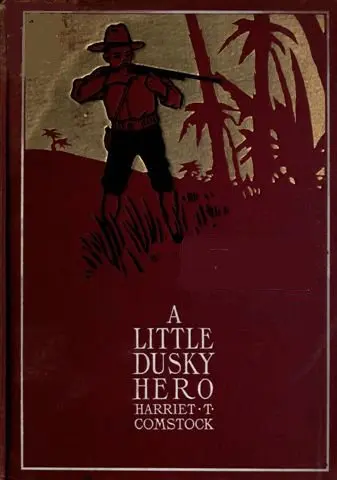
A Little Dusky Hero
Harriet T. (Harriet Theresa) Comstock
THE CLASSIC COLLECTION · 1913
"A Son of the Hills" by Harriet T. Comstock is a novel written in the early 20th century. The story centers around Sandy Morley, a young boy living in the impoverished Lost Hollow, who is determined to rise above his circumstances and seek a better life for himself and his family. Set against the backdrop of the post-Civil War South, the novel explores themes of class disparity, personal ambition, and the quest for identity amidst familial and societal struggles. At the start of the novel, we are introduced to Lost Hollow and its inhabitants, who are depicted as downcast and marginalized individuals struggling with poverty and social stigma. Sandy's home life is fraught with turmoil, particularly due to his father's troubled marriage to Mary and the shadow of their past. Sandy displays an early yearning for change, manifesting his desire to escape the squalor of his home through his budding entrepreneurial ventures, selling nature's bounty for money. He dreams of going to Massachusetts for education and a chance at a better life, all while navigating his complex relationships with Cynthia Walden, a girl from the more affluent part of town, and his own family. The opening chapters set the stage for Sandy's ambitions, his struggles against a heritage of shame and poverty, and the challenges he must face as he seeks to forge his path.
Introduction adapted from the source catalogue; source summaries may be automatically generated.
Free to read · English · 92,769 words · No account needed
MAKE TIME FOR A GOOD BOOK
On by default. Untick to stop anonymous reading totals. Each page counts after 10 seconds in view. How this works.
Anonymous counting is on unless you have switched it off.
The little doctor shuddered, but controlled her features; her eyes did not fall from the wretched man's face.
"Tell me!" was all she said. Then Martin slowly in a hushed voice, described all that had passed, even the vision of Sandy.
"The Lord-a'mighty, He knows I didn't mean to kill," Martin quivered; "but who-all will believe that? I meant to stay clean and fair for the boy's coming back, Miss Lowe, ma'am, deed I did, and now he'll come back to----" Martin could not frame the hideous truth in words; he gulped miserably and went on; "please, ma'am, keep--her, Molly, from Teale and them-all!"
"And you?" So simply did the question come that the man replied in
kind.
"I--I can't let them-all cotch me, ma'am. Come morning, I'll be past
hurting any one, more."
The childlike pathos in this criminal's voice and attitude confused the listener. For the life of her she could not deal with the situation in any ordinary fashion; it seemed like a dramatic incident bungled by amateurs. Presently she asked gently:
"Are you sure she is dead, Mr. Morley?"
The unreality held Martin, too.
"I reckon she is," he faltered; "I--I couldn't hear her heart--and she laid right still. I expect she is dead."
The ludicrous overpowered even the turn of possibility, and the little
doctor said:
"You just mustn't kill yourself or harm Sandy unless it is necessary, you know. If you will go out and harness my horse to the buggy, you and I will make sure."
By the time Morley had mechanically fulfilled these commands, Marcia Lowe had decided, from the sound of Molly's breathing, that she might safely be left alone, and, cloaked and hooded, joined Martin outside.
It was a dreary ride, and the two spoke seldom.
"You are to be no coward, Morley," Marcia Lowe had said; "you're to face your future like a man--like Sandy's father. He will well understand. I will stand by you and see fair play for you; I'll pay for a good lawyer, and you will take your medicine, whatever it is, and be clean and decent for your boy and girl. I'll take care of Molly."
After a time Martin agreed to this, but from the shivering of the form beside her, the little doctor realized the struggle.
And so they reached Morley's cabin and entered, like ghosts, into the fear-haunted place. Mary was gone. The fire was smouldering in the last flashes, the damp ashes were drying--but Mary had made a bodily escape.
"So!" whispered Marcia Lowe. "It was better to make sure. Go
upstairs, see if she is there."
Mary was not there.
"Now come back."
Your reading position is saved on this browser. Take it to another device with a library code. Reading pages adapt to text, rather than matching a printed edition.
Harriet T. (Harriet Theresa) Comstock
Harriet T. (Harriet Theresa) Comstock
Harriet T. (Harriet Theresa) Comstock
BEHIND THE BOOK
This eBook is for the use of anyone anywhere in the United States and most other parts of the world at no cost and with almost no restrictions whatsoever. You may copy it, give it away or re-use it under the terms of the Project Gutenberg License included with this eBook or online at www.gutenberg.org. If you are not located in the United States, you will have to check the laws of the country where you are located before using this eBook. Read the source licence.
The original source file, including credits and licence, is retained by this library. Request an original-format copy at no charge. Please include the book title and Project Gutenberg identifier #20424.
KEEP YOUR CURIOSITY GOING
Coulson Kernahan

Maurice Baring
Frances Wright
Cécile Tormay

Frederic Jesup Stimson

W. H. P. (William Henry Pope) Jarvis