THE CLASSIC COLLECTION✦A dead man’s diaryCLASSIC FREE BOOKS
A dead man’s diary
Coulson Kernahan
THE CLASSIC COLLECTION · 1912
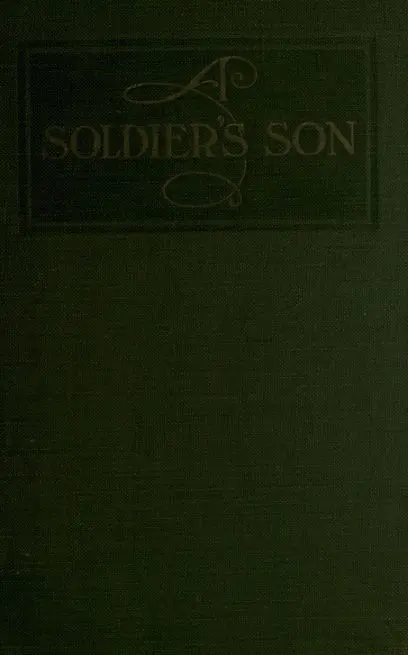
"A Soldier's Son" by Maude Mary Butler is a novel written in the early 20th century. The story revolves around a young boy named Carol, who is the son of a soldier killed in battle. The narrative explores themes of grief, healing, and the impact of Christian Science as Carol navigates his new life with his cousins after his father's death, all while facing his own health struggles and forming deep connections with those around him. The opening of the book introduces the aftermath of the war, depicting the emotional turmoil of a family awaiting the return of a beloved member while grappling with loss. Carol's transition from a life of illness and sorrow into one where he is cherished by his new family unfolds as he arrives at the Manor House. The early chapters highlight Carol's innocence, his desire to help others, and his pursuit of understanding his healing journey through Christian Science, setting the stage for further exploration of his interactions with both family and the wider community as he begins to forge his identity in this new environment.
Introduction adapted from the source catalogue; source summaries may be automatically generated.
Free to read · English · 38,780 words · No account needed
MAKE TIME FOR A GOOD BOOK
On by default. Untick to stop anonymous reading totals. Each page counts after 10 seconds in view. How this works.
Anonymous counting is on unless you have switched it off.
"You must only kiss Carol, darling." The little arms were about to twine themselves around him. "Me does 'ove 'ou, Tarol, so welly much."
The boy would have liked to hold her closely to him, but he could not
raise an arm.
"It does make me so happy to see Rosebud again, Auntie. Perhaps to-morrow I shall be able to see all my cousins."
Mrs. Mandeville did not say, but she thought it would be many
"to-morrows" before he would be strong enough to receive them all in his
room.
"Now run back to the nursery, darling," she said to the wee girlie.
"Take a good-night kiss to Sylvia and Estelle, will you Rosebud?" Carol said. Then she had to be lifted up again to receive a kiss for "eberybody."
Mrs. Mandeville sat silent by the bedside for some time after Rosebud left the room. Then she said in a very low, soft voice, "Do you remember, Carol, coming to my room one day when I lay prostrate with one of my bad headaches?"
"Yes, Auntie; I remember quite well."
"I was very ungrateful, Carol, I would not let myself acknowledge it was your little prayer that took it away. Yet I knew it was, for I had never lost a headache like that before."
"Yes, Auntie, I knew Christian Science had helped you. But I thought
you did not understand."
She kissed him very tenderly. "I am not ungrateful any longer, dear. I acknowledge the debt. Now I must not let you talk any more or Dr. Burton will insist upon having a trained nurse. He has suggested it several times."
"He couldn't keep you away from me, could he, Auntie?"
"I think he would find it a trifle difficult, dear."
"But I want you to go downstairs to dinner to-night, Auntie. Uncle will like to have you, and Nurse will stay with me."
"Perhaps I will go then, for an hour, dear."
So, later on, to everyone's surprise Mrs. Mandeville appeared at the dinner table, and was so bright they all knew, without asking, that Carol was improving, though he had not been pronounced out of danger.
Nurse was quietly making all the needful little preparations for the night when Carol asked her to place the clock where he could see it as he lay in bed.
"The nights seem so long when I cannot sleep, Nurse. I like to watch the fingers of the clock, then I know how long it will be before the light can peep through the curtains."
Your reading position is saved on this browser. Take it to another device with a library code. Reading pages adapt to text, rather than matching a printed edition.
BEHIND THE BOOK
This eBook is for the use of anyone anywhere in the United States and most other parts of the world at no cost and with almost no restrictions whatsoever. You may copy it, give it away or re-use it under the terms of the Project Gutenberg License included with this eBook or online at www.gutenberg.org. If you are not located in the United States, you will have to check the laws of the country where you are located before using this eBook. Read the source licence.
The original source file, including credits and licence, is retained by this library. Request an original-format copy at no charge. Please include the book title and Project Gutenberg identifier #39538.
KEEP YOUR CURIOSITY GOING
Coulson Kernahan

Maurice Baring
Frances Wright
Cécile Tormay

Frederic Jesup Stimson

W. H. P. (William Henry Pope) Jarvis