THE CLASSIC COLLECTION✦Angel Unawares: A Story of Christmas EveCLASSIC FREE BOOKS
Angel Unawares: A Story of Christmas Eve
C. N. (Charles Norris) Williamson & A. M. (Alice Muriel) Williamson
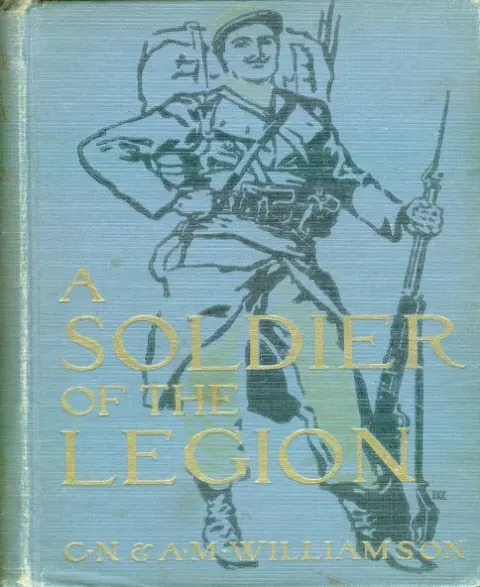
THE CLASSIC COLLECTION · 1914
"A Soldier of the Legion" by C. N. Williamson and A. M. Williamson is a novel written in the early 20th century. The story begins at a ball at Fort Ellsworth, where the young officer Max Doran waits eagerly for the arrival of Billie Brookton, a dazzling actress, with whom he has become romantically involved. The narrative hints at themes of love, ambition, and the complications of duty, set against a backdrop of military life and societal expectations. At the start of the novel, the atmosphere is vibrant with excitement as Max anticipates Billie's entrance at the ball. The narrative introduces us to their budding romance, showcasing Billie as somewhat self-absorbed, while Max is depicted as earnest and devoted. However, their moment of joy is disrupted by the arrival of an urgent telegram, revealing that Max's mother has been injured in a motor accident. This shocking news sends him rushing to New York, marking the beginning of a tumultuous journey that intertwines personal sacrifice with revelations about identity and family, suggesting deeper crises and choices that will unfold as the story progresses.
Introduction adapted from the source catalogue; source summaries may be automatically generated.
Free to read · English · 102,341 words · No account needed
MAKE TIME FOR A GOOD BOOK
On by default. Untick to stop anonymous reading totals. Each page counts after 10 seconds in view. How this works.
Anonymous counting is on unless you have switched it off.
"I gave you the right, by confiding in you. But I didn't confide enough, to do my father justice. I knew he wasn't heartless, though he couldn't bear the sight of me when I was a baby, and put me out of his life. He has always said that a soldier's life was not for a young girl to share. I knew he had a heart, because of that, not in spite of it. It was that he loved my mother so desperately, and I'd robbed him of her. Now you've seen him, you must let me tell you a little----"
"Would he wish it?"
"Yes, if he knew why, and if he knew you, and what you are going through at this time. He fell in love with my mother at first sight in Paris, and she with him. He was on leave, and she was there with her parents from Ireland. He'd never meant to marry, but he was swept off his feet. Mother's people wouldn't hear of it. They took her home in a hurry, and tried to make her marry some one else. She nearly did--because they were stronger than she. She wrote father a letter of good-bye, to his post in the southern desert, where he was stationed then. He supposed, when he read the letter, that she was already married when he got it. But suddenly she appeared--as unexpectedly as I appeared to-day. She'd run away from home, because she couldn't live without him. Oh, how well I understand her! Think of the joy! It was like waking from a dreadful dream for both of them. They were going to be married at once, though mother was half dead with fatigue and excitement after her long, hurried journey; but on their wedding eve she was taken ill, and became delirious. It was typhoid fever. She had got it somehow on the journey. She had come without stopping to rest, from Dublin to Touggourt, where father was stationed. They say it's wild there even now. It was far wilder then, more than twenty-one years ago. He nursed mother himself, scarcely eating or sleeping: not taking off his clothes for weeks. One of his aunts--my great-aunt--told me the story. It came to her from a friend of father's. He never spoke of it. For three months mother wasn't out of danger. Father was her nurse, her doctor, not her husband. But at last she was well again. They had their honeymoon in a tent in the desert. She loved the desert, then--or thought she did. Afterward, though, she changed, for I was coming, and she was ill again. By that time they were stationed still farther south. She grew so homesick for the north that my father got leave. They started to travel by easy stages through the desert, with a small caravan. Their hope was to reach Algiers, and to get to France long before the baby should come; but the heat grew suddenly terrible, and one day they were caught in a fearful sandstorm. My mother was terrified. I was born two months before the time. That same night she died, while the storm was still raging; and before she went, she begged my father to promise, whatever happened, not to leave her body buried in the desert. He did promise. And then began his martyrdom. The caravan could not march fast because of me. A negro woman who'd come as mother's maid took care of me as well as she could, and fed me on condensed milk. Strange I should have lived.... My father had his men make for my mother's body a case of many tins, which they spread open and soldered together, with lead from bullets they melted. In the next oasis they cut down a palm tree and hollowed out the trunk for a coffin. They sealed up the tin case in it, and the coffin travelled on the camel mother had ridden when she was alive, in one of those beautiful hooded bassourahs you must have seen in pictures. At night the coffin rested in my father's tent, and he lay beside it as he had lain beside my mother when she lived, and they were happy. Because she'd been a Catholic, and because she'd always hated the dark, father burned candles on the coffin always till dawn; and the men who loved him looked for wild flowers in the desert to lay upon it. He had forty days, and forty nights, marching through the desert with the dead body of his love, before they came to the railway. Then he took mother to France, and left me with his two aunts there. Now do you wonder he never loved me, or wanted to have me with him?"
Your reading position is saved on this browser. Take it to another device with a library code. Reading pages adapt to text, rather than matching a printed edition.
C. N. (Charles Norris) Williamson & A. M. (Alice Muriel) Williamson
C. N. (Charles Norris) Williamson & A. M. (Alice Muriel) Williamson
C. N. (Charles Norris) Williamson & A. M. (Alice Muriel) Williamson
C. N. (Charles Norris) Williamson & A. M. (Alice Muriel) Williamson
BEHIND THE BOOK
This eBook is for the use of anyone anywhere in the United States and most other parts of the world at no cost and with almost no restrictions whatsoever. You may copy it, give it away or re-use it under the terms of the Project Gutenberg License included with this eBook or online at www.gutenberg.org. If you are not located in the United States, you will have to check the laws of the country where you are located before using this eBook. Read the source licence.
The original source file, including credits and licence, is retained by this library. Request an original-format copy at no charge. Please include the book title and Project Gutenberg identifier #20815.
KEEP YOUR CURIOSITY GOING
Coulson Kernahan

Maurice Baring
Frances Wright
Cécile Tormay

Frederic Jesup Stimson

W. H. P. (William Henry Pope) Jarvis