THE CLASSIC COLLECTION✦Angel Unawares: A Story of Christmas EveCLASSIC FREE BOOKS
Angel Unawares: A Story of Christmas Eve
C. N. (Charles Norris) Williamson & A. M. (Alice Muriel) Williamson
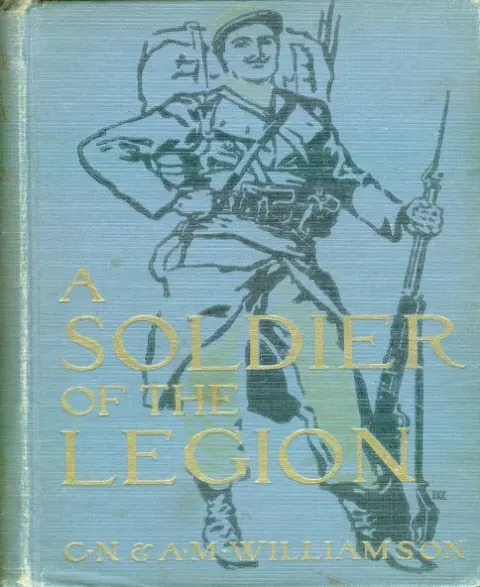
THE CLASSIC COLLECTION · 1914
"A Soldier of the Legion" by C. N. Williamson and A. M. Williamson is a novel written in the early 20th century. The story begins at a ball at Fort Ellsworth, where the young officer Max Doran waits eagerly for the arrival of Billie Brookton, a dazzling actress, with whom he has become romantically involved. The narrative hints at themes of love, ambition, and the complications of duty, set against a backdrop of military life and societal expectations. At the start of the novel, the atmosphere is vibrant with excitement as Max anticipates Billie's entrance at the ball. The narrative introduces us to their budding romance, showcasing Billie as somewhat self-absorbed, while Max is depicted as earnest and devoted. However, their moment of joy is disrupted by the arrival of an urgent telegram, revealing that Max's mother has been injured in a motor accident. This shocking news sends him rushing to New York, marking the beginning of a tumultuous journey that intertwines personal sacrifice with revelations about identity and family, suggesting deeper crises and choices that will unfold as the story progresses.
Introduction adapted from the source catalogue; source summaries may be automatically generated.
Free to read · English · 102,341 words · No account needed
MAKE TIME FOR A GOOD BOOK
On by default. Untick to stop anonymous reading totals. Each page counts after 10 seconds in view. How this works.
Anonymous counting is on unless you have switched it off.
Every moment the weather grew worse, and one after another the few second-class passengers who had dared to risk dining faded away. At last, about halfway through the badly served meal, the girl got up with a wan little smile for her talkative neighbour, and went out, keeping her balance by catching at the back of a chair now and then. The bullet-headed man soon followed, charging at the open door like a bull, as a wave dropped the floor under his feet. But Max, priding himself on his qualities as a sailor, managed to sit through the meagre dessert.
The girl was not visible on the rain-swept deck, or in the gloomy reading-room, where Max glanced over old French papers until his optic nerves sent imperative messages of protest to his brain. Then he strayed on deck again, finding excuse after excuse to keep out of his cabin, where no doubt a seasick roommate was by this time wallowing and guzzling. At last, however, his swimming head begged for a pillow, no matter how hard, and in desperation he went below. He found the cabin door on the hook, and the faded curtain of cretonne drawn across. There was one comfort, at least: the wretch liked air. Max hoped the fellow had gone to sleep, in which case there might be some chance of rest. Gently he unhooked the door and fastened it again in the same manner. A little light flittered through the thin curtain, enabling Max to grope his way about the tiny stateroom, and he determined not to rouse his companion by switching on the electricity.
It had occurred to him, on his way to the cabin, that he might find his berth usurped by a prostrate form, as in the afternoon by a bag. But his first peering glance through the dimness reassured him on this point. The owner of the bag had taken the hint, and stowed himself in his own bunk. Max could just make out a huddled shape under bedclothes which had been drawn high for warmth. Then he knelt down to grope for the suitcase which he had pushed far under his own berth. Seeking it in the semi-darkness, a wave sent him sprawling. He heard from somewhere a shrill crash of glass, a sudden babble of excited voices, and decided it would not be worth while to undress unless the storm should abate. He scrambled up, and thankfully flung himself, just as he was, on to his bunk. In the wild confusion of squeaking, straining planks, the thump of waves against the porthole, the demon-shrieks of infuriated wind, and the shouts and running to and fro of sailors overhead, it seemed impossible that any human being could sleep. Yet the creature overhead was mercifully quiet; and suddenly slumber fell upon Max, shutting out thought and sound. For a while he slept heavily; but by and by dreams came and lifted the curtain of unconsciousness, stirring him to restlessness. It seemed that he had lived through years since New York, and that everything had long ago been decided for him, one way or the other, though his dulled brain kept the secret. He knew only that he was at Sidi-bel-Abbes--Sidi-bel-Abbes. How he had got there, and what he was doing, he could not tell. It ought to be a town, but it was not. There were no houses nor buildings of any kind in this strange Sidi-bel-Abbes. He could see only waves of yellow sand, billowing and moving all around him like sea waves; and it was sea as well as desert. Suddenly one of the waves rolled away, to show a small white tent, almost like a covered boat. A voice was calling to him from it, and he struggled to get near, falling and stumbling among the yellow waves. Then abruptly he started back. It was Billie Brookton's voice. Instead of being glad to hear it, he was bitterly, bleakly disappointed, and felt chilled to the heart with cold. Surprised at his own despair, he waked up, with a great start, just in time to brace his feet against the bottom of the berth and save himself from being thrown out by a shuddering bound of the ship. From overhead he heard a sigh of pain or weariness, and the top berth creaked with some movement of its occupant. "The beast's awake!" thought Max, resentfully. "Now for ructions! No more hope of sleep for me, I suppose."
Your reading position is saved on this browser. Take it to another device with a library code. Reading pages adapt to text, rather than matching a printed edition.
C. N. (Charles Norris) Williamson & A. M. (Alice Muriel) Williamson
C. N. (Charles Norris) Williamson & A. M. (Alice Muriel) Williamson
C. N. (Charles Norris) Williamson & A. M. (Alice Muriel) Williamson
C. N. (Charles Norris) Williamson & A. M. (Alice Muriel) Williamson
BEHIND THE BOOK
This eBook is for the use of anyone anywhere in the United States and most other parts of the world at no cost and with almost no restrictions whatsoever. You may copy it, give it away or re-use it under the terms of the Project Gutenberg License included with this eBook or online at www.gutenberg.org. If you are not located in the United States, you will have to check the laws of the country where you are located before using this eBook. Read the source licence.
The original source file, including credits and licence, is retained by this library. Request an original-format copy at no charge. Please include the book title and Project Gutenberg identifier #20815.
KEEP YOUR CURIOSITY GOING
Coulson Kernahan

Maurice Baring
Frances Wright
Cécile Tormay

Frederic Jesup Stimson

W. H. P. (William Henry Pope) Jarvis