
The Book of the Native
Charles G. D., Sir Roberts
THE CLASSIC COLLECTION · 1898
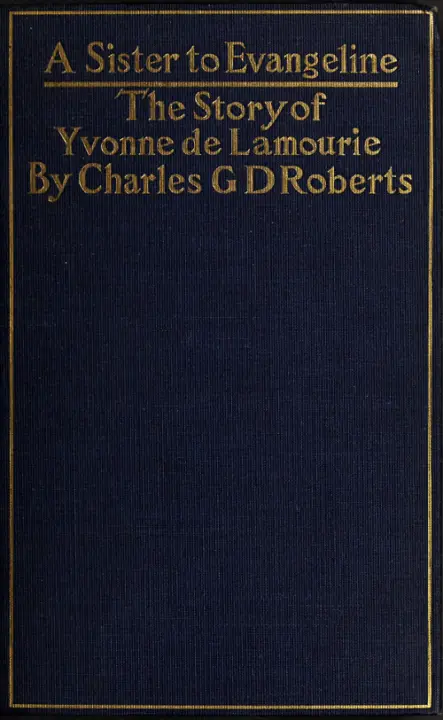
"A Sister to Evangeline" by Sir Charles G. D. Roberts is a historical fiction novel written in the late 19th century. The story centers around Paul Grande, an Acadian soldier returning home to the village of Grand Pré after two years. As he reconnects with his memories, particularly of Yvonne de Lamourie, he is soon drawn into the fraught political landscape of Acadia, where loyalty and allegiance to England versus France loom ever larger. At the start of the novel, Paul Grande reflects on his return to Grand Pré and its picturesque beauty, filled with apple blossoms and familiarity, igniting his memories of relationships and unresolved feelings for Yvonne. Upon arriving, he experiences a mix of joy and apprehension, remembering those lost to the battles waged between French and English interests. The story introduces various characters, including the ominous madman Grûl, who prophesizes doom for Acadie, and the menacing figure of the Black Abbé, who manipulates the populace. As Paul navigates these tensions, his feelings for Yvonne deepen while he faces the threat posed by political betrayal and violence that could alter their lives forever.
Introduction adapted from the source catalogue; source summaries may be automatically generated.
Free to read · English · 63,165 words · No account needed
MAKE TIME FOR A GOOD BOOK
On by default. Untick to stop anonymous reading totals. Each page counts after 10 seconds in view. How this works.
Anonymous counting is on unless you have switched it off.
He fitted his glass to his eye.
“Gad!” he said to himself, “it really is!”
He removed the glass, and giving it a more careful readjustment, stared
again.
“Gad!” said he, “it is none other! A devilish fine girl! She couldn’t be beat in all London for looks or wits. What does it mean? Given that cad Anderson the slip, eh? Discriminating, begad!”
Lieutenant Shafto had a definite contempt for Anderson, as a man who sat by the fire when he might have been fighting. If a man fought well or dressed well, Shafto could respect him. Anderson did neither. He was therefore easily placed.
“There’s something rich behind this,” went on the lieutenant to himself. “But, gad! there is a savour to this voyage, after all. There’s a pair of bright eyes—devilish bright eyes—to dress for!”
He hitched his sword to a more gallant angle as he stepped primly down the deck. He gave the flow of his coat an airy curve. He would have felt of his queue had he dared, to assure himself it was dressed to a nicety. He glanced with complaisance at his correct and entirely spotless ruffles. And by this he was come to mademoiselle’s side, where he stood, bowing low, his cap held very precisely across his breast.
“The honour, mademoiselle! Ah, the marvel of it!” he murmured. “The ship is transfigured. I was but now anathematizing it as a most especial hell: I looked up, and it had become a paradise—a paradise of one fair spirit!”
Yvonne looked at him with searching eyes as he delivered this fantasia, then a trifle imperiously gave him her hand to kiss.
She had spoken passingly with him twice or thrice before, at Father Fafard’s. She understood him—read him through: a man absurd, but never contemptible; to be quite heartily disliked, yet wholly trusted; to be laughed at, yet discreetly; vain, indomitable, a fighter and a fop; living for the field and the hair-dresser. Here was a man whom she would use, yet respect him the while.
“You do nobly, monsieur,” she said, with a faint, enigmatic smile, “to thus keep the light of courtly custom burning clear, even in our darknesses.”
“There can be no darkness where your face shines, mademoiselle,” he cried, delighted not less with himself than with her.
It was a little obvious, but she accepted it graciously with a look, and
he went on:
“I beg that you will let me place my cabin at your disposal during the voyage. You will find it narrow, but roomy enough to accommodate you and your maid.”
Here Captain Eliphalet interfered.
Your reading position is saved on this browser. Take it to another device with a library code. Reading pages adapt to text, rather than matching a printed edition.
Charles G. D., Sir Roberts

Charles G. D., Sir Roberts
Charles G. D., Sir Roberts
Charles G. D., Sir Roberts
BEHIND THE BOOK
This eBook is for the use of anyone anywhere in the United States and most other parts of the world at no cost and with almost no restrictions whatsoever. You may copy it, give it away or re-use it under the terms of the Project Gutenberg License included with this eBook or online at www.gutenberg.org. If you are not located in the United States, you will have to check the laws of the country where you are located before using this eBook. Read the source licence.
The original source file, including credits and licence, is retained by this library. Request an original-format copy at no charge. Please include the book title and Project Gutenberg identifier #53610.
KEEP YOUR CURIOSITY GOING
Cécile Tormay

Moritz Busch
Coulson Kernahan
John L. Ransom

Maurice Baring
Frances Wright