
The Gates Ajar
Elizabeth Stuart Phelps
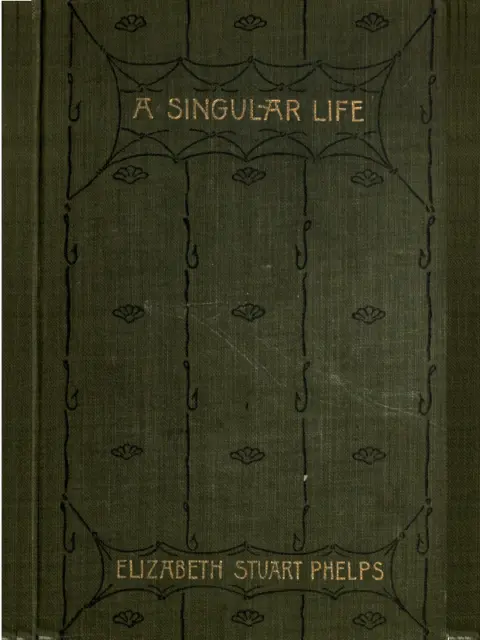
THE CLASSIC COLLECTION · 1894
"A Singular Life" by Elizabeth Stuart Phelps is a novel written in the late 19th century. The narrative revolves around themes of morality, theology, and the struggles faced by young men studying for the ministry, particularly focusing on the character Emanuel Bayard, who is torn between his personal beliefs and societal expectations. The opening chapters set the stage for a deep exploration of these characters as they engage in discussions about heredity, philosophy, and the complexities of faith. At the start of the story, we meet a group of theological students at a dinner discussing the implications of heredity as they navigate their academic and personal lives. Among them is Bayard, who appears introspective and sensitive but is grappling with his self-identity and future. The narrative transitions between interactions among the students and glimpses into Bayard’s thoughts about his path, revealing a blend of ambition, theological skepticism, and personal conflict. As the story progresses, we are introduced to female characters like Helen Carruth, adding layers of romantic tension and complexity to the unfolding narrative, setting up for the larger themes of love, sacrifice, and social barriers that will be explored throughout the novel.
Introduction adapted from the source catalogue; source summaries may be automatically generated.
Free to read · English · 100,671 words · No account needed
MAKE TIME FOR A GOOD BOOK
On by default. Untick to stop anonymous reading totals. Each page counts after 10 seconds in view. How this works.
Anonymous counting is on unless you have switched it off.
State explicitly his conception of the Trinity. Had none? Ah--ah!
Were the three Persons in the Trinity separate as qualities or as natures? Did not know? Ah--ah.
State the precise nature, province, and character of each Person. Did not feel qualified to do so? Ha--hum.
What was the difference between Arianism and Socinianism?
Did the Son exist coördinate with, and yet subordinate to the
Father?
What is the distinction between the attributes and the faculties of
the Deity?
Did an impenitent person ever pray?
Describe the doctrine of Free Will.
Is a sinner ever able to repent, of his own choice?
Is he punished for not being able to do so?
Is the human race responsible for the guilt of Adam?
Why not?
Explain the process of sanctification, and the exact province of
the Holy Spirit.
Carefully elucidate your views on Total Depravity.
Could a man--did we understand you?--become regenerate without waiting for the compelling action of the Holy Spirit?
Is there any Scriptural ground for belief in the possibility of a second probation? What? Please repeat that reply.
Did not the first sin of a child justly expose him to eternal
punishment? What?
At this point in the trial, Bayard was acutely conscious of the controlled voice of Professor Carruth, who had asked no question up to that moment. Dear old Professor! he was trying to haul his favorite student out of the fire before it was too late.
“But,” he asked gently, “is not one act of sin an infinite wrong?”
“I believe it is; or it may reasonably become so.”
“Is it not a wrong committed against an Infinite Being?”
“Yes, sir, it is.”
“Does not an infinite wrong committed against an Infinite Being deserve an infinite punishment?” pleaded the Professor of Theology.
“You have taught me so, sir.”
A rustle swept the house. The stern face of the Professor melted in its sudden, winning fashion. He drew in his breath. At least, the reputation of the Department was secured!
“Do you not believe what you have been taught?”
“Professor,” said Bayard, smiling, “do you?”
It being well known that the now conservative Professor of Theology had been the liberal and the progressive of his first youth, this reply created a slight smile. But the Professor did not smile. The crisis was too serious.
“The candidate does not deny the doctrine,” he urged. “He will undoubtedly grow into it as other men have done before him.”
“Whether men are eternally damned”--began Bayard.
“Job,” whispered the Italian back by the door, “he swear at ’em!”
“No, he ain’t,” said the sober fellow. “It’s the way they talk in
churches.”
Your reading position is saved on this browser. Take it to another device with a library code. Reading pages adapt to text, rather than matching a printed edition.
Elizabeth Stuart Phelps
Elizabeth Stuart Phelps
Elizabeth Stuart Phelps
Elizabeth Stuart Phelps
BEHIND THE BOOK
This eBook is for the use of anyone anywhere in the United States and most other parts of the world at no cost and with almost no restrictions whatsoever. You may copy it, give it away or re-use it under the terms of the Project Gutenberg License included with this eBook or online at www.gutenberg.org. If you are not located in the United States, you will have to check the laws of the country where you are located before using this eBook. Read the source licence.
The original source file, including credits and licence, is retained by this library. Request an original-format copy at no charge. Please include the book title and Project Gutenberg identifier #48443.
KEEP YOUR CURIOSITY GOING
Coulson Kernahan

Maurice Baring
Frances Wright
Cécile Tormay

Frederic Jesup Stimson

W. H. P. (William Henry Pope) Jarvis