
Last letters from the living dead man
David Patterson (Spirit) Hatch
THE CLASSIC COLLECTION · 1698
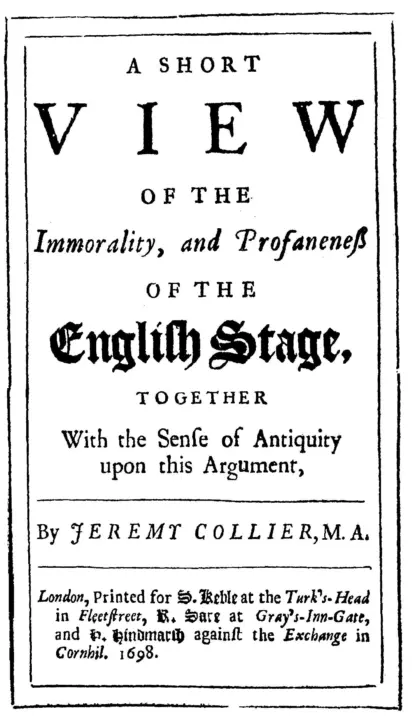
"A Short View of the Immorality, and Profaneness of the English Stage" by Jeremy Collier is an anti-theatre pamphlet published in 1698. Collier launches a fierce attack on leading playwrights of Restoration comedy, accusing them of profanity, blasphemy, and undermining public morality. Through exhaustive analysis, he condemns their failure to punish vice and enforce poetic justice. His innovative critical approach sparked a pamphlet war lasting nearly three decades, as outraged playwrights defended their art while public sentiment shifted toward theatrical reform.
Introduction adapted from the source catalogue; source summaries may be automatically generated.
Free to read · English · 61,164 words · No account needed
MAKE TIME FOR A GOOD BOOK
On by default. Untick to stop anonymous reading totals. Each page counts after 10 seconds in view. How this works.
Anonymous counting is on unless you have switched it off.
If 'tis Objected that the Clergy in Plays are commonly Chaplains, And that these Belonging to Persons of Quality they were obliged to represent them servile and submissive. To this I Answer
1st. In my former remark, that the Stage often outrages the whole Order, without regard to any particular Office. But were it not so in the
2d. Place, They quite overlook the Character, and mistake the Business of Chaplains. They are no Servants, neither do they Belong to any Body, but God Almighty. This Point I have fully proved in another, Treatise,[286] and thither I refer the Reader.
The Stage-Poets make their Principal Persons Vitious, and reward them at
the End of the Play.
The Lines of Virtue and Vice are Struck out by Nature in very Legible Distinctions; They tend to a different Point, and in the greater Instances the Space between them is easily perceiv'd. Nothing can be more unlike than the Original Forms of these Qualities: The First has all the sweetness, Charms, and Graces imaginable; The other has the Air of a Post ill Carved into a Monster, and looks both foolish and Frightful together. These are the Native Appearances of good and Evil: And they that endeavour to blot the Distinctions, to rub out the Colours, or change the Marks, are extreamly to blame. 'Tis confessed as long as the Mind is awake, and Conscience goes true, there's no fear of being imposed on. But when Vice is varnish'd over with Pleasure, and comes in the Shape of Convenience, the case grows somewhat dangerous; for then the Fancy may be gain'd, and the Guards corrupted, and Reason suborn'd against it self. And thus a Disguise often passes when the Person would otherwise be stopt. To put Lewdness into a Thriving condition, to give it an Equipage of Quality, and to treat it with Ceremony and Respect, is the way to confound the Understanding, to fortifie the Charm, and to make the Mischief invincible. Innocence is often owing to Fear, and Appetite is kept under by Shame; But when these Restraints are once taken off, when Profit and Liberty lie on the same side, and a Man can Debauch himself into Credit, what can be expected in such a case, but that Pleasure should grow Absolute, and Madness carry all before it? The Stage seem eager to bring Matters to this Issue; They have made a considerable progress, and are still pushing their Point with all the Vigour imaginable. If this be not their Aim why is Lewdness so much consider'd in Character and Success? Why are their Favourites Atheistical, and their fine Gentleman debauched? To what purpose is Vice thus prefer'd, thus ornamented, and caress'd, unless for Imitation? That matter of Fact stands thus, I shall make good by several Instances: To begin then with their Men of Breeding and Figure. Wild-blood sets up for Debauchery, Ridicules Marriage, and Swears by Mahomet.[287] Bellamy makes sport with the Devil,[288] and Lorenzo is vitious and calls his Father Bawdy Magistrate.[289] Horner is horridly Smutty, and Harcourt false to his Friend who used him kindly.[290] In the Plain Dealer Freeman talks coarsely, cheats the Widdow, debauches her Son, and makes him undutiful. Bellmour is Lewd and Profane,[291] And Mellefont puts Careless in the best way he can to debauch Lady Plyant.[292] These Sparks generally Marry up the Top Ladys, and those that do not, are brought to no Pennance, but go off with the Character of Fine Gentlemen: In Don-Sebastian, Antonio an Atheistical Bully is rewarded with the Lady Moraima, and half the Muffty's Estate. Valentine in Love for Love is (if I may so call him) the Hero of the Play;[293] This Spark the Poet would pass for a Person of Virtue, but he speaks to late. 'Tis true, He was hearty in his Affection to Angelica. Now without question, to be in Love with a fine Lady of 30000 Pounds is a great Virtue! But then abating this single Commendation, Valentine is altogether compounded of Vice.[294] He is a prodigal Debauchee, unnatural, and Profane, Obscene, Sawcy, and undutiful, And yet this Libertine is crown'd for the Man of Merit, has his Wishes thrown into his Lap, and makes the Happy Exit. I perceive we should have a rare set of Virtues if these Poets had the making of them! How they hug a Vitious Character, and how profuse are they in their Liberalities to Lewdness? In the Provoked Wife, Constant Swears at Length, solicits Lady Brute, Confesses himself Lewd, and prefers Debauchery to Marriage. He handles the last Sybject very notably and worth the Hearing. There is (says he) a poor sordid Slavery in Marriage, that turns the flowing Tide of Honour, and sinks it to the lowest ebb of Infamy. 'Tis a Corrupted Soil, Ill Nature, Avarice, Sloth, Cowardize, and Dirt, are all its Product.--But then Constancy (alias Whoring) is a Brave, Free, Haughty, Generous, Agent. This is admirable stuff both for the Rhetorick and the Reason![295] The Character Young Fashion in the Relapse is of the same Staunchness, but this the Reader may have in another Place.
Your reading position is saved on this browser. Take it to another device with a library code. Reading pages adapt to text, rather than matching a printed edition.
BEHIND THE BOOK
This eBook is for the use of anyone anywhere in the United States and most other parts of the world at no cost and with almost no restrictions whatsoever. You may copy it, give it away or re-use it under the terms of the Project Gutenberg License included with this eBook or online at www.gutenberg.org. If you are not located in the United States, you will have to check the laws of the country where you are located before using this eBook. Read the source licence.
The original source file, including credits and licence, is retained by this library. Request an original-format copy at no charge. Please include the book title and Project Gutenberg identifier #44645.
KEEP YOUR CURIOSITY GOING
David Patterson (Spirit) Hatch

David Patterson (Spirit) Hatch

David Patterson (Spirit) Hatch

Ralph Waldo Emerson

Maurice Baring

Oscar Wilde & James McNeill Whistler