READ · DISCOVER · ENJOYClassic literature · Always free
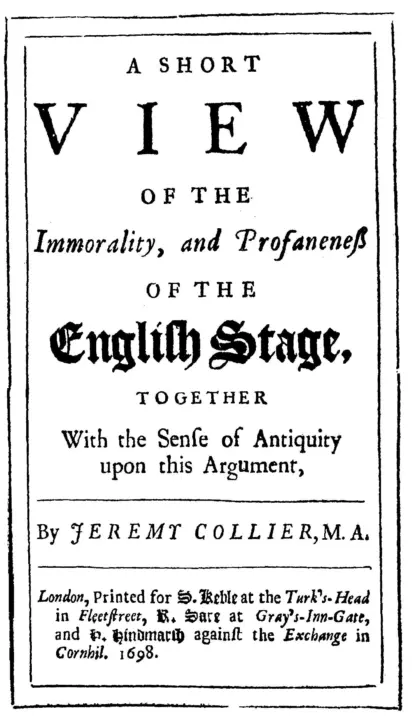
A Short View of the Immorality, and Profaneness of the English Stage Together with the Sense of Antiquity on this Argument — digital edition cover

THE CLASSIC COLLECTION · 1698

A Short View of the Immorality, and Profaneness of the English Stage Together with the Sense of Antiquity on this Argument

"A Short View of the Immorality, and Profaneness of the English Stage" by Jeremy Collier is an anti-theatre pamphlet published in 1698. Collier launches a fierce attack on leading playwrights of Restoration comedy, accusing them of profanity, blasphemy, and undermining public morality. Through exhaustive analysis, he condemns their failure to punish vice and enforce poetic justice. His innovative critical approach sparked a pamphlet war lasting nearly three decades, as outraged playwrights defended their art while public sentiment shifted toward theatrical reform.

Introduction adapted from the source catalogue; source summaries may be automatically generated.

Start reading ↓

Free to read · English · 61,164 words · No account needed

MAKE TIME FOR A GOOD BOOK

A Short View of the Immorality, and Profaneness of the English Stage Together with the Sense of Antiquity on this Argument

On by default. Untick to stop anonymous reading totals. Each page counts after 10 seconds in view. How this works.

Anonymous counting is on unless you have switched it off.

A Short View of the Immorality, and Profaneness of the English Stage Together with the Sense of Antiquity on this Argument

Very Solemnly and Religiously express'd! Lucian and Celsus could not have ridiculed the Resurrection better! Certainly the Poet never expects to be there. Such a light Turn would have agreed much better to a Man who was in the Dark, and was feeling for his Stockings. But let those who talk of Fumbling for their Limbs, take care they don't find them too fast. In the Fourth Act Mustapha dates his Exaltation to Tumult, from the second Night of the Month Abib.[127] Thus you have the Holy Text abused by Captain Tom; And the Bible torn by the Rabble! The Design of this Liberty I can't understand, unless it be to make Mustapha as considerable as Moses; and the prevalence of a Tumult, as much a Miracle as the Deliverance out of Ægypt. We have heard this Author hitherto in his Characters, let us hear him now in his own Person. In his Dedication of Aurenge Zebe he is so hardy as to affirm that he who is too lightly reconciled after high Provocation, may Recommend himself to the World for a Christian, but I should hardly trust him for a Friend. And why is a Christian not fit to make a Friend of? Are the Principles of Christianity defective, and the Laws of it Ill contriv'd? Are the Interests and Capacities of Mankind overlook'd? Did our Great Master bind us to Disadvantage, and make our Duty our Misfortune? And did he grudge us all the Pleasures and Securities of Friendship? Are not all these horrid Suppositions? Are they not a flat Contradiction to the Bible, and a Satyr on the Attributes of the Deity? Our Saviour tells us we must forgive until Seventy times Seven; That is, we must never be tired out of Clemency and Good Nature. He has taught us to pray for the Forgiveness of our own Sins, only upon the Condition of forgiving others. Here is no exception upon the Repetition of the Fault, or the Quality of the Provocation. Mr. Dryden to do him right, do's not dispute the Precept. He confesses this is the way to be a Christian: But for all that he should hardly trust him for a Friend. And why so? Because the Italian Proverb says, He that forgives the second time is a Fool.[128] This Lewd Proverb comes in for Authority, and is a piece of very pertinent Blasphemy! Thus in some Peoples Logick one proof from Atheism, is worth Ten from the New Testament. But here the Poet argues no better than he Believes. For most certainly, a Christian of all others is best qualified for Friendship. For He that loves his Neighbour as himself, and carries Benevolence and Good Nature beyond the Heights of Philosophy: He that is not govern'd by Vanity, or Design; He that prefers his Conscience to his Life, and has Courage to Maintain his Reason; He that is thus qualified must be a good Friend; And he that falls short, is no good Christian. And since the Poet is pleas'd to find fault with Christianity, let us examine his own Scheme. Our Minds (says he) are perpetually wrought on by the Temperament of our Bodies, which makes me suspect they are nearer Allyed than either our Philosophers, or School Divines will allow them to be.[129] The meaning is, he suspects our Souls are nothing but Organiz'd Matter. Or in plain English, our Souls are nothing but our Bodies. And then when the Body dies you may guess what becomes of them! Thus the Authorities of Religion are weaken'd, and the prospect of the other World almost shut up. And is this a likely Supposition for Sincerity and good Nature? Do's Honour use to rise upon the Ruines of Conscience? And are People the best Friends where they have the least Reason to be so? But not only the Inclinations to Friendship must Languish upon this Scheme, but the very Powers of it are as it were destroy'd. By this Systeme no Man can say his Soul is his own. He can't be assured the same Colours of Reason and Desire will last. Any little Accident from without may metamorphose his Fancy, and push him upon a new set of Thoughts. Matter and Motion are the most Humorsom Capricious Things in Nature; and withall, the most Arbitrary and uncontroll'd. And can Constancy proceed from Chance, Choice from Fate, and Virtue from Necessity? In short a Man at this rate must be a Friend or an Enemy in spite of his Teeth, and just as long as the Atoms please and no longer. Every Change in Figure and Impulse, must alter the Idea, and wear off the former Impression. So that by these Principles, Friendship will depend on the Seasons, and we must look in the Weather Glass for our Inclinations. But this 'tis to Refine upon Revelation, and grow wiser than Wisdom! The same Author in his Dedication of Juvenal and Persius, has these words: My Lord, I am come to the last Petition of Abraham;[130] If there be ten Righteous Lines in this vast Preface, spare it for their sake; and also spare the next City because it is but a little one. Here the Poet stands for Abraham; and the Patron for God Almighty: And where lies the Wit of all this? In the Decency of the Comparison? I doubt not. And for the next City he would have spared, he is out in the Allusion. 'Tis no Zoar, but much rather Sodom and Gomorrah, Let them take care the Fire and Brimstone does not follow: And that those who are so bold with Abraham's Petition, are not forced to that of Dives. To beg Protection for a Lewd Book in Scripture Phrase, is very extraordinary! 'Tis in effect to Prostitute the Holy Rhetorick, and send the Bible to the Brothell! I can hardly imagin why these Tombs of Antiquity were raked in, and disturb'd? Unless it were to conjure up a departed Vice, and revive the Pagan Impurities: Unless it were to raise the Stench of the Vault, and Poyson the Living with the Dead. Indeed Juvenal has a very untoward way with him in some of his Satyrs. His Pen has such a Libertine stroak that 'tis a Question whether the Practise, or the Reproof, the Age, or the Author, were the more Licentious. He teaches those Vices he would correct, and writes more like a Pimp, than a Poet. And truly I think there is but little of Lewdness lost in the Translation. The Sixth and Eleventh Satyrs are Particularly remarkable. Such nauseous stuff is almost enough to debauch the Alphabet, and make the Language scandalous. One would almost be sorry for the privilege of Speech, and the Invention of Letters, to see them thus wretchedly abused. And since the Business must be undertaken, why was not the Thought Blanched, the Expression made remote, and the ill Features cast into shadows? I'm mistaken if we have not Lewdness enough of our own Growth, without Importing from our Neighbours. No. This can't be. An Author must have Right done him, and be shown in his own shape, and Complexion. Yes by all means! Vice must be disrobed, and People poyson'd, and all for the sake of Justice! To do Right to such an Author is to burn him. I hope Modesty is much better than Resemblance. The Imitation of an ill Thing is the worse for being exact: And sometimes to report a Fault is to repeat it.

Your reading position is saved on this browser. Take it to another device with a library code. Reading pages adapt to text, rather than matching a printed edition.

BEHIND THE WORDS

About Jeremy Collier

Jeremy Collier (1650–1726). Explore A Short View of the Immorality, and Profaneness of the English Stage Together with the Sense of Antiquity on this Argument in this collection. These books span drama & theatre, essays & ideas.

Explore this author’s books →

THE READERS’ VERDICT

How did this story stay with you?

Not rated yet
Your rating for A Short View of the Immorality, and Profaneness of the English Stage Together with the Sense of Antiquity on this Argument

Be the first to share your verdict.

One rating per browser, which you can change or remove. A necessary browser identifier remembers your vote. How ratings work

A GOOD STORY DESERVES COMPANY

Pass this book along.

A great read is even better when it’s shared.

SEND A LITTLE INSPIRATION

Share this book

BEHIND THE BOOK

Edition & source details.

Title
A Short View of the Immorality, and Profaneness of the English Stage Together with the Sense of Antiquity on this Argument
Author
Jeremy Collier
First publication (Open Library catalogue match)
1698
Digital edition publisher
Project Gutenberg
Gutenberg release date
2014-01-11
Language
English
Source edition imprint
Not stated in source catalogue
Source identifier
Project Gutenberg #44645
Contributors
No additional named contributors in source metadata

Public-domain source & licence

This eBook is for the use of anyone anywhere in the United States and most other parts of the world at no cost and with almost no restrictions whatsoever. You may copy it, give it away or re-use it under the terms of the Project Gutenberg License included with this eBook or online at www.gutenberg.org. If you are not located in the United States, you will have to check the laws of the country where you are located before using this eBook. Read the source licence.

Full source licence and obtaining an original copy

The original source file, including credits and licence, is retained by this library. Request an original-format copy at no charge. Please include the book title and Project Gutenberg identifier #44645.

the full Project Gutenberg License must appear
prominently whenever any copy of a Project Gutenberg work (any work
on which the phrase “Project Gutenberg” appears, or with which the
phrase “Project Gutenberg” is associated) is accessed, displayed,
performed, viewed, copied or distributed:

This eBook is for the use of anyone anywhere in the United States and most
other parts of the world at no cost and with almost no restrictions
whatsoever. You may copy it, give it away or re-use it under the terms
of the Project Gutenberg™ License included with this eBook or online
at www.gutenberg.org. If you
are not located in the United States, you will have to check the laws
of the country where you are located before using this eBook.

1.E.2. If an individual Project Gutenberg electronic work is
derived from texts not protected by U.S. copyright law (does not
contain a notice indicating that it is posted with permission of the
copyright holder), the work can be copied and distributed to anyone in
the United States without paying any fees or charges. If you are
redistributing or providing access to a work with the phrase “Project
Gutenberg” associated with or appearing on the work, you must comply
either with the requirements of paragraphs 1.E.1 through 1.E.7 or
obtain permission for the use of the work and the Project Gutenberg
trademark as set forth in paragraphs 1.E.8 or 1.E.9.

1.E.3. If an individual Project Gutenberg electronic work is posted
with the permission of the copyright holder, your use and distribution
must comply with both paragraphs 1.E.1 through 1.E.7 and any
additional terms imposed by the copyright holder. Additional terms
will be linked to the Project Gutenberg License for all works
posted with the permission of the copyright holder found at the
beginning of this work.

1.E.4. Do not unlink or detach or remove the full Project Gutenberg
License terms from this work, or any files containing a part of this
work or any other work associated with Project Gutenberg.

1.E.5. Do not copy, display, perform, distribute or redistribute this
electronic work, or any part of this electronic work, without
prominently displaying the sentence set forth in paragraph 1.E.1 with
active links or immediate access to the full terms of the Project
Gutenberg License.

1.E.6. You may convert to and distribute this work in any binary,
compressed, marked up, nonproprietary or proprietary form, including
any word processing or hypertext form. However, if you provide access
to or distribute copies of a Project Gutenberg work in a format
other than “Plain Vanilla ASCII” or other format used in the official
version posted on the official Project Gutenberg website
(www.gutenberg.org), you must, at no additional cost, fee or expense
to the user, provide a copy, a means of exporting a copy, or a means
of obtaining a copy upon request, of the work in its original “Plain
Vanilla ASCII” or other form. Any alternate format must include the
full Project Gutenberg License as specified in paragraph 1.E.1.

1.E.7. Do not charge a fee for access to, viewing, displaying,
performing, copying or distributing any Project Gutenberg works
unless you comply with paragraph 1.E.8 or 1.E.9.

1.E.8. You may charge a reasonable fee for copies of or providing
access to or distributing Project Gutenberg electronic works
provided that:

• You pay a royalty fee of 20% of the gross profits you derive from
the use of Project Gutenberg works calculated using the method
you already use to calculate your applicable taxes. The fee is owed
to the owner of the Project Gutenberg trademark, but he has
agreed to donate royalties under this paragraph to the Project
Gutenberg Literary Archive Foundation. Royalty payments must be paid
within 60 days following each date on which you prepare (or are
legally required to prepare) your periodic tax returns. Royalty
payments should be clearly marked as such and sent to the Project
Gutenberg Literary Archive Foundation at the address specified in
Section 4, “Information about donations to the Project Gutenberg
Literary Archive Foundation.”

• You provide a full refund of any money paid by a user who notifies
you in writing (or by e-mail) within 30 days of receipt that s/he
does not agree to the terms of the full Project Gutenberg™
License. You must require such a user to return or destroy all
copies of the works possessed in a physical medium and discontinue
all use of and all access to other copies of Project Gutenberg™
works.

• You provide, in accordance with paragraph 1.F.3, a full refund of
any money paid for a work or a replacement copy, if a defect in the
electronic work is discovered and reported to you within 90 days of
receipt of the work.

• You comply with all other terms of this agreement for free
distribution of Project Gutenberg™ works.


1.E.9. If you wish to charge a fee or distribute a Project
Gutenberg™ electronic work or group of works on different terms than
are set forth in this agreement, you must obtain permission in writing
from the Project Gutenberg Literary Archive Foundation, the manager of
the Project Gutenberg™ trademark. Contact the Foundation as set
forth in Section 3 below.

1.F.

1.F.1. Project Gutenberg volunteers and employees expend considerable
effort to identify, do copyright research on, transcribe and proofread
works not protected by U.S. copyright law in creating the Project
Gutenberg™ collection. Despite these efforts, Project Gutenberg™
electronic works, and the medium on which they may be stored, may
contain “Defects,” such as, but not limited to, incomplete, inaccurate
or corrupt data, transcription errors, a copyright or other
intellectual property infringement, a defective or damaged disk or
other medium, a computer virus, or computer codes that damage or
cannot be read by your equipment.

1.F.2. LIMITED WARRANTY, DISCLAIMER OF DAMAGES - Except for the “Right
of Replacement or Refund” described in paragraph 1.F.3, the Project
Gutenberg Literary Archive Foundation, the owner of the Project
Gutenberg™ trademark, and any other party distributing a Project
Gutenberg™ electronic work under this agreement, disclaim all
liability to you for damages, costs and expenses, including legal
fees. YOU AGREE THAT YOU HAVE NO REMEDIES FOR NEGLIGENCE, STRICT
LIABILITY, BREACH OF WARRANTY OR BREACH OF CONTRACT EXCEPT THOSE
PROVIDED IN PARAGRAPH 1.F.3. YOU AGREE THAT THE FOUNDATION, THE
TRADEMARK OWNER, AND ANY DISTRIBUTOR UNDER THIS AGREEMENT WILL NOT BE
LIABLE TO YOU FOR ACTUAL, DIRECT, INDIRECT, CONSEQUENTIAL, PUNITIVE OR
INCIDENTAL DAMAGES EVEN IF YOU GIVE NOTICE OF THE POSSIBILITY OF SUCH
DAMAGE.

1.F.3. LIMITED RIGHT OF REPLACEMENT OR REFUND - If you discover a
defect in this electronic work within 90 days of receiving it, you can
receive a refund of the money (if any) you paid for it by sending a
written explanation to the person you received the work from. If you
received the work on a physical medium, you must return the medium
with your written explanation. The person or entity that provided you
with the defective work may elect to provide a replacement copy in
lieu of a refund. If you received the work electronically, the person
or entity providing it to you may choose to give you a second
opportunity to receive the work electronically in lieu of a refund. If
the second copy is also defective, you may demand a refund in writing
without further opportunities to fix the problem.

1.F.4. Except for the limited right of replacement or refund set forth
in paragraph 1.F.3, this work is provided to you ‘AS-IS’, WITH NO
OTHER WARRANTIES OF ANY KIND, EXPRESS OR IMPLIED, INCLUDING BUT NOT
LIMITED TO WARRANTIES OF MERCHANTABILITY OR FITNESS FOR ANY PURPOSE.

1.F.5. Some states do not allow disclaimers of certain implied
warranties or the exclusion or limitation of certain types of
damages. If any disclaimer or limitation set forth in this agreement
violates the law of the state applicable to this agreement, the
agreement shall be interpreted to make the maximum disclaimer or
limitation permitted by the applicable state law. The invalidity or
unenforceability of any provision of this agreement shall not void the
remaining provisions.

1.F.6. INDEMNITY - You agree to indemnify and hold the Foundation, the
trademark owner, any agent or employee of the Foundation, anyone
providing copies of Project Gutenberg™ electronic works in
accordance with this agreement, and any volunteers associated with the
production, promotion and distribution of Project Gutenberg™
electronic works, harmless from all liability, costs and expenses,
including legal fees, that arise directly or indirectly from any of
the following which you do or cause to occur: (a) distribution of this
or any Project Gutenberg work, (b) alteration, modification, or
additions or deletions to any Project Gutenberg work, and (c) any
Defect you cause.

Section 2. Information about the Mission of Project Gutenberg

Project Gutenberg is synonymous with the free distribution of
electronic works in formats readable by the widest variety of
computers including obsolete, old, middle-aged and new computers. It
exists because of the efforts of hundreds of volunteers and donations
from people in all walks of life.

Volunteers and financial support to provide volunteers with the
assistance they need are critical to reaching Project Gutenberg’s
goals and ensuring that the Project Gutenberg collection will
remain freely available for generations to come. In 2001, the Project
Gutenberg Literary Archive Foundation was created to provide a secure
and permanent future for Project Gutenberg and future
generations. To learn more about the Project Gutenberg Literary
Archive Foundation and how your efforts and donations can help, see
Sections 3 and 4 and the Foundation information page at www.gutenberg.org.

Section 3. Information about the Project Gutenberg Literary Archive Foundation

The Project Gutenberg Literary Archive Foundation is a non-profit
501(c)(3) educational corporation organized under the laws of the
state of Mississippi and granted tax exempt status by the Internal
Revenue Service. The Foundation’s EIN or federal tax identification
number is 64-6221541. Contributions to the Project Gutenberg Literary
Archive Foundation are tax deductible to the full extent permitted by
U.S. federal laws and your state’s laws.

The Foundation’s business office is located at 41 Watchung Plaza #516,
Montclair NJ 07042, USA, +1 (862) 621-9288. Email contact links and up
to date contact information can be found at the Foundation’s website
and official page at www.gutenberg.org/contact

Section 4. Information about Donations to the Project Gutenberg
Literary Archive Foundation

Project Gutenberg™ depends upon and cannot survive without widespread
public support and donations to carry out its mission of
increasing the number of public domain and licensed works that can be
freely distributed in machine-readable form accessible by the widest
array of equipment including outdated equipment. Many small donations
($1 to $5,000) are particularly important to maintaining tax exempt
status with the IRS.

The Foundation is committed to complying with the laws regulating
charities and charitable donations in all 50 states of the United
States. Compliance requirements are not uniform and it takes a
considerable effort, much paperwork and many fees to meet and keep up
with these requirements. We do not solicit donations in locations
where we have not received written confirmation of compliance. To SEND
DONATIONS or determine the status of compliance for any particular state
visit www.gutenberg.org/donate.

While we cannot and do not solicit contributions from states where we
have not met the solicitation requirements, we know of no prohibition
against accepting unsolicited donations from donors in such states who
approach us with offers to donate.

International donations are gratefully accepted, but we cannot make
any statements concerning tax treatment of donations received from
outside the United States. U.S. laws alone swamp our small staff.

Please check the Project Gutenberg web pages for current donation
methods and addresses. Donations are accepted in a number of other
ways including checks, online payments and credit card donations. To
donate, please visit: www.gutenberg.org/donate.

Section 5. General Information About Project Gutenberg electronic works

Professor Michael S. Hart was the originator of the Project
Gutenberg concept of a library of electronic works that could be
freely shared with anyone. For forty years, he produced and
distributed Project Gutenberg eBooks with only a loose network of
volunteer support.

Project Gutenberg eBooks are often created from several printed
editions, all of which are confirmed as not protected by copyright in
the U.S. unless a copyright notice is included. Thus, we do not
necessarily keep eBooks in compliance with any particular paper
edition.

Most people start at our website which has the main PG search
facility: www.gutenberg.org.

This website includes information about Project Gutenberg,
including how to make donations to the Project Gutenberg Literary
Archive Foundation, how to help produce our new eBooks, and how to
subscribe to our email newsletter to hear about new eBooks.


KEEP YOUR CURIOSITY GOING

Your next chapter awaits.

Your privacy choices

Reading is always free. You can change these settings at any time.

Book banners link to our books on simonward.net. They do not use advertising cookies or tracking.

Privacy & cookie policy · Reading data and privacy controls