
Last letters from the living dead man
David Patterson (Spirit) Hatch
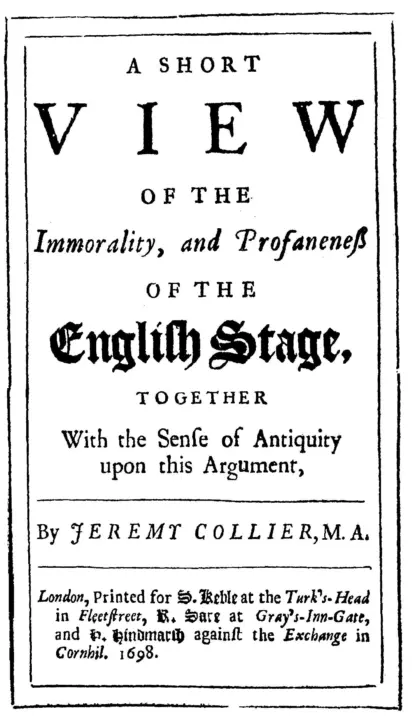
THE CLASSIC COLLECTION · 1698
"A Short View of the Immorality, and Profaneness of the English Stage" by Jeremy Collier is an anti-theatre pamphlet published in 1698. Collier launches a fierce attack on leading playwrights of Restoration comedy, accusing them of profanity, blasphemy, and undermining public morality. Through exhaustive analysis, he condemns their failure to punish vice and enforce poetic justice. His innovative critical approach sparked a pamphlet war lasting nearly three decades, as outraged playwrights defended their art while public sentiment shifted toward theatrical reform.
Introduction adapted from the source catalogue; source summaries may be automatically generated.
Free to read · English · 61,164 words · No account needed
MAKE TIME FOR A GOOD BOOK
On by default. Untick to stop anonymous reading totals. Each page counts after 10 seconds in view. How this works.
Anonymous counting is on unless you have switched it off.
This I take to be part of the Moral of his Fable. If we look farther into him we shall see more of his Mind. His Ranæ makes Merry with the Heathen Scheme of Heaven and Hell. Here Charon and the Stygian Frogs are brought in Comically enough. And that you may understand his opinion more perfectly we are told, that He that Bilks his Catamite after a Sodomitical Abuse, is thrown into the Common shore of Hades. And what Company do you think he is lodg'd with? Why with those who Perjure themselves, with those who Kick their Fathers and Mothers? It seems in the Poets Justice a Man might as good be false to his Oath, as to his Lewdness.[75] To disappoint the Stews, is every jot as great a Crime; as to fly in the Face of Nature, and outrage our Parents. His Quartering his Malefactors thus critically, was without question on purpose to Banter the perswasion of future Punishment. In the same Play Xanthias bids Æacus answer him by Jove, [Greek: Hos hêmin estin homomastigias]. This little Scoundrel of a Slave has the Manners to make Jupiters Quality no better than his own. To go on with him: In his Aves he speaks out to purpose. Here Pisthetærus tells Epops that if the Birds would build a Castle in the Air, they might intercept the Fumes of the Sacrifices, and starve the Gods unless they would come too, and be Tributary. It seems the Birds had very good Pretences to execute this project; for they were ancienter than Jupiter and Saturn, and Govern'd before the Gods. And to speak truth were more capable of the Function. Their Adviser goes on to inform them,[76] that after they had built their pensile City, and fortifyed the Air, their next business was to demand their ancient Soveragnity: If Jupiter refused to quit, they were to declare a Holy War against Him, and the rest of the Confederate Gods, and to cut off the Communication between Heaven and Earth. Pisthæterus[77] grows very warm in his new Interest, and swears by Jove that Men ought to Sacrifice to the Birds, and not to Jupiter. And if things came to a Rupture, and Jupiter grew Troublesome, he undertakes[78] to send a Detachement of Eagles against Him; with Orders to storm his Palace with Flambeaux, and fire it about his Ears. At last to prevent the Calamities of a War, Hercules proposes an Accomodation,[79] and is willing Jupiter should Resign. Neptune calls him a Block-head for his pains, because he was Heir at Law, and after Jupiters Decease was of Course to succeed in his Dominions: Once more, and I have done: In Eirene, Trygæus speaks in a menacing way.[80] That unless Jupiter gave him Satisfaction in his business, he would inform against Him as a disaffected Person, and a betrayer of the Liberties of Greece.[81] I might add many other Instances, and some more Scandalous than any I have mentioned; But these are sufficient to shew the Authors Sentiment: And is it any wonder an Atheist should misbehave himself in point of Modesty? What can we expect less from those who laugh at the Being of a God, at the Doctrines of Providence, and the Distinctions of Good and Evil? A Sceptick has no notion of Conscience, no Relish for Virtue, nor is under any Moral restraints from Hope or Fear. Such a one has nothing to do but to consult his Ease, and gratifie his Vanity, and fill his Pocket. But how these Ends are compassed, he has no squeamishness, or Scruples about it. 'Tis true when the Methods of Lewdness will Take, they are generally most agreeable. This way suits their Talent, and screens their practise, and obliges their Malice. For nothing is a greater Eye-sore to these Men, then Virtue and Regularity. What a pleasure is it then to be admired for Mischeif, to be reveng'd on Religion, and to see Vice prosper and improve under our Hands! To return: Beside Aristophanes Atheisme, I have a Second objection to his Authority, and that is want of Judgment. If we examine his Plays we shall find his Characters improper, or ununiform; either wrong at first, or unsteady in the Right. For the purpose. In his Nubes. A. 3. S. 3. p. 146. 150. He puts dirty expressions in the Mouth of his Man of Probity, makes him declaim vitiously against Vice, and Corrects scurrility with Impudence; Now what can be more idle and senceless, than such Conduct as this? Epecially when this Justus as he calls him had told them in the beginning of his speech, that People used to be well slash'd for such Fooling, when Government and Discipline were in their due Force. The Chorus of his Ranæ slides[82] into the same Inconsistency of Precept, and Practise. Farther, in the Progress of this Play; Æschylus falls a rallying contrary to his Humour, and jests away his own Arguments at a very unseasonable Juncture, when he was disputing for no less prize than the Laureatship. This Tragedian after he had play'd a little with the Story of Bellerophon,[83] goes on in the same strain; And charges Euripides that he had furnish'd all sorts of People with Sawciness and Prattle. The Schools and Academies were spoil'd by this means; So that the Boys were often whip'd, and the Boatswains drubb'd, for their Chattering.[84] These Comical Levities come with an ill Grace from Æschylus. His Character was quite different both in Reality, and in the Play before us. He is all along represented as a Person of a serious Temper, of a reserv'd Loftiness, Cholerick, and tender of his Honour to an Excess, and almost in a rage at the Affront of a Rival, and being forc'd to enter the Lists with Euripides. The case standing thus, neither the Man, nor the Business, would admit of Drolling. Another Instance of his want of Conduct we have in his Concionatores. Here Blepyrus and some others of his Legislative Assembly, talk at a very dirty insipid rate. The Lowest of the Mob, can hardly jest with less Wit, and more Lewdness. And to make their Discourse more remarkable; These douty Members were just going to the House, and had their Heads full of the Good of the Nation, when they entertain'd themselves thus decently[85]. And are these little Buffoons fit to consult de Arduis Regni, &c. to give Authority to Law, and Rules for publick Life? Do's Ribaldry and Nonsence become the Dignity of their Station, and the Solemnity of their Office? To make his Parliament-Men play the Fool thus egregiously, must needs have a great deal of Decorum, and State-Policy in the Contrivance; And is just as wise as if a Painter should have Drawn them in the Habit of Jack-Puddings, and Merry-Andrews. But Aristophanes has still higher Flights of Absurdity. He won't so much as spare the Gods but makes them act these little Parts of Clownishness and Infamy. Bacchus and Hercules in his Ranæ are forced to talk Smut and rally like Link-boys, and do almost all the Tricks of Bartholomew-Fair. To mention something that will bear the quoting. Bacchus enquires of Hercules the readiest way to Hades, or the other World. He bids him either Hang, or Poyson himself, and he can't miss the Road. This is Hercules's Humour to a Tittle! And represents him as much to the Life, as an Ape would do the Grand Signior at a publick Audience! This with a short Sentence or two of Lewdness,[86] is the hardest of Hercules his Usage: And 'tis well he escaped so; for Bacchus is treated much worse. He appears under the disadvantages of a Clownish Debauchee, and a Coward. And is terribly afraid of a Spectre.[87] When he comes before Æacus, this Judge is very rough with him; and tries his pretences to a Deity by Bastinado: Bacchus howls in the drubbing and had almost spoil'd all.[88] Now do's this paultry Behaviour agree with the Heathen Theology, with the Common Opinion concerning Bacchus and Hercules? Do's a Blew-Cap and a Ladle, become the Sons of Jupiter and the Objects of Religious Worship? Those who at the lowest, were counted the Conquerors of the World, and more than Men both by Birth and Enterprize? Sophocles and Euripides make these two Persons manage at a quite different rate of Decency. 'Tis no defence to say Aristophanes wrot Comedy, and so was obliged to make his Scenes more diverting. This excuse I say is defective; for a Comedian ought to imitate Life and Probability, no less than a Tragedian. To Metomorphose Characters, and present Contradictions to Common Belief, is to write, Farce instead of Plays. Such Comedians like Thespis ought to have a travelling Stage, and take the Air with Porcupines and Dromedaryes. If 'tis said that Gravity and greatness do's not suit the Complection and Entertainment of Comedy. To this I answer, that therefore the Persons should be chosen accordingly. They should have nothing in their known Humour, and Condition too Noble, and solemn for Trifling. 'Tis Horaces advice.
Your reading position is saved on this browser. Take it to another device with a library code. Reading pages adapt to text, rather than matching a printed edition.
BEHIND THE BOOK
This eBook is for the use of anyone anywhere in the United States and most other parts of the world at no cost and with almost no restrictions whatsoever. You may copy it, give it away or re-use it under the terms of the Project Gutenberg License included with this eBook or online at www.gutenberg.org. If you are not located in the United States, you will have to check the laws of the country where you are located before using this eBook. Read the source licence.
The original source file, including credits and licence, is retained by this library. Request an original-format copy at no charge. Please include the book title and Project Gutenberg identifier #44645.
KEEP YOUR CURIOSITY GOING
David Patterson (Spirit) Hatch

David Patterson (Spirit) Hatch

David Patterson (Spirit) Hatch

Ralph Waldo Emerson

Maurice Baring

Oscar Wilde & James McNeill Whistler