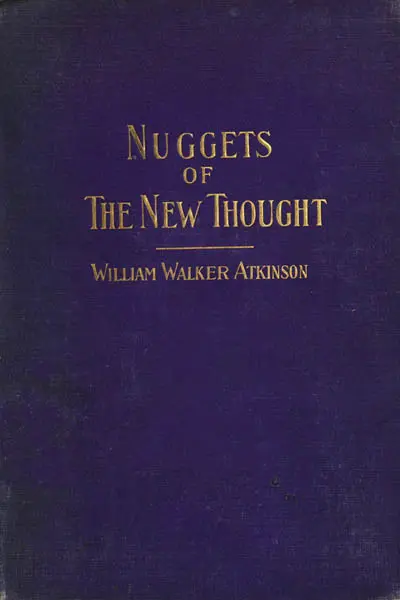
Nuggets of the New Thought: Several Things That Have Helped People
William Walker Atkinson
THE CLASSIC COLLECTION · 1906
"A Series of Lessons in Gnani Yoga: The Yoga of Wisdom" by William Walker Atkinson is an instructional philosophical text likely written in the late 19th century. This work explores profound spiritual concepts, particularly focusing on the nature of consciousness, the Absolute, and the essence of existence from the perspective of Gnani Yoga, which is characterized as the Yoga of Wisdom. The author presents a structured approach to understanding life and reality, encouraging readers to engage deeply with the thoughts and experiences shared. At the start of the book, the author introduces the fundamental concept of "The One," emphasizing the interconnectedness of all existence and asserting that there is a singular underlying reality to all phenomena. Readers are invited to explore various branches of yoga, including Hatha, Raja, Bhakti, and especially Gnani Yoga, which seeks to uncover the scientific and intellectual understanding of life. In this initial lesson, Atkinson sets the stage for a deeper examination of what constitutes reality, encouraging contemplation of profound philosophical questions regarding the nature of existence and spirituality, thus laying the groundwork for the lessons that follow.
Introduction adapted from the source catalogue; source summaries may be automatically generated.
Free to read · English · 75,786 words · No account needed
MAKE TIME FOR A GOOD BOOK
On by default. Untick to stop anonymous reading totals. Each page counts after 10 seconds in view. How this works.
Anonymous counting is on unless you have switched it off.
Edwin Arnold, in his wonderful poem, "The Light of Asia," which tells the story of the Buddha, explains the doctrine of Karma from the Buddhist standpoint. We feel that our students should become acquainted with this view, so beautifully expressed, and so we herewith quote the passages referred to:
"Karma--all that total of a soul
Which is the things it did, the thoughts it had,
The 'self' it wove with woof of viewless time
Crossed on the warp invisible of acts.
"What hath been bringeth what shall be, and is,
Worse--better--last for first and first for last;
The angels in the heavens of gladness reap
Fruits of a holy past.
"The devils in the underworlds wear out
Deeds that were wicked in an age gone by.
Nothing endures: fair virtues waste with time,
Foul sins grow purged thereby.
"Who toiled a slave may come anew a prince
For gentle worthiness and merit won;
Who ruled a king may wander earth in rags
For things done and undone.
"Before beginning, and without an end,
As space eternal and as surety sure,
Is fixed a Power divine which moves to good,
Only its laws endure.
"It will not be contemned of any one:
Who thwarts it loses, and who serves it gains;
The hidden good it pays with peace and bliss,
The hidden ill with pains.
"It seeth everywhere and marketh all:
Do right--it recompenseth! Do one wrong--
The equal retribution must be made,
Though DHARMA tarry long.
"It knows not wrath nor pardon; utter-true
Its measures mete, its faultless balance weighs;
Times are as naught, to-morrow it will judge,
Or after many days.
"By this the slayer's knife did stab himself;
The unjust judge hath lost his own defender;
The false tongue dooms its lie; the creeping thief
And spoiler rob, to render.
"Such is the law which moves to righteousness,
Which none at last can turn aside or stay;
The heart of it is love, the end of it
Is peace and consummation sweet. Obey!
"The books say well, my brothers! each man's life
The outcome of his former living is;
The bygone wrongs bring forth sorrow and woes,
The bygone right breeds bliss.
"That which ye sow ye reap. See yonder fields!
The sesamum was sesamum, the corn
Was corn. The silence and the darkness knew;
So is a man's fate born.
"He cometh, reaper of the things he sowed,
Sesamum, corn, so much cast in past birth;
And so much weed and poison-stuff, which mar
Him and the aching earth.
"If he shall labor rightly, rooting these,
And planting wholesome seedlings where they grew,
Fruitful and fair and clean the ground shall be,
And rich the harvest due.
Your reading position is saved on this browser. Take it to another device with a library code. Reading pages adapt to text, rather than matching a printed edition.
William Walker Atkinson
William Walker Atkinson
William Walker Atkinson
William Walker Atkinson
BEHIND THE BOOK
This eBook is for the use of anyone anywhere in the United States and most other parts of the world at no cost and with almost no restrictions whatsoever. You may copy it, give it away or re-use it under the terms of the Project Gutenberg License included with this eBook or online at www.gutenberg.org. If you are not located in the United States, you will have to check the laws of the country where you are located before using this eBook. Read the source licence.
The original source file, including credits and licence, is retained by this library. Request an original-format copy at no charge. Please include the book title and Project Gutenberg identifier #13407.
KEEP YOUR CURIOSITY GOING

David Patterson (Spirit) Hatch

David Patterson (Spirit) Hatch

David Patterson (Spirit) Hatch
Coulson Kernahan

Ralph Waldo Emerson
Frances Wright