
Lying lips
William Le Queux
THE CLASSIC COLLECTION · 1892
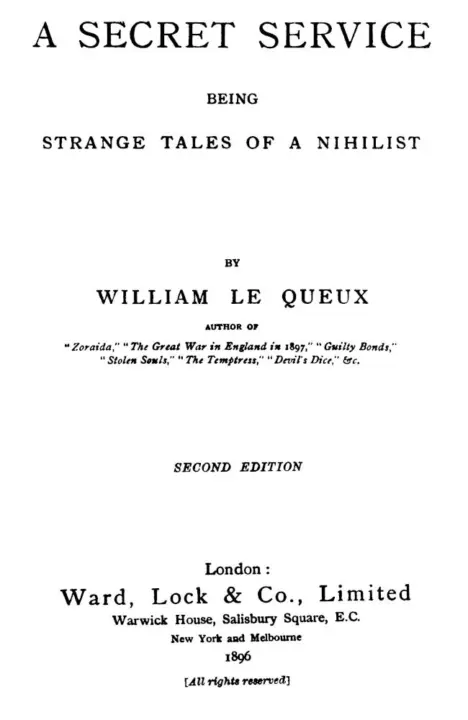
"A Secret Service: Being Strange Tales of a Nihilist" by William Le Queux is a historical fiction novel likely written in the late 19th century. The narrative introduces readers to Anton Prèhznev, a Jewish exile who becomes embroiled in the tumultuous world of Nihilism amid the oppression of the Russian autocracy. Through his eyes, the book explores themes of political exile, rebellion, and the human cost of autocratic rule. The opening of the book sets a dramatic tone by presenting Anton's reflections on his tragic backstory, marked by the oppressive regime represented by the Tzar. It recounts the painful events that led him to become a member of the Nihilist party, detailing the arrest of his father, the illness and subsequent death of his mother, and the struggles of his sister Mascha. As Anton vows revenge against the tyrannical forces that wreaked havoc on his family, the narrative profoundly delves into the upbringing and hardships faced by those challenging the oppressive societal structures in Russia. This opening portion establishes a gripping foundation that promises a blend of personal and collective struggles amidst radical political movements.
Introduction adapted from the source catalogue; source summaries may be automatically generated.
Free to read · English · 70,327 words · No account needed
MAKE TIME FOR A GOOD BOOK
On by default. Untick to stop anonymous reading totals. Each page counts after 10 seconds in view. How this works.
Anonymous counting is on unless you have switched it off.
Only by repute was General Martianoff, the Governor of Mstislavl, known to her. She knew that by the inhabitants of the Ghetto he was dreaded as a cruel, drunken, and depraved official, and she had heard the Rabbi warn them against breaking any of the thousand tyrannical laws which comprise the Swod, or penal code. A Russian District Governor is locally as much of an autocrat as his Imperial Master, the Tzar. He can do exactly what he pleases with the poor, cringing wretches over whom he is given authority. He can condemn Jew or Gentile to prison without trial; he can order any one who displeases him to be knouted, and with his colleague, the ispravnik, and his myrmidons, can enforce inhuman tortures not a whit the less terrible than those of the Spanish Inquisition.
General Martianoff, an average specimen of the nachalniki, ruled his district with the knout, and hating Jews, considered death without torture too good for them. He had even ordered unoffending Hebrews to be flogged because their children omitted to doff their caps to Government officials whom they met in the streets!
It was of this harsh, inhuman Governor that my poor, trusting sister, famished and desperate, sought aid for her dying mother.
The General was lazily smoking a cigar and reading the Novosti in his own well-furnished room, when a man-servant entered, and, after saluting, said, “A young girl desires to see your Excellency. I told her you could not give audience to any one.”
“Idiot! Why did you send her away?”
“She was only a Jewess, your Excellency. But she is still here. She’s the daughter of the financier Prèhznev, of Petersburg, who was sent to the mines.”
“Prèhznev!” repeated the General, in surprise. “Ah! Show her in—and—and see we are not disturbed, Ivanovitch—you understand.”
“Yes, your Excellency.” And the man saluted and disappeared.
In a few seconds Mascha, pale and trembling, advanced timidly into the room. The Governor was standing near the door when she entered, and as he closed it after her he pushed the small brass bolt into its socket. Then he turned sharply, and asked—
“Well, girl, what do you want?”
“Your Excellency,” said Mascha, bowing with that fawning humility which every Hebrew is bound to show towards Government officials, “I have been sent by our good ispravnik, Ivan Osnavitsch.”
“Very kind of him to select beauty for me and send it to my door, I’m sure,” remarked the General, under his breath.
Continuing, Mascha briefly explained that she and her mother were starving, and that her parent was dying of sheer want.
Your reading position is saved on this browser. Take it to another device with a library code. Reading pages adapt to text, rather than matching a printed edition.
William Le Queux
William Le Queux
William Le Queux
William Le Queux
BEHIND THE BOOK
This eBook is for the use of anyone anywhere in the United States and most other parts of the world at no cost and with almost no restrictions whatsoever. You may copy it, give it away or re-use it under the terms of the Project Gutenberg License included with this eBook or online at www.gutenberg.org. If you are not located in the United States, you will have to check the laws of the country where you are located before using this eBook. Read the source licence.
The original source file, including credits and licence, is retained by this library. Request an original-format copy at no charge. Please include the book title and Project Gutenberg identifier #67278.
KEEP YOUR CURIOSITY GOING
Cécile Tormay

Moritz Busch
Coulson Kernahan
John L. Ransom

Maurice Baring
Frances Wright