
Lying lips
William Le Queux
THE CLASSIC COLLECTION · 1892
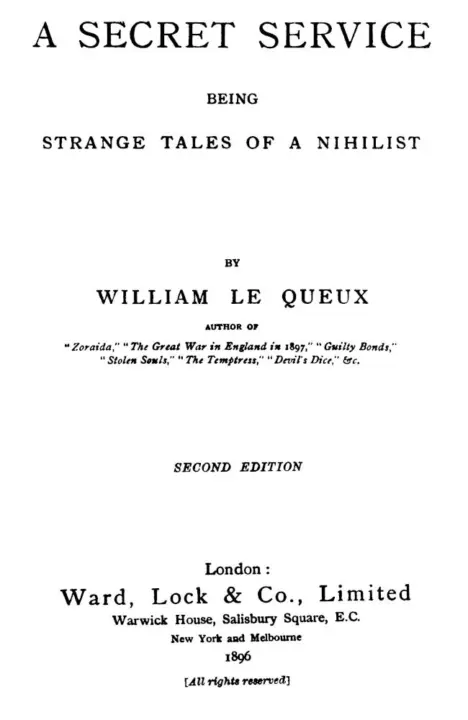
"A Secret Service: Being Strange Tales of a Nihilist" by William Le Queux is a historical fiction novel likely written in the late 19th century. The narrative introduces readers to Anton Prèhznev, a Jewish exile who becomes embroiled in the tumultuous world of Nihilism amid the oppression of the Russian autocracy. Through his eyes, the book explores themes of political exile, rebellion, and the human cost of autocratic rule. The opening of the book sets a dramatic tone by presenting Anton's reflections on his tragic backstory, marked by the oppressive regime represented by the Tzar. It recounts the painful events that led him to become a member of the Nihilist party, detailing the arrest of his father, the illness and subsequent death of his mother, and the struggles of his sister Mascha. As Anton vows revenge against the tyrannical forces that wreaked havoc on his family, the narrative profoundly delves into the upbringing and hardships faced by those challenging the oppressive societal structures in Russia. This opening portion establishes a gripping foundation that promises a blend of personal and collective struggles amidst radical political movements.
Introduction adapted from the source catalogue; source summaries may be automatically generated.
Free to read · English · 70,327 words · No account needed
MAKE TIME FOR A GOOD BOOK
On by default. Untick to stop anonymous reading totals. Each page counts after 10 seconds in view. How this works.
Anonymous counting is on unless you have switched it off.
But as these grave thoughts took possession of me, the “House” filled, the tellers advanced to the table, and the result of the division was declared.
I went out to hand it to my telegraphist in the lobby. When I returned the object of my thoughts had gone. It was certainly a curious coincidence that we should thus meet, yet what proof had I that she was a murderess? Nothing beyond a strange, fitful fancy.
In a handsome drawing-room in Brook Street, Grosvenor Square, where the wintry twilight filtered through pale-blue silk curtains, I was, about two months later, sitting alone with Mrs. Elworthy.
Through a friend of the family I had succeeded in obtaining an introduction to her, and now regularly received cards for all her little festivities. Both she and her husband welcomed me warmly whenever I called, and very soon I found myself one of a very pleasant, if extravagant set. I made, however, two discoveries of a somewhat remarkable character. Firstly, that Mrs. Elworthy was a Russian, and, secondly, that the fascinating girl I had known as Wanda Waluiski was living with her, and was, in reality, her daughter!
On this particular afternoon I had remained behind after the other visitors had departed, and was chatting with Mrs. Elworthy, who, with all a woman’s cunning, had chosen a vieux rose tea-gown, which, falling in artistic folds, gave sculptural relief to her almost angular outline.
For a woman, she was unusually conversant with political questions, and I had purposely turned our discussion upon the prevalence of famine in Russia.
“Were you ever in Petersburg?” I asked, glancing at her suddenly.
She gazed at me inquiringly, and the smile died from her face.
“No,” she replied quickly. “I came from Odessa. I have never been to the capital. But of course you have.”
“Yes,” I said reflectively. “Unfortunately, however, my last visit was marred by a very sad occurrence.”
“What was it?” she asked, lounging languidly in her chair.
“The murder of my friend Ivan Liustig,” I replied calmly, gazing straight
into her eyes.
The announcement did not produce the effect I had intended. She stirred uneasily, but merely raised her eyebrows and uttered a low exclamation of horror.
“The poor fellow was poisoned,” I continued, at the same time drawing my wallet from my pocket. “Here is his photograph,” I added, handing her a carte de visite.
She looked calmly at the pictured face.
“Very sad—very sad indeed,” she remarked. “And was the murderer caught?”
She kept her eyes upon the photograph as she asked the question.
“Murderess,” I said, in as unconcerned a tone as I could.
“A woman, then?”
Your reading position is saved on this browser. Take it to another device with a library code. Reading pages adapt to text, rather than matching a printed edition.
William Le Queux
William Le Queux
William Le Queux
William Le Queux
BEHIND THE BOOK
This eBook is for the use of anyone anywhere in the United States and most other parts of the world at no cost and with almost no restrictions whatsoever. You may copy it, give it away or re-use it under the terms of the Project Gutenberg License included with this eBook or online at www.gutenberg.org. If you are not located in the United States, you will have to check the laws of the country where you are located before using this eBook. Read the source licence.
The original source file, including credits and licence, is retained by this library. Request an original-format copy at no charge. Please include the book title and Project Gutenberg identifier #67278.
KEEP YOUR CURIOSITY GOING
Cécile Tormay

Moritz Busch
Coulson Kernahan
John L. Ransom

Maurice Baring
Frances Wright