
Lying lips
William Le Queux
THE CLASSIC COLLECTION · 1892
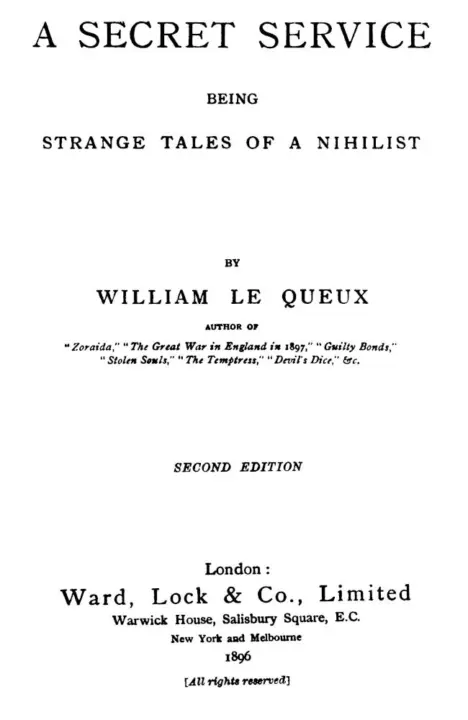
"A Secret Service: Being Strange Tales of a Nihilist" by William Le Queux is a historical fiction novel likely written in the late 19th century. The narrative introduces readers to Anton Prèhznev, a Jewish exile who becomes embroiled in the tumultuous world of Nihilism amid the oppression of the Russian autocracy. Through his eyes, the book explores themes of political exile, rebellion, and the human cost of autocratic rule. The opening of the book sets a dramatic tone by presenting Anton's reflections on his tragic backstory, marked by the oppressive regime represented by the Tzar. It recounts the painful events that led him to become a member of the Nihilist party, detailing the arrest of his father, the illness and subsequent death of his mother, and the struggles of his sister Mascha. As Anton vows revenge against the tyrannical forces that wreaked havoc on his family, the narrative profoundly delves into the upbringing and hardships faced by those challenging the oppressive societal structures in Russia. This opening portion establishes a gripping foundation that promises a blend of personal and collective struggles amidst radical political movements.
Introduction adapted from the source catalogue; source summaries may be automatically generated.
Free to read · English · 70,327 words · No account needed
MAKE TIME FOR A GOOD BOOK
On by default. Untick to stop anonymous reading totals. Each page counts after 10 seconds in view. How this works.
Anonymous counting is on unless you have switched it off.
To sweep the Autocrat from his throne, to break his power, to destroy the corrupt ministers and infamous advisers by whom he is surrounded, to bring enlightenment, peace, and freedom to millions of honest, God-fearing men, women, and children in Russia, are the objects and aims of those who are so frequently designated as murderers.
Yet the work goes on, silently, steadily, deadly. Each day brings the power of the Tzar’s nearer its disastrous termination; each day increases the hopes of those thousands of “political suspects” buried alive in Siberian snow-drifts; each night brings us nearer the dawn of a bright and prosperous day.
Already my readers have learnt the reason I, Anton Prèhznev, loyal soldier of his Imperial Majesty, became transformed into a revolutionist. My case is but one of many thousands. In Russia, one must be either a flunkey or a Nihilist, and most persons prefer to work for the cause of freedom.
It was in a small room over a dingy and uninviting-looking café in Gerrard Street, Soho—to which our headquarters had been transferred, in order to elude the vigilance of the spies of the Embassy—that there was arranged one of the most bold and terrible plots since the assassination of Alexander II.
The meeting was held hurriedly at midnight, and I attended. Paul Pétroff—who had that day returned from Petersburg—presided, and Tersinski, Irteneff, Grinevitch, and Bounakoff were present.
“Brothers,” exclaimed Pétroff, after we had seated ourselves and transacted some preliminary business, “our time has arrived. By the exercise of due caution we shall be enabled to strike a blow that will paralyse Europe, and remove the Tyrant and his underlings. Shall we do so?”
“Yes,” we replied, with one accord.
“Now that the lips of that traitress, Vera Kovalski, are sealed, we are free to act,” he continued. “The Zemliá i Vólia (”Land and Liberty“) group in Petersburg have supplied us with information. The Tzar and Tzarina will leave the Winter Palace this day fortnight for Astrakhan.”
He took from the papers at his elbow a large map of Russia, upon which was marked in red the route by which the Imperial party were to travel. It showed that they would go by way of Moscow, Riazan, Tambov, Atkarsk, to Saratov, and thence by steamer down the Volga.
“You observe, brothers,” he said, “the train will pass over several unimportant branch lines. It is suggested by the Circle in Petersburg that a disaster should occur on one of these, as they will not be so closely watched as the trunk lines.”
“What kind of a disaster?” I asked.
Your reading position is saved on this browser. Take it to another device with a library code. Reading pages adapt to text, rather than matching a printed edition.
William Le Queux
William Le Queux
William Le Queux
William Le Queux
BEHIND THE BOOK
This eBook is for the use of anyone anywhere in the United States and most other parts of the world at no cost and with almost no restrictions whatsoever. You may copy it, give it away or re-use it under the terms of the Project Gutenberg License included with this eBook or online at www.gutenberg.org. If you are not located in the United States, you will have to check the laws of the country where you are located before using this eBook. Read the source licence.
The original source file, including credits and licence, is retained by this library. Request an original-format copy at no charge. Please include the book title and Project Gutenberg identifier #67278.
KEEP YOUR CURIOSITY GOING
Cécile Tormay

Moritz Busch
Coulson Kernahan
John L. Ransom

Maurice Baring
Frances Wright