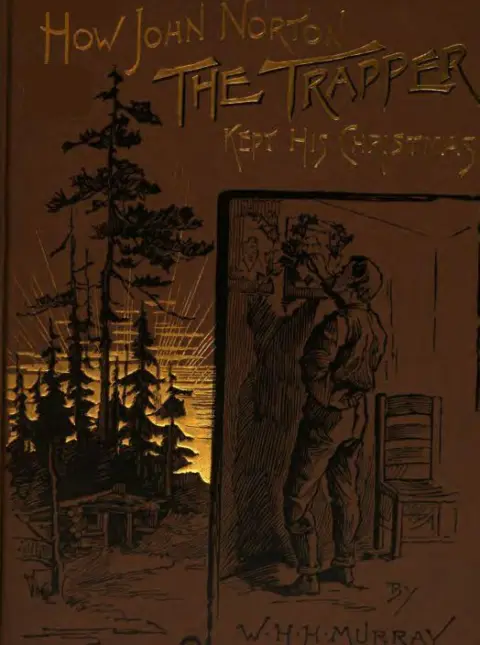
How John Norton the Trapper Kept His Christmas
W. H. H. (William Henry Harrison) Murray
THE CLASSIC COLLECTION · 1898
"A Ride With A Mad Horse In A Freight-Car" by W. H. H. Murray is a vivid narrative and war memoir written in the late 19th century. This book encapsulates the personal experiences of the author during the American Civil War, focusing on the bond he shares with a horse named Gulnare against the backdrop of war. It explores themes of companionship, loyalty, and the emotional turmoil of battle while delving into the tragic fate of both horse and rider. The story begins with the author recalling a fierce battle at Malvern Hill, where he is injured and encounters a beautiful, riderless mare amidst the chaos. He names her Gulnare, and a deep bond forms between them over the course of the war. This connection is emphasized through his tender care and their shared experiences, as she accompanies him through battles and personal struggles. However, the narrative takes a heart-wrenching turn as Gulnare contracts phrenitis during their journey home, spiraling into madness. The vivid descriptions of her suffering, coupled with the author's desperate attempts to save her, culminate in a poignant farewell as he holds her in his lap as she dies. The book ultimately reflects on the profound impact of love and loss, leaving readers with a bittersweet sense of the sacrifices made in war.
Introduction adapted from the source catalogue; source summaries may be automatically generated.
Free to read · English · 6,343 words · No account needed
MAKE TIME FOR A GOOD BOOK
On by default. Untick to stop anonymous reading totals. Each page counts after 10 seconds in view. How this works.
Anonymous counting is on unless you have switched it off.
"But little time was given me to mourn. My life was soon to be in peril, and I must summon up the utmost power of eye and limb to escape the violence of my frenzied mare. Did you ever see a mad horse when his madness is on him? Take your stand with me in that car, and you shall see what suffering a dumb creature can endure before it dies. In no malady does a horse suffer more than in phrenitis, or inflammation of the brain. Possibly in severe cases of colic, probably in rabies in its fiercest form, the pain is equally intense. These three are the most agonizing of all the diseases to which the noblest of animals is exposed. Had my pistols been with me, I should then and there, with whatever strength Heaven granted, have taken my companion's life, that she might be spared the suffering which was so soon to rack and wring her sensitive frame. A horse laboring under an attack of phrenitis is as violent as a horse can be. He is not ferocious as is one in a fit of rabies. He may kill his master, but he does it without design. There is in him no desire of mischief for its own sake, no cruel cunning, no stratagem and malice. A rabid horse is conscious in every act and motion. He recognizes the man he destroys. There is in him an insane desire to kill. Not so with the phrenetic horse. He is unconscious in his violence. He sees and recognizes no one. There is no method or purpose in his madness. He kills without knowing it.
"I knew what was coming. I could not jump out, that would be certain death. I must abide in the car, and take my chance of life. The car was fortunately high, long, and roomy. I took my position in front of my horse, watchful, and ready to spring. Suddenly her lids, which had been closed, came open with a snap, as if an electric shock had passed through her, and the eyes, wild in their brightness, stared directly at me. And what eyes they were! The membrane grew red and redder until it was of the color of blood, standing out in frightful contrast with the transparency of the cornea. The pupil gradually dilated until it seemed about to burst out of the socket. The nostrils, which had been sunken and motionless, quivered, swelled, and glowed. The respiration became short, quick and gasping. The limp and dripping ears stiffened and stood erect, pricked sharply forward, as if to catch the slightest sound. Spasms, as the car swerved and vibrated, ran along her frame. More horrid than all, the lips slowly contracted, and the white, sharp-edged teeth stood uncovered, giving an indescribable look of ferocity to the partially opened mouth. The car suddenly reeled as it dashed around a curve, swaying her almost off her feet, and, as a contortion shook her, she recovered herself, and rearing upward as high as the car permitted, plunged directly at me. I was expecting the movement, and dodged. Then followed exhibitions of pain which I pray God I may never see again. Time and again did she dash herself upon the floor, and roll over and over, ladling out with her feet in all directions. Pausing a moment, she would stretch her body to its extreme length, and, lying upon her side, pound the floor with her head as if it were a maul. Then like a flash she would leap to her feet, and whirl round and round until from very giddiness she would stagger and fall. She would lay hold of the straw with her teeth, and shake it as a dog shakes a struggling woodchuck; then dashing it from her mouth, she would seize hold of her own sides, and send herself. Springing up, she would rush against the end of the car, falling all in a heap from the violence of the concussion. For some fifteen minutes without intermission the frenzy lasted. I was nearly exhausted. My efforts to avoid her mad rushes, the terrible tension of my nervous system produced by the spectacle of such exquisite and prolonged suffering, were weakening me beyond what I should have thought it possible an hour before for anything to weaken me. In fact, I felt my strength leaving me. A terror such as I had never yet felt was taking possession of my mind. I sickened at the sight before me, and at the thought of agonies yet to come. 'My God,' I exclaimed, 'must I be killed by own horse in this miserable car!' Even as I spoke the end came. The mare raised herself until her shoulders touched the roof, then dashed her body upon the floor with a violence which threatened the stout frame beneath her. I leaned, panting and exhausted, against the side of the car. Gulnare did not stir. She lay motionless, her breath coming and going in lessening respirations. I tottered toward her, and, as I stood above her, my ear detected a low gurgling sound. I can not describe the feeling that followed. Joy and grief contended within me. I knew the meaning of that sound. Gulnare, in her frenzied violence, had broken a blood-vessel, and was bleeding internally. Pain and life were passing away together.
Your reading position is saved on this browser. Take it to another device with a library code. Reading pages adapt to text, rather than matching a printed edition.
W. H. H. (William Henry Harrison) Murray
W. H. H. (William Henry Harrison) Murray
W. H. H. (William Henry Harrison) Murray
BEHIND THE BOOK
This eBook is for the use of anyone anywhere in the United States and most other parts of the world at no cost and with almost no restrictions whatsoever. You may copy it, give it away or re-use it under the terms of the Project Gutenberg License included with this eBook or online at www.gutenberg.org. If you are not located in the United States, you will have to check the laws of the country where you are located before using this eBook. Read the source licence.
The original source file, including credits and licence, is retained by this library. Request an original-format copy at no charge. Please include the book title and Project Gutenberg identifier #23168.
KEEP YOUR CURIOSITY GOING
Cécile Tormay

Moritz Busch
John L. Ransom
Frances Wright
Cécile Tormay

Mabel Potter Daggett