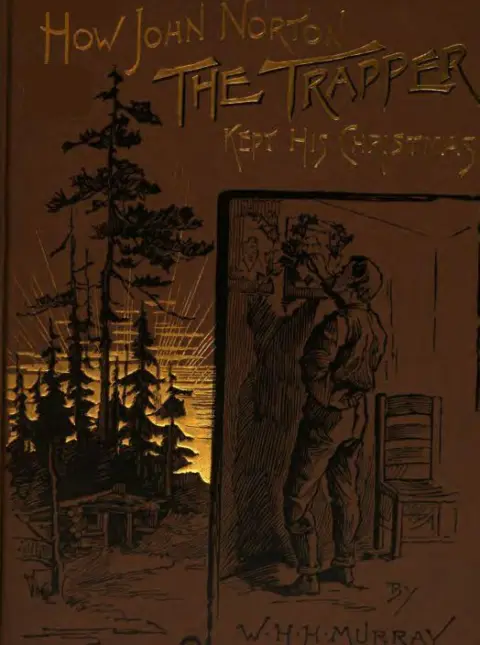
How John Norton the Trapper Kept His Christmas
W. H. H. (William Henry Harrison) Murray
THE CLASSIC COLLECTION · 1898
"A Ride With A Mad Horse In A Freight-Car" by W. H. H. Murray is a vivid narrative and war memoir written in the late 19th century. This book encapsulates the personal experiences of the author during the American Civil War, focusing on the bond he shares with a horse named Gulnare against the backdrop of war. It explores themes of companionship, loyalty, and the emotional turmoil of battle while delving into the tragic fate of both horse and rider. The story begins with the author recalling a fierce battle at Malvern Hill, where he is injured and encounters a beautiful, riderless mare amidst the chaos. He names her Gulnare, and a deep bond forms between them over the course of the war. This connection is emphasized through his tender care and their shared experiences, as she accompanies him through battles and personal struggles. However, the narrative takes a heart-wrenching turn as Gulnare contracts phrenitis during their journey home, spiraling into madness. The vivid descriptions of her suffering, coupled with the author's desperate attempts to save her, culminate in a poignant farewell as he holds her in his lap as she dies. The book ultimately reflects on the profound impact of love and loss, leaving readers with a bittersweet sense of the sacrifices made in war.
Introduction adapted from the source catalogue; source summaries may be automatically generated.
Free to read · English · 6,343 words · No account needed
MAKE TIME FOR A GOOD BOOK
On by default. Untick to stop anonymous reading totals. Each page counts after 10 seconds in view. How this works.
Anonymous counting is on unless you have switched it off.
"The brigade was formed in line for the last time, and as I rode down the front to review the boys she moved with all her old battle grace and power. Only now and then, by a shake of the head, was I reminded of her actions during the night. I said a few words of farewell to the men whom I had led so often to battle, with whom I had shared perils not a few, and by whom, as I had reason to think, I was loved, and then gave, with a voice slightly unsteady, the last order they would ever receive from me: 'Brigade, Attention, Ready to break ranks, Break Ranks.'The order was obeyed. But ere they scattered, moved by a common impulse, they gave first three cheers for me, and then, with the same heartiness and even more power, three cheers for Gulnare. And she, standing there, looking with her bright, cheerful countenance full at the men, pawing with her forefeet, alternately, the ground, seemed to understand the compliment; for no sooner had the cheering died away than she arched her neck to its proudest curve, lifted her thin, delicate head into the air, and gave a short, joyful neigh.
"My arrangements for transporting her had been made by a friend the day before. A large, roomy car had been secured, its floor strewn with bright, clean straw, a bucket and a bag of oats provided, and everything done for her comfort. The car was to be attached to the through express, in consideration of fifty dollars extra, which I gladly paid, because of the greater rapidity with which it enabled me to make my journey. As the brigade broke up into groups, I glanced at my watch and saw that I had barely time to reach the cars before they started. I shook the reins upon her neck, and with a plunge, startled at the energy of my signal, away she flew. What a stride she had! What an elastic spring! She touched and left the earth as if her limbs were of spiral wire. When I reached the car my friend was standing in front of it, the gang-plank was ready, I leaped from the saddle and, running up the plank into the car, whistled to her; and she, timid and hesitating, yet unwilling to be separated from me, crept slowly and cautiously up the steep incline and stood beside me. Inside I found a complete suit of flannel clothes with a blanket and, better than all, a lunch-basket. My friend explained that he had bought the clothes as he came down to the depot, thinking, as he said, 'that they would be much better than your regimentals,' and suggested that I doff the one and don the other. To this I assented the more readily as I reflected that I would have to pass one night at least in the car, with no better bed than the straw under my feet. I had barely time to undress before the cars were coupled and started. I tossed the clothes to my friend with the injunction to pack them in my trunk and express them on to me, and waved him my adieu. I arrayed myself in the nice, cool flannel and looked around. The thoughtfulness of my friend had anticipated every want. An old cane-seated chair stood in one corner. The lunch-basket was large and well supplied. Amid the oats I found a dozen oranges, some bananas, and a package of real Havana cigars. How I called down blessings on his thoughtful head as I took the chair and, lighting one of the fine-flavored figaros, gazed out on the fields past which we were gliding, yet wet with morning dew. As I sat dreamily admiring the beauty before me, Gulnare came and, resting her head upon my shoulder, seemed to share my mood. As I stroked her fine-haired, satin-like nose, recollection quickened and memories of our companionship in perils thronged into my mind. I rode again that midnight ride to Knoxville, when Burnside lay intrenched, desperately holding his own, waiting for news from Chattanooga of which I was the bearer, chosen by Grant himself because of the reputation of my mare. What riding that was! We started, ten riders of us in all, each with the same message. I parted company the first hour out with all save one, an iron-gray stallion of Messenger blood. Jack Murdock rode him, who learned his horsemanship from buffalo and Indian hunting on the plains--not a bad school to graduate from. Ten miles out of Knoxville the gray, his flanks dripping with blood, plunged up abreast of the mare's shoulders and fell dead; and Gulnare and I passed through the lines alone. I had ridden the terrible race without whip or spur. With what scenes of blood and flight she would ever be associated!
Your reading position is saved on this browser. Take it to another device with a library code. Reading pages adapt to text, rather than matching a printed edition.
W. H. H. (William Henry Harrison) Murray
W. H. H. (William Henry Harrison) Murray
W. H. H. (William Henry Harrison) Murray
BEHIND THE BOOK
This eBook is for the use of anyone anywhere in the United States and most other parts of the world at no cost and with almost no restrictions whatsoever. You may copy it, give it away or re-use it under the terms of the Project Gutenberg License included with this eBook or online at www.gutenberg.org. If you are not located in the United States, you will have to check the laws of the country where you are located before using this eBook. Read the source licence.
The original source file, including credits and licence, is retained by this library. Request an original-format copy at no charge. Please include the book title and Project Gutenberg identifier #23168.
KEEP YOUR CURIOSITY GOING
Cécile Tormay

Moritz Busch
John L. Ransom
Frances Wright
Cécile Tormay

Mabel Potter Daggett