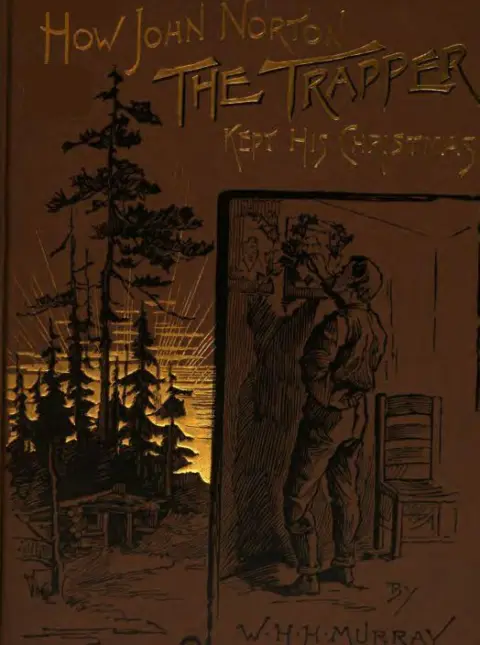
How John Norton the Trapper Kept His Christmas
W. H. H. (William Henry Harrison) Murray
THE CLASSIC COLLECTION · 1898
"A Ride With A Mad Horse In A Freight-Car" by W. H. H. Murray is a vivid narrative and war memoir written in the late 19th century. This book encapsulates the personal experiences of the author during the American Civil War, focusing on the bond he shares with a horse named Gulnare against the backdrop of war. It explores themes of companionship, loyalty, and the emotional turmoil of battle while delving into the tragic fate of both horse and rider. The story begins with the author recalling a fierce battle at Malvern Hill, where he is injured and encounters a beautiful, riderless mare amidst the chaos. He names her Gulnare, and a deep bond forms between them over the course of the war. This connection is emphasized through his tender care and their shared experiences, as she accompanies him through battles and personal struggles. However, the narrative takes a heart-wrenching turn as Gulnare contracts phrenitis during their journey home, spiraling into madness. The vivid descriptions of her suffering, coupled with the author's desperate attempts to save her, culminate in a poignant farewell as he holds her in his lap as she dies. The book ultimately reflects on the profound impact of love and loss, leaving readers with a bittersweet sense of the sacrifices made in war.
Introduction adapted from the source catalogue; source summaries may be automatically generated.
Free to read · English · 6,343 words · No account needed
MAKE TIME FOR A GOOD BOOK
On by default. Untick to stop anonymous reading totals. Each page counts after 10 seconds in view. How this works.
Anonymous counting is on unless you have switched it off.
"All that afternoon the beautiful mare stood over me, while away to the right of us the hoarse tide of battle flowed and ebbed. What charm, what delusion of memory held her there? Was my face to her as the face of her dead master, sleeping a sleep from which not even the wildest roar of battle, no, nor her cheerful neigh at morning, would ever wake him? Or is there in animals some instinct, answering to our intuition, only more potent, which tells them whom to trust and whom to avoid? I know not, and yet some such sense they may have, they must have; or else why should this mare so fearlessly attach herself to me? By what process of reason or instinct I know not, but there she chose me for her mastery for when some of my men at dusk came searching, and found me, and, laying me on a stretcher, started toward our lines, the mare, uncompelled, of her own free will, followed at my side; and all through that stormy night of wind and rain, as my men struggled along through the mud and mire toward Harrison's Landing, the mare followed, and ever after, until she died, was with me, and was mine, and I, so far as man might be, was hers. I named her Gulnare.
"As quickly as my wound permitted, I was transported to Washington, whither I took the mare with me. Her fondness for me grew daily, and soon became so marked as to cause universal comment. I had her boarded while in Washington at the corner of ------ Street and ------ Avenue. The groom had instructions to lead her around to the window against which was my bed, at the hospital, twice every day, so that by opening the sash I might reach out my hand and pet her. But the second day, no sooner had she reached the street, than she broke suddenly from the groom and dashed away at full speed. I was lying, bolstered up in bed, reading, when I heard the rush of flying feet, and in an instant, with a loud, joyful neigh, she checked herself in front of my window. And when the nurse lifted the sash, the beautiful creature thrust her head through the aperture, and rubbed her nose against my shoulder like a dog. I am not ashamed to say that I put both my arms around her neck, and, burying my face in her silken mane, kissed her again and again. Wounded, weak, and away from home, with only strangers to wait upon me, and scant service at that, the affection of this lovely creature for me, so tender and touching, seemed almost human, and my heart went out to her beyond any power of expression, as to the only being, of all the thousands around me, who thought of me and loved me. Shortly after her appearance at my window, the groom, who had divined where he should find her, came into the yard. But she would not allow him to come near her, much less touch her. If he tried to approach she would lash out at him with her heels most spitefully, and then, laying back her ears and opening her mouth savagely, would make a short dash at him, and, as the terrified African disappeared around the corner of the hospital, she would wheel, and, with a face bright as a happy child's, come trotting to the window for me to pet her. I shouted to the groom to go back to the stable, for I had no doubt but that she would return to her stall when I closed the window. Rejoiced at the permission, he departed. After some thirty minutes, the last ten of which she was standing with her slim, delicate head in my lap, while I braided her foretop and combed out her silken mane, I lifted her head, and, patting her softly on either cheek, told her that she must 'go.' I gently pushed her head out of the window and closed it, and then, holding up my hand, with the palm turned toward her, charged her, making the appropriate motion, to 'go away right straight back to her stable.' For a moment she stood looking steadily at me, with an indescribable expression of hesitation and surprise in her clear, liquid eyes, and then, turning lingeringly, walked slowly out of the yard.
Your reading position is saved on this browser. Take it to another device with a library code. Reading pages adapt to text, rather than matching a printed edition.
W. H. H. (William Henry Harrison) Murray
W. H. H. (William Henry Harrison) Murray
W. H. H. (William Henry Harrison) Murray
BEHIND THE BOOK
This eBook is for the use of anyone anywhere in the United States and most other parts of the world at no cost and with almost no restrictions whatsoever. You may copy it, give it away or re-use it under the terms of the Project Gutenberg License included with this eBook or online at www.gutenberg.org. If you are not located in the United States, you will have to check the laws of the country where you are located before using this eBook. Read the source licence.
The original source file, including credits and licence, is retained by this library. Request an original-format copy at no charge. Please include the book title and Project Gutenberg identifier #23168.
KEEP YOUR CURIOSITY GOING
Cécile Tormay

Moritz Busch
John L. Ransom
Frances Wright
Cécile Tormay

Mabel Potter Daggett