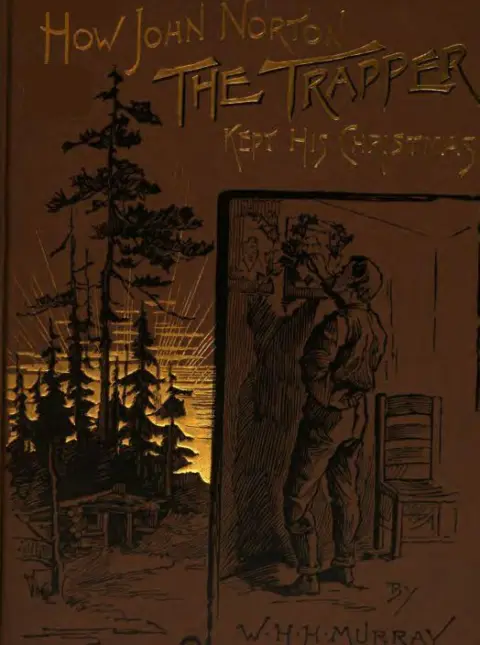
How John Norton the Trapper Kept His Christmas
W. H. H. (William Henry Harrison) Murray
THE CLASSIC COLLECTION · 1898
"A Ride With A Mad Horse In A Freight-Car" by W. H. H. Murray is a vivid narrative and war memoir written in the late 19th century. This book encapsulates the personal experiences of the author during the American Civil War, focusing on the bond he shares with a horse named Gulnare against the backdrop of war. It explores themes of companionship, loyalty, and the emotional turmoil of battle while delving into the tragic fate of both horse and rider. The story begins with the author recalling a fierce battle at Malvern Hill, where he is injured and encounters a beautiful, riderless mare amidst the chaos. He names her Gulnare, and a deep bond forms between them over the course of the war. This connection is emphasized through his tender care and their shared experiences, as she accompanies him through battles and personal struggles. However, the narrative takes a heart-wrenching turn as Gulnare contracts phrenitis during their journey home, spiraling into madness. The vivid descriptions of her suffering, coupled with the author's desperate attempts to save her, culminate in a poignant farewell as he holds her in his lap as she dies. The book ultimately reflects on the profound impact of love and loss, leaving readers with a bittersweet sense of the sacrifices made in war.
Introduction adapted from the source catalogue; source summaries may be automatically generated.
Free to read · English · 6,343 words · No account needed
MAKE TIME FOR A GOOD BOOK
On by default. Untick to stop anonymous reading totals. Each page counts after 10 seconds in view. How this works.
Anonymous counting is on unless you have switched it off.
It was at the battle of Malvern Hill--a battle where the carnage was more frightful, as it seems to me, than in any this side of the Alleghanies during the whole war--that my story must begin. I was then serving as Major in the --th Massachusetts Regiment--the old --th, as we used to call it--and a bloody time the boys had of it too. About 2 p. m. we had been sent out to skirmish along the edge of the wood in which, as our generals suspected, the Rebs lay massing for a charge across the slope, upon the crest of which our army was posted. We had barely entered the underbrush when we met the heavy formations of Magruder in the very act of charging. Of course, our thin line of skirmishers was no impediment to those onrushing masses. They were on us and over us before we could get out of the way. I do not think that half of those running, screaming masses of men ever knew that they had passed over the remnants of as plucky a regiment as ever came out of the old Bay State. But many of the boys had good reason to remember that afternoon at the base of Malvern Hill, and I among the number; for when the last line of Rebs had passed over me, I was left among the bushes with the breath nearly trampled out of me and an ugly bayonet-gash through my thigh; and mighty little consolation was it for me at that moment to see the fellow who ran me through lying stark dead at my side, with a bullet-hole in his head, his shock of coarse black hair matted with blood, and his stony eyes looking into mine. Well, I bandaged up my limb the best I might, and started to crawl away, for our batteries had opened, and the grape and canister that came hurtling down the slope passed but a few feet over my head. It was slow and painful work, as you can imagine, but at last, by dint of perseverance, I had dragged myself away to the left of the direct range of the batteries, and, creeping to the verge of the wood, looked off over the green slope. I understood by the crash and roar of the guns, the yells and cheers of the men, and that hoarse murmur which those who have been in battle know, but which I can not describe in words, that there was hot work going on out there; but never have I seen, no, not in that three days' desperate melee at the Wilderness, nor at that terrific repulse we had at Cold Harbor, such absolute slaughter as I saw that afternoon on the green slope of Malvern Hill. The guns of the entire army were massed on the crest, and thirty thousand of our infantry lay, musket in hand, in front. For eight hundred yards the hill sank in easy declension to the wood, and across this smooth expanse the Rebs must charge to reach our lines. It was nothing short of downright insanity to order men to charge that hill; and so his generals told Lee, but he would not listen to reason that day, and so he sent regiment after regiment, and brigade after brigade, and division after division, to certain death. Talk about Grant's disregard of human life, his efforts at Cold Harbor--and I ought to know, for I got a Minie in my shoulder that day--was hopeful and easy work to what Lee laid on Hill's and Ma-gruder's divisions at Malvern. It was at the close of the second charge, when the yelling mass reeled back from before the blaze of those sixty guns and thirty thousand rifles, even as they began to break and fly backward toward the woods, that I saw from the spot where I lay a riderless horse break out of the confused and flying mass, and, with mane and tail erect and spreading nostril, come dashing obliquely down the slope. Over fallen steeds and heaps of the dead she leaped with a motion as airy as that of the flying fox when, fresh and unjaded, he leads away from the hounds, whose sudden cry has broken him off from hunting mice amid the bogs of the meadow. So this riderless horse came vaulting along. Now from my earliest boyhood I have had what horsemen call a 'weakness' for horses. Only give me a colt of wild, irregular temper and fierce blood to tame, and I am perfectly happy. Never did lash of mine, singing with cruel sound through the air, fall on such a colt's soft hide. Never did yell or kick send his hot blood from heart to head deluging his sensitive brain with fiery currents, driving him into frenzy or blinding him with fear; but touches, soft and gentle as a woman's caressing words, and oats given from the open palm, and unfailing kindness, were the means I used to 'subjugate' him. Sweet subjugation, both to him who subdues and to him who yields! The wild, unmannerly, and unmanageable colt, the fear of horsemen the country round, finding in you not an enemy, but a friend, receiving his daily food from you, and all those little 'nothings' which go as far with a horse as a woman, to win and retain affection, grows to look upon you as his protector and friend, and testifies in countless ways his fondness for you. So when I saw this horse, with action so free and motion so graceful, amid that storm of bullets, my heart involuntarily went out to her, and my feelings rose higher and higher at every leap she took from amid the whirlwind of fire and lead. And as she plunged at last over a little hillock out of range and came careering toward me as only a riderless horse might come, her head flung wildly from side to side, her nostrils widely spread, her flank and shoulders flecked with foam, her eye dilating, I forgot my wound and all the wild roar of battle, and, lifting myself involuntarily to a sitting posture as she swept grandly by, gave her a ringing cheer.
Your reading position is saved on this browser. Take it to another device with a library code. Reading pages adapt to text, rather than matching a printed edition.
W. H. H. (William Henry Harrison) Murray
W. H. H. (William Henry Harrison) Murray
W. H. H. (William Henry Harrison) Murray
BEHIND THE BOOK
This eBook is for the use of anyone anywhere in the United States and most other parts of the world at no cost and with almost no restrictions whatsoever. You may copy it, give it away or re-use it under the terms of the Project Gutenberg License included with this eBook or online at www.gutenberg.org. If you are not located in the United States, you will have to check the laws of the country where you are located before using this eBook. Read the source licence.
The original source file, including credits and licence, is retained by this library. Request an original-format copy at no charge. Please include the book title and Project Gutenberg identifier #23168.
KEEP YOUR CURIOSITY GOING
Cécile Tormay

Moritz Busch
John L. Ransom
Frances Wright
Cécile Tormay

Mabel Potter Daggett