THE CLASSIC COLLECTION✦My diaries, being a personal narrative of events 1888-1914, Part 2 (1900-1914)CLASSIC FREE BOOKS
My diaries, being a personal narrative of events 1888-1914, Part 2 (1900-1914)
Wilfrid Scawen Blunt
THE CLASSIC COLLECTION · 1887
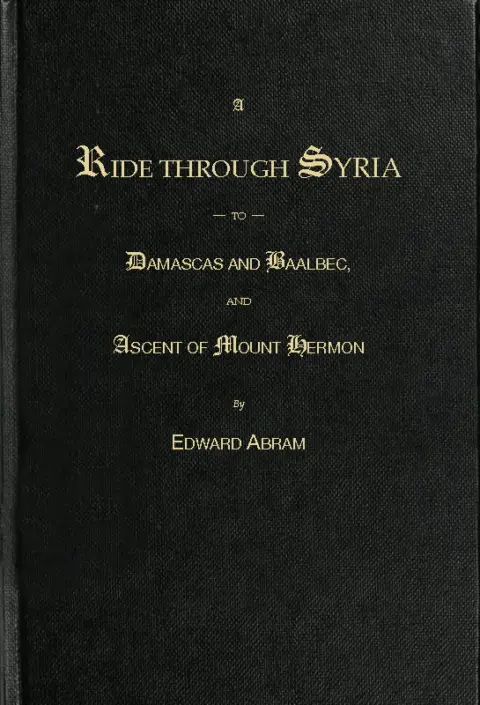
"A Ride through Syria to Damascus and Baalbec, and Ascent of Mount Hermon" by Edward Abram is a travel narrative written in the late 19th century. The book chronicles Abram's exploratory journey through the historical regions of Syria, highlighting significant locations such as Damascus and Baalbec, as well as his ascent of Mount Hermon. The narrative is rich in historical references and observations about the landscape and the people Abram encounters along his route. At the start of the narrative, the author reflects on the changing landscape of the Holy Land compared to what it was in biblical times, showing awareness of both natural beauty and the historical significance of the places he travels through. He begins his adventure in Jaffa and makes a two-day ride across the plains towards Nazareth, noting the remnants of past civilizations and engaging with local Bedouins for safety. The opening chapters reveal Abram's deep appreciation for the history of the land, the richness of its past, and his eagerness to explore often overlooked paths that diverge from traditional routes taken by other travelers. Through vivid descriptions and anecdotes, he sets the stage for a remarkable journey filled with insights into both the ancient and contemporary life of the region.
Introduction adapted from the source catalogue; source summaries may be automatically generated.
Free to read · English · 17,967 words · No account needed
MAKE TIME FOR A GOOD BOOK
On by default. Untick to stop anonymous reading totals. Each page counts after 10 seconds in view. How this works.
Anonymous counting is on unless you have switched it off.
My flying visit here without tents, traversing the country by little known paths, creates some curiosity, even among the Europeans, who wish to know if I am travelling under diplomatic orders; a negative answer to such a question is not, of course, worth much. The Turkish police give vent to their curiosity by visiting me in my bedroom and cross-examining my dragoman as to my intents and purposes, position in life, &c., &c. Things are rather strained here. The attitude of the allied Powers to Turkey makes this fanatical people never well disposed to Christians, now still less so, and to make matters worse, Arab placards have been posted here and at Beyrût in the Bazaars, summoning the natives to revolt against the Turks, asking reasonably what common interest the Arabs have with their now imbecile and insolent conquerors, the Osmanli usurpers of the Khalifate, who monopolise all place and power, using them only to oppress the people, whose language they do not even understand, and whose lives, liberties, and properties they either cannot or do not care to protect. This is a sign of the times—a writing on the wall to warn the feeble despots of Stamboul of their doom. This movement has since developed into an organised Arab League, following the example of the Albanians. An Armenian League probably is not far behind. The collapse of the rule of the Osmanlis is merely a matter of time. They may retain Asia Minor for the present (if England does not seize it to save it from Russia), but they will have to clear out of Europe, and Syria, Lebanon and Palestine must ere long be like Egypt, semi-independent vice-royalties under European protection, or they will become Russian and French appanages. The Turkish Government have authorised their postmasters in Syria to detain telegrams and open letters at their pleasure. A remedy for that is to give the letters to the Consul who forwards them in his bag. The Consul here lives in a hired house liable to a notice to quit at any moment. What a pity that our Government does not buy itself a consular residence in such an important post as this? It is so undignified for an English Consul to have to turn out at the bidding of a Moslem landlord, and troublesome in the extreme to have to move all the archives every few years; and in case of an intrigue, which is not uncommon in these parts, we might find it difficult to find a suitable place for the Consul at all. In one of the squares we see a crowd and several soldiers looking at the dead body of an Arab. This poor fellow was, with others, in charge of a caravan of camels, some Druses swooped upon them within only a few hours of Damascus, all ran except the murdered man, who stuck to his post; they of course soon killed him and cleared off with the camels. This is the security for life and property which Turkey provides for its subjects in the neighbourhood of a great city. We will now take a stroll through this thoroughly Eastern city, where the far East and the far West meet more than in any other city in the world, more so even than in Tanjiers and Tunis. Here we see English tourists in tweed suits, black-coated Americans in tall hats, Bedouins in dirty bornous, Druses with white turbans and blood-stained hands, Turks in officials fezzes, orthodox Moslems in flowing robes and showy green turbans, Circassians with breast full of cartridges (murderous looking rascals), Kurds in rough sheep skin cloaks, Persians, Afghans, Pariahs and Parsees, slipshod veiled Eastern women, gorgeous Jewesses and smartly dressed Parisian dames, all these meet together in this metropolis of the East, jostling each other in the narrow unpaved bazaars. Camels also, and mules, horses and donkeys, with perhaps a drove of long-tailed sheep, from the far steppes of Turkestan, press on amidst this motley crew, “Oua garda”—take care, take care, get out of the way quickly! A pack mule is no respecter of persons, he cares not for your Consul, and over you go if you do not get out of his way, unless by a vigorous shove you send him over, just as in self-defence we were obliged to do once. A pack mule on his back, legs up in the air, is a helpless, pitiable spectacle.
Your reading position is saved on this browser. Take it to another device with a library code. Reading pages adapt to text, rather than matching a printed edition.
BEHIND THE BOOK
This eBook is for the use of anyone anywhere in the United States and most other parts of the world at no cost and with almost no restrictions whatsoever. You may copy it, give it away or re-use it under the terms of the Project Gutenberg License included with this eBook or online at www.gutenberg.org. If you are not located in the United States, you will have to check the laws of the country where you are located before using this eBook. Read the source licence.
The original source file, including credits and licence, is retained by this library. Request an original-format copy at no charge. Please include the book title and Project Gutenberg identifier #60615.
KEEP YOUR CURIOSITY GOING
Wilfrid Scawen Blunt
Wilfrid Scawen Blunt

E. W. (Edgar Watson) Howe
Francis Greenleaf Allinson & Anne C. E. (Anne Crosby Emery) Allinson
Cyrenus Cole

John Martineau